August 23, 2020
Defense & Military, Space Technology, Defense & Exploration
Sensors are usually thought of in terms of physical devices that receive and respond to electromagnetic signals – from everyday sensors in our smartphones and connected home appliances to more advanced sensors in buildings, cars, airplanes and spacecraft. However present day physical sensors are severely limited in range to continuously …
Read More »
August 18, 2020
Industry & Market Dynamics, Space Technology, Defense & Exploration, Strategy, Policy & Governance
Military today is more reliant on space than ever before including ISR, Electronic warefare, Communications, Command and control and ballistic Missile defence. The joint warfighter uses space to satisfy an ever expanding and diverse set of requirements such as cutting the fog and friction of war or to enable net-centric …
Read More »
August 17, 2020
AI & IT, Space Technology, Defense & Exploration
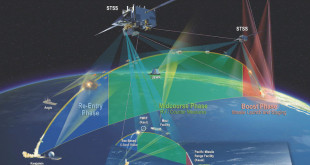
US, Russia and China are in race for Hypersonic Weapons that shall provide prompt global strike capability. Russia’s Avangard hypersonic missile system became operational in Dec 2019, defence minister Sergey Shoygu has said. The intercontinental weapon can fly 27 times the speed of sound and, unlike a regular missile warhead, …
Read More »
July 16, 2020
AI & IT, Space Technology, Defense & Exploration
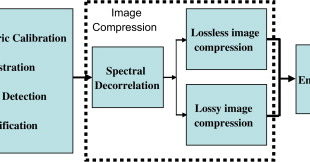
Remote sensing of the environment, and especially Earth observation, is witnessing an explosion in terms of volume of available observations, which offer unprecedented capabilities towards the global-scale monitoring of natural and artificial processes. Satellite imaging payloads, mostly operate a store-and-forward mechanism, whereby the captured images are stored on board …
Read More »
June 6, 2020
Geopolitics, Strategy & Technological Rivalries, Space Technology, Defense & Exploration, Weapons & Munitions
The warning bells has ringed in US, as Kim has finally succeeded in developing an ICBM operational capability through which it can deliver a nuclear weapon anywhere in the United States, according to analysis based on Images released by North Korea. North Korea released dozens of photos and a video …
Read More »
June 3, 2020
Security & Threat Management, Space Technology, Defense & Exploration
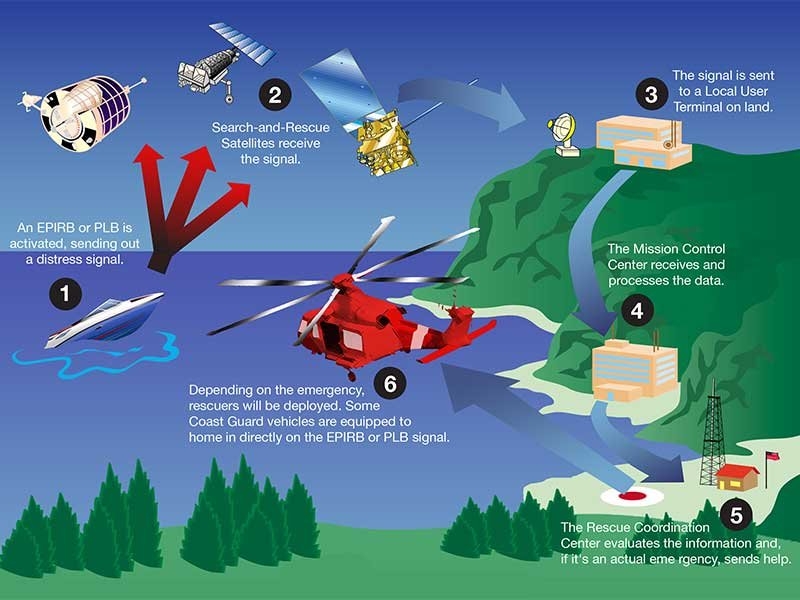
Search and Rescue (SAR) is receiving a lot of attention recently due to several high-profile incidents on land, in the air and at sea. Flight MH370 left Kuala Lumpur was bound for Beijing in March 2014 when it disappeared, with 239 people on board. Even after the largest and most …
Read More »
May 30, 2020
Electronics & EW, Geopolitics, Strategy & Technological Rivalries, Space Technology, Defense & Exploration
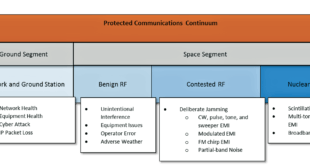
Military has become highly dependent on satellites for high data rate beyond line of sight communications as well as network centric operations. Satellite communications are also required to support military operations that are becoming more complex as conflict areas grow more dispersed on a global scale. The ever increasing …
Read More »
February 25, 2020
Cyber & IW, Space Technology, Defense & Exploration
Historically, there was a necessity for a third party that demanded a payment to perform transactions or submit information to ensure the accuracy of transactions and create a reliable history. Blockchain eradicates the need for an intermediary through creating a trustless medium of exchange and immutable public ledger. It creates …
Read More »
February 7, 2020
AI & IT, Space Technology, Defense & Exploration
Pulsars are highly magnetized, rotating neutron stars that emit electromagnetic radiation at regular intervals. They radiate energy across a broad range of frequencies, but they are most visible in their X-ray beams. Pulsars emit powerful beams in opposite directions as they spin. These beams are observable only when they’re pointed toward …
Read More »
January 11, 2020
AI & IT, Global Risks & Future Threats, Space Technology, Defense & Exploration
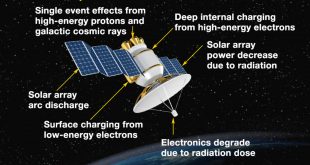
One of the biggest threats to the deployed aerospace and defense electronics systems is radiation. Outside the protective cover of the Earth’s atmosphere, the solar system is filled with radiation. The natural space environment consists of electrons and protons trapped by Earth’s magnetic field, protons and small amount of heavy nuclei …
Read More »
 International Defense Security & Technology Your trusted Source for News, Research and Analysis