 International Defense Security & Technology Your trusted Source for News, Research and Analysis
Related Articles



Introduction: The Rise of Intersatellite Connectivity in the Space Age
In today’s rapidly advancing space and communication landscape, Intersatellite Links (ISLs) are emerging as a cornerstone of modern satellite constellations. These links—whether microwave or laser-based—enable satellites to communicate directly with each other, forming a seamless orbital mesh network that bypasses traditional reliance on ground stations. This innovation not only reduces latency and increases bandwidth, but also boosts the resilience and autonomy of space-based infrastructure, which is increasingly critical for defense, government, and commercial applications.
The surge in Low Earth Orbit (LEO) constellations—with over 1,000 small satellites launched in 2021 alone—has accelerated the demand for robust onboard connectivity and intelligent routing between satellites. The explosive growth of satellite deployments—particularly in Low Earth Orbit (LEO)—has fundamentally transformed the landscape of space-based communication. With over 12,000 active satellites now circling the Earth (accounting for 85% of all orbital assets launched since 2020), direct inter-satellite links (ISLs) have moved from optional enhancements to mission-critical infrastructure. By enabling satellites to communicate with one another without routing data through Earth-based ground stations, ISLs drastically reduce latency, increase network throughput, and enable seamless, continuous coverage across the globe. For instance, the Space Development Agency’s Proliferated Warfighter Space Architecture alone aims to operate more than 300 ISL-equipped satellites by 2026, underlining their strategic importance for both defense operations and the commercial space economy.
At the same time, High-Throughput Satellite (HTS) systems are pushing the limits of capacity through frequency reuse and multiple spot beams. Together, these technologies are revolutionizing satellite communication, enabling global broadband access, supporting emerging 6G infrastructure, and transforming how network resources are managed in space. As we enter an era of hyperconnectivity, intersatellite communication isn’t just enhancing existing capabilities—it’s redefining the architecture of the orbital internet.
Intersatellite Links: The Backbone of the Orbital Internet
Intersatellite Links (ISLs) have emerged as a transformative enabler in modern satellite communication systems. Traditionally, satellite communication relied heavily on ground stations to send and receive signals, often resulting in latency and limited coverage. ISLs solve this challenge by allowing satellites to communicate directly with one another through beams directed into space instead of toward Earth. This peer-to-peer orbital communication infrastructure is particularly crucial for Low Earth Orbit (LEO) constellations, where the ability to transfer data rapidly across the network improves operational flexibility, reduces dependence on ground infrastructure, and ensures real-time data relay.
There are three primary types of ISLs: intraorbital plane links (between satellites in the same plane), inter-orbital plane links (across adjacent orbital planes), and inter-orbit links (between satellites in different orbits such as LEO and GEO). Each type serves specific operational needs but poses unique challenges, especially when dealing with relative velocity, Doppler shifts, or pointing accuracy at high orbital speeds. In stable configurations like intraorbital links, communication is relatively straightforward, while dynamic configurations such as inter-orbit links require more sophisticated acquisition, tracking, and pointing (ATP) systems.
ISLs also power various advanced mission architectures. For instance, GEO-GEO links extend system coverage and distribute traffic loads between geostationary satellites, while GEO-LEO links serve as permanent relays—used by NASA’s TDRS system and Europe’s ARTEMIS—to maintain communication with fast-moving LEO spacecraft. LEO-LEO networks, such as those being deployed in mega-constellations, facilitate high-speed, low-latency global data transfer by creating autonomous, space-based data highways. These LEO constellations minimize reliance on terrestrial relays and offer capabilities like real-time Earth observation, seamless IoT connectivity, and autonomous spacecraft formation flying.
Beyond communications, ISLs are critical for navigation systems, particularly for improving the precision of Global Navigation Satellite Systems (GNSS). China’s BeiDou system, for example, integrates Ka-band ISLs to enhance orbit determination and inter-satellite synchronization, improving navigation accuracy and resiliency. By enabling direct data exchange in orbit, ISLs reduce the need for frequent ground contact, mitigate atmospheric interference, and support the evolution toward a self-sustaining, AI-optimized space-based network—effectively extending the terrestrial internet into space.
Microwave ISLs: The Durable Backbone of Critical Space Functions
Microwave intersatellite links (ISLs) operate within the radio frequency spectrum—typically between 1 GHz and 40 GHz—and have long served as the backbone of space-based communication networks. These links enable satellites to transmit data to one another through focused radio beams, bypassing the need for constant communication with ground stations. The frequencies selected are typically those with strong atmospheric absorption to shield against terrestrial interference, following guidelines set by the ITU Radiocommunication Regulations. Despite the rise of optical communication, microwave ISLs continue to offer unmatched reliability, particularly in scenarios demanding all-weather operability and robust system maturity.
The advantages of microwave ISLs are well established. Their relative immunity to atmospheric conditions like rain, fog, and clouds makes them indispensable for continuous operations, especially in regions with unpredictable climates. As a mature and well-understood technology, microwave systems are simpler to integrate and maintain than their optical counterparts. They can also support wide-area coverage and are lightweight enough to be deployed on smaller satellite platforms. Systems like GPS and BeiDou, along with many Earth observation missions, rely heavily on microwave ISLs for dependable, real-time data relay and navigation synchronization.
However, microwave ISLs are not without limitations. The lower frequencies result in limited bandwidth compared to optical systems, capping the maximum data throughput achievable. Additionally, the longer wavelengths require physically larger antennas—typically 1 to 2 meters in diameter—which adds mass and volume to satellite payloads. Pointing precision is also crucial; even small deviations can degrade link quality. For instance, at 60 GHz, a 2-meter antenna yields a beamwidth of just 0.2 degrees, necessitating antenna pointing errors below 0.1 degrees to keep losses under 0.5 dB. While these challenges can be managed on large satellites, they can become prohibitive for smaller or swarming systems.
To overcome beam steering challenges, advanced antenna technologies are being deployed. Traditional mechanical systems are being replaced or augmented by switched beam antennas (SBAs), phased arrays, and reflectarrays. These techniques reduce the need for moving parts and offer rapid, energy-efficient beam steering. For example, Iridium satellites use phased array ISLs to support global connectivity, while missions like TerraSAR-X and TanDEM-X demonstrate the effectiveness of SBA configurations. Phased arrays use electronically controlled phase shifts across multiple antenna elements to steer beams, allowing satellites to maintain link alignment during dynamic orbital conditions.
Recent advances in metamaterials are further transforming the design of microwave ISLs. These engineered structures manipulate electromagnetic waves in unconventional ways, allowing antennas to achieve higher gain and beam steering without bulkier components. By integrating tunable elements like diodes or MEMS switches, metamaterial-based antennas can dynamically reconfigure their shape and radiation pattern. Though still in the research and early deployment phase, metamaterials promise lightweight, compact, and steerable antenna systems ideally suited for the demands of next-generation satellite constellations and distributed space architectures.
Despite the excitement surrounding laser-based ISLs, microwave-based interlinks—operating primarily in Ka-band and V-band (24–40 GHz)—remain indispensable. These links are highly resilient and form the backbone for mission-critical applications such as satellite navigation and command-and-control operations. Technological advances have revitalized microwave ISLs, particularly through the adoption of metamaterial antennas, which replace traditional bulky dishes with lightweight flat-panel arrays capable of 0.1° beam-steering accuracy. Meanwhile, artificial intelligence is being harnessed to manage beam handovers dynamically, mitigating Doppler shift issues in fast-moving constellations such as BeiDou-3. Additionally, synchronized satellite clusters in geostationary orbit now operate as unified virtual satellites, using microwave ISLs to provide consistent coverage in hard-to-reach regions like the Arctic.
The key strength of microwave ISLs lies in their all-weather reliability. This is vital for global navigation satellite systems (GNSS), where continuous signal integrity is paramount. BeiDou-3’s Ka-band ISLs, for instance, maintain timing accuracy of under three nanoseconds—even during solar radiation storms—ensuring uninterrupted navigation services.
Optical ISLs: Powering the Next Wave of Space-Based Speed
Laser-based optical intersatellite links (ISLs) are revolutionizing how satellites exchange data, enabling gigabit to terabit-scale throughput at ultra-low latency. Unlike traditional microwave systems, which are limited by bandwidth and antenna size, optical ISLs leverage tightly focused laser beams in the near-infrared spectrum to transmit data with minimal signal loss and virtually no electromagnetic interference. Systems like Starlink’s V2 satellites already feature multiple high-speed optical terminals, forming a dense mesh of over 10,000 interlinked nodes in orbit. NASA’s TeraByte InfraRed Delivery (TBIRD) mission has pushed this technology even further, achieving 200 Gbps downlinks from lunar orbit—setting a new benchmark for deep space data transmission.
The key advantage of optical ISLs lies in their combination of high bandwidth, small form factor, and operational efficiency. Because laser communication uses much shorter wavelengths than radio, optical terminals can be built with lightweight, compact telescopes—typically around 10 cm in diameter—offering massive data rates with a fraction of the bulk. These links also operate license-free in the light spectrum and are inherently more secure due to their narrow beamwidths, which make interception extremely difficult. Moreover, optical ISLs consume less power per bit transmitted compared to microwave systems, making them ideal for modern satellite constellations aiming to balance performance with efficiency.
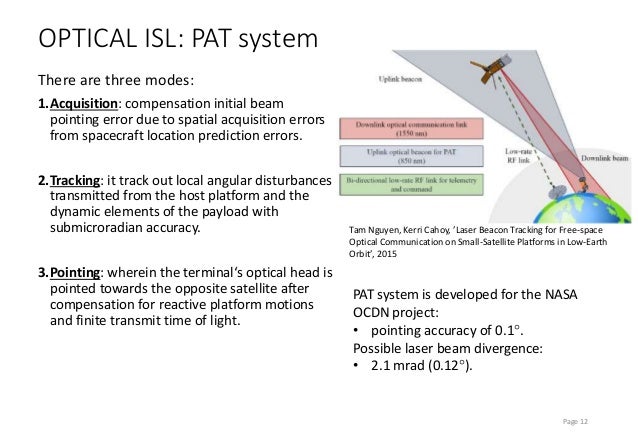
However, the promise of optical ISLs also brings unique challenges. Their narrow beamwidths—often less than 5 microradians—require incredibly precise pointing, acquisition, and tracking (PAT) systems to keep transmitter and receiver telescopes perfectly aligned over thousands of kilometers. Initial acquisition is particularly demanding, often requiring high-powered or pulsed lasers to scan the expected receiver location. Once contact is established, satellites transition into a tracking phase where real-time adjustments are made to account for vibrations, orbital drift, and relative velocity. Technologies like Lockheed Martin’s AI-enhanced PAT systems and SA Photonics’ CrossBeam™ terminals are at the forefront of solving these challenges by leveraging neural networks and multi-laser arrays for reliable high-speed tracking even under dynamic conditions.
The complete optical ISL system architecture comprises a laser-based transmitter, a sensitive optical receiver, and a PAT system that manages alignment across all phases of communication. During the acquisition phase, wide laser beams and brute-force scanning techniques were historically used but proved inefficient. Today, sophisticated algorithms and sensor-driven systems dramatically reduce acquisition time to within seconds. Once in the tracking phase, satellites fine-tune their alignment using feedback loops, beacon signals, and detectors to maintain beam lock and account for the lead-ahead angle caused by satellite motion. Continuous communication then proceeds with amplified, filtered optical signals converted back to electrical data via photodiodes for downstream processing.
Optical ISLs are now vital for high-speed data exchange in Earth observation, navigation, deep-space missions, and future satellite internet infrastructure. They enable satellite clusters, such as those in LEO constellations, to relay data without relying on ground stations, providing global coverage and resilience against terrestrial outages. For interplanetary applications, their superior range and throughput make them the leading candidate for long-distance missions—NASA’s upcoming Psyche mission plans to use optical links to transmit data from 0.5 AU. As AI-based routing and quantum key distribution begin to merge with laser-based communication, optical ISLs are poised to serve as the high-speed nervous system of the orbital and interplanetary internet of the future.
Hybrid Architectures: Merging Optical Speed with Microwave Resilience
A new era of hybrid intersatellite communication is emerging, blending the unparalleled speed of optical links with the proven reliability of microwave systems. Advanced navigation constellations, such as China’s BeiDou-3, are leading this shift by deploying dual-mode systems that capitalize on the unique advantages of each technology. Optical intersatellite links are used for millimeter-scale precision ranging, enabling highly accurate orbital determination critical for positioning services. Meanwhile, Ka-band microwave links provide a resilient backbone for telemetry, tracking, and control—particularly during periods of intense space weather like solar storms, when optical performance may degrade.
To further enhance system adaptability, dynamic link allocation algorithms like NSGA-II are being used to optimize communication in real time. These intelligent algorithms prioritize laser links for mission-critical, time-sensitive data—such as hypersonic missile alerts or real-time sensor relays—where low latency and high throughput are vital. When atmospheric or geomagnetic conditions disrupt optical channels, the system seamlessly defaults to microwave communication, ensuring uninterrupted data flow. This hybrid approach not only strengthens operational continuity but also builds resilience into the fabric of space-based communication networks, making them more versatile and robust for both civilian and military applications.
Overcoming the Final Hurdles
As satellite networks scale to hundreds and even thousands of nodes, improving power efficiency and manufacturing agility becomes essential. Recent breakthroughs in Python-optimized laser systems now enable satellites to dynamically model variable orbital distances, allowing for adaptive power scaling. For instance, SpaceX’s Starlink V2 Mini satellites report up to a 60% reduction in transmit power by fine-tuning output based on orbital geometry. Meanwhile, chip-scale atomic clocks (CSACs) are revolutionizing timing systems, delivering sub-nanosecond precision with minimal energy draw—an essential enabler for large-scale constellations like the Space Development Agency’s 500-satellite mesh.
Simultaneously, the industrial base is rapidly evolving to meet surging demand. In the UK, techUK has called for a £160 million satellite communications fund to build sovereign supply chains for photonic and optical terminals, securing strategic independence. On the manufacturing front, companies like Lockheed Martin are leading the charge, producing over 50 satellite-grade laser communication terminals per month using additive manufacturing (3D printing). This shift dramatically reduces production timelines, lowers costs, and allows for rapid iteration—closing the final gap between innovation and deployment in next-gen intersatellite communications.
Deployment Hotspots: Who’s Leading the ISL Charge
Globally, several hotspots are emerging as focal points for ISL deployment. In the U.S. and NATO member countries, military mesh networks are rapidly being rolled out. The Space Development Agency’s Transport Layer features hybrid ISLs that transmit missile-tracking data from LEO satellites directly to platforms like the F-35 in under 500 milliseconds. DARPA’s Blackjack program is launching 96 optical crosslinked satellites designed to function as a jam-proof, battlefield internet backbone.
In parallel, China’s BeiDou-3 constellation has deployed Ka-band ISLs across 30 satellites to enable real-time orbit updates, greatly reducing dependency on ground control. The European Union’s Galileo second-generation system is also experimenting with laser ISLs to improve timing accuracy by a factor of ten. On the commercial front, Amazon’s Project Kuiper plans to link 3,236 satellites using optical backhaul for global 100 Gbps connectivity. Meanwhile, Rivada Space is launching a constellation of 300 encrypted laser-linked satellites tailored for enterprise-grade communication.
Military Applications: Securing the Skies with Optical Intersatellite Networks
Modern military operations increasingly depend on resilient, secure, and real-time communications—especially in remote or contested environments. Nanosatellites and microsatellites, deployed in large low Earth orbit (LEO) constellations, have emerged as critical enablers of this vision. Enabled by advancements in mobile communications, electronics miniaturization, and energy-efficient battery systems, these compact satellites now deliver robust communication infrastructure for unmanned aerial vehicle (UAV) operations and on-ground units. They support command, control, and data processing functions while enabling near-instantaneous coordination through real-time or near-real-time inter-satellite data relay.
At the heart of these networks are inter-satellite communications (ISC), with optical ISLs (OISLs) providing the bandwidth, latency, and security essential for next-generation military mesh architectures. DARPA’s Project Blackjack exemplifies this shift, deploying small, agile satellites interconnected via OISLs to deliver rapid sensor-to-shooter data flows. LGS Innovations, under a DARPA contract, is building lightweight, low-power optical terminals tailored for these missions. Such terminals offer gigabit-speed, low-latency performance in secure optical frequencies, avoiding spectrum congestion and jamming threats typical of RF systems.
The Space Development Agency (SDA) is also driving forward this capability within its National Defense Space Architecture. Its Transport Layer of LEO satellites will serve as the backbone for linking orbital sensors, airborne systems, and ground forces in a seamless web of connectivity. Optical ISLs will not only transmit vast volumes of sensor data but will also support precision ranging—measuring satellite-to-satellite and satellite-to-ground distances to within one meter. This level of positional accuracy is vital for navigation, targeting, and coordinated defense operations. To achieve this, each satellite will be equipped with chip-scale atomic clocks and GPS receivers to maintain synchronization across the entire constellation.
Companies like General Atomics and SA Photonics are building the foundational technologies for this shift. SA Photonics’ CrossBeam™ system, developed under Blackjack, enables stable high-G maneuver communication through multi-laser terminals. Meanwhile, General Atomics is testing internally developed laser communication terminals (LCTs) capable of long-distance, high-data-rate transmissions. These innovations mark a pivotal transition toward optical-centric military constellations, delivering resilient, jam-resistant communication infrastructures essential for future warfare domains—where speed, stealth, and synchronization define mission success.
Engineering the Next Leap: From Power to Production
Power consumption remains a hurdle, particularly for high-bandwidth optical terminals. However, emerging solutions are addressing this. Starlink’s V2 Mini models use Python-optimized software to dynamically adjust transmit power based on satellite position, reducing energy usage by 60%. Meanwhile, chip-scale atomic clocks are being integrated into communication payloads, offering ultra-precise timing without large power draws—essential for constellations with hundreds or thousands of nodes.
From a manufacturing perspective, economies of scale are kicking in. The UK is investing over £160 million to build a sovereign photonics supply chain. Lockheed Martin, for example, now produces more than 50 satellite laser communication units per month via additive manufacturing. These developments reduce costs and accelerate deployment timelines.
Tomorrow’s Frontier: Quantum, Mars, and AI-Optimized Constellations
The next frontier of intersatellite communication is being shaped by quantum encryption, deep-space laser relays, and AI-optimized constellations. QinetiQ’s quantum-encrypted ISL prototypes, leveraging entanglement-based key exchange, promise unbreakable security by detecting even the slightest photon disturbance—ensuring tamper-proof, spy-resistant data links. Meanwhile, NASA’s upcoming Psyche mission (2026) will push the limits of optical ISLs, testing 1 Gbps laser relays across 0.5 astronomical units (AU)—a pioneering leap in deep-space data transfer that could define future Mars communications architecture.
As satellite constellations scale into the thousands, the next frontier in intersatellite communication lies in intelligent, resilient networks built on a hybrid backbone of optical and microwave links. Advanced Pointing, Acquisition, and Tracking (PAT) systems—enhanced by artificial intelligence—will be central to maintaining stable laser communication despite dynamic orbital mechanics and high relative velocities. AI-driven beam steering, predictive orbital alignment, and adaptive optics will enable seamless optical connectivity across vast mesh networks. Whether supporting real-time Earth observation swarms, next-generation GNSS systems, or tactical defense constellations, hybrid ISLs will ensure continuous, scalable, and low-latency communication with built-in surge capacity.
On the AI front, SpaceX’s Starlink Gen3 satellites are incorporating reinforcement learning algorithms to autonomously reroute traffic around congested nodes in real time, laying the foundation for truly adaptive, self-healing space networks. These innovations don’t just boost speed—they redefine satellite constellations as intelligent, decentralized infrastructures. As Dr. Lena Meyer, Optical Communications Lead at DLR, aptly notes: “Optical ISLs aren’t just faster—they enable new architectures. When every satellite can ‘talk’ directly, constellations become smart meshes.” The age of autonomous, quantum-secure, interplanetary satellite networks is rapidly approaching.
Looking ahead, transformative technologies such as adaptive optics, quantum encryption, and photonic miniaturization are converging with ISL infrastructure to push the boundaries of performance and security. Optical terminals are becoming smaller, lighter, and more power-efficient, while microwave systems remain vital as a fallback layer during adverse conditions. In this synergistic architecture, optical and microwave ISLs are no longer competing technologies—they are complementary forces driving a new era of autonomous, intelligent, and fail-safe satellite communication systems. These hybrid networks will be essential as space becomes increasingly congested and operational tempos quicken, requiring resilient, real-time, and adaptive data architectures.
Several groundbreaking innovations are already charting this path. Quantum Key Distribution (QKD), pioneered by companies like QinetiQ, is being tested over ISLs to enable encryption based on quantum entanglement—offering theoretically unbreakable security. NASA’s upcoming Psyche mission aims to demonstrate 1 Gbps deep-space optical relays at distances of nearly 0.5 AU, revolutionizing how we think about interplanetary data links. Meanwhile, Starlink Gen3 satellites are expected to leverage reinforcement learning to autonomously reroute traffic away from congestion, laying the groundwork for self-optimizing, AI-managed constellations. As Dr. Lena Meyer of DLR succinctly puts it: “Optical ISLs aren’t just faster—they enable new architectures. When every satellite can ‘talk’ directly, constellations become smart meshes.”
Conclusion: The In-Orbit Internet Has Arrived
What was once a dream—an internet in space—is now tangible. The Inter-Satellite Link revolution has redefined how data moves through space, integrating satellite constellations into a unified, global infrastructure. While microwave ISLs offer enduring resilience, optical links are delivering terabit-class bandwidths and millisecond-level latency. Together, they are powering applications from Earth observation and missile defense to lunar relays and AI-driven drone swarms. With over 50,000 satellites projected by 2030, these links form the neural pathways of an orbital nervous system—enabling data to flow freely, securely, and instantaneously across space, just as fiber does on Earth.
Explore Further:
- ESA’s EDRS: Europe’s Space Data Highway
- SDA’s Hybrid Transport Layer
- Python Model for Optical Power Optimization
Data Sources: Satellite Industry Association, Euroconsult | Analysis: 2025 ISL Market Dynamics
References and Resources also include:
https://www.ijraset.com/fileserve.php?FID=7815


