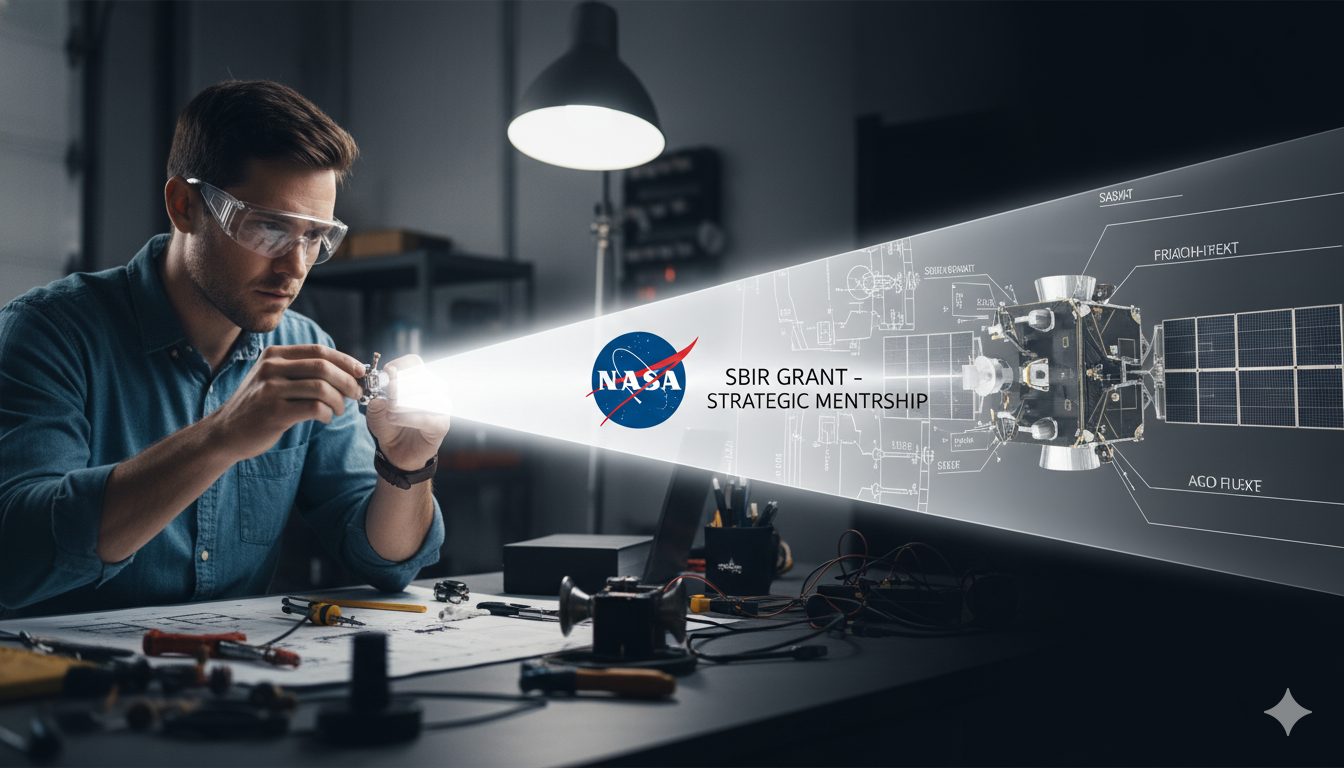

In the high-stakes and high-cost world of space technology, having a brilliant idea is only the first step. For small startups and research teams, the real challenge lies in bridging the gap between a groundbreaking concept and a flight-ready prototype. This critical gap, often called the “valley of death,” has swallowed countless promising technologies due to the lack of funding and resources needed to move beyond early research.
Fortunately, for those who know where to look, NASA has created a powerful engine for innovation: the Small Business Innovation Research (SBIR) and Small Business Technology Transfer (STTR) programs. Far more than just funding opportunities, these programs act as strategic gateways, designed not only to support NASA’s most pressing technological needs but also to fuel the broader commercial space ecosystem. Whether it’s in-space manufacturing, satellite servicing, or active debris removal, NASA is inviting partners to help build the infrastructure for a sustainable space economy.
More Than a Grant: A Strategic Partnership
What sets the SBIR/STTR programs apart from typical government grants is their design as competitive, contracts-based initiatives. Each year, NASA allocates around $200 million across a wide range of technology areas. But the competition is fierce—thousands of proposals are submitted annually, and only about 300 make it to Phase I. This ensures that only the most innovative and relevant ideas receive funding.
Unlike venture capital, SBIR/STTR awards are non-dilutive, meaning companies don’t have to give up equity in exchange for support. Instead, NASA invests in the technology itself, helping startups retain control of their business while reducing risk for future private investors. As Jason L. Kessler, NASA’s SBIR/STTR Program Executive, explains, the programs provide “a burgeoning opportunity where subsystems and components come together at a system level, and there’s interest from the financial community.” In other words, an SBIR award is not just funding—it is a seal of credibility that signals to the market that the technology has both technical merit and a real customer: NASA.
The Flight Path: From Phase I to Commercial Orbit
The SBIR/STTR journey is structured like a flight path to maturity, with each stage building on the last:
The Flight Path: From Phase I to Commercial Orbit
The Small Business Innovation Research (SBIR) and Small Business Technology Transfer (STTR) programs are structured like a carefully planned flight path, guiding companies from early-stage ideas to commercially viable technologies. Each stage builds on the one before, gradually reducing risk while increasing the maturity and readiness of the technology. This staged approach ensures that innovation remains aligned with NASA’s strategic priorities while giving small businesses the resources and partnerships needed to thrive.
Phase I: Feasibility
Phase I represents the first lift-off. At this stage, companies receive around $150,000 over 6 to 13 months to explore the feasibility of their idea. The emphasis here is not on building a finished product but on demonstrating the scientific and technical merit of the concept. Awardees work closely with NASA technical monitors, who provide feedback and ensure the project is aligned with the agency’s long-term goals. This early-stage collaboration helps innovators avoid pursuing purely academic exercises and instead focus on solutions that can integrate into NASA’s missions.
Phase II: Prototyping
Phase II marks the climb toward operational capability. Here, companies can secure up to $850,000 over 24 months to move beyond theory and develop a working prototype. The aim is to push the technology to a Technology Readiness Level (TRL) of at least 5, meaning that components are validated in a relevant environment. This is where many collaborations blossom—awardees often partner with other small businesses, research institutions, or prime contractors to combine complementary innovations. In fields like in-space manufacturing, robotics, and propulsion, this phase provides the proving ground where ideas become practical systems ready for future missions.
Post-Phase II: Bridge to Commercialization
The path doesn’t end with Phase II. Post-Phase II opportunities, sometimes referred to as the bridge to commercialization, are designed to help companies scale. NASA provides Phase III contracts funded directly from mission budgets, ensuring that promising technologies find a real-world home in active programs. Another unique feature is the matching funds model, where private capital can be matched dollar-for-dollar with NASA support. This mechanism has been particularly impactful in resource-intensive areas like Active Debris Remediation (ADR) and advanced power systems, where significant investment is required to bring concepts to operational scale. By combining federal funding with private investment, SBIR/STTR ensures that groundbreaking ideas don’t stall in the lab but instead make the leap into orbit and beyond.
Success Stories: From SBIR Funding to Industry Leadership
The true measure of NASA’s SBIR/STTR programs lies in the tangible companies and technologies they have propelled into orbit and beyond. These are not just theoretical exercises; they are foundational investments in the companies building the infrastructure of the new space economy.
As the space tech industry rapidly evolves, the overlap between government funding and private sector investment is creating more opportunities for small businesses to thrive. “What’s exciting is the convergence of government funding with venture capital interest,” Kessler said, noting that the combination of investment sources allows companies to address both short-term market needs and long-term ambitions.
Starfish Space: Pioneering On-Orbit Servicing
A compelling example of the SBIR model in action is Starfish Space, a Washington-based company pioneering satellite servicing technologies. Their work includes extending satellite lifespans, changing orbits, and even deorbiting outdated spacecraft. Recently, Starfish secured a Phase III SBIR contract from NASA to execute the first-ever commercial debris inspection mission.
As Jason Kessler explained, Starfish’s business model revolves around providing logistics for satellites—essentially, making space operations more sustainable and efficient. By combining NASA’s early support with private investment, the company has built a scalable business with a dual focus: serving government needs while tapping into a growing commercial market. This success demonstrates how SBIR funding, when paired with private capital, can turn promising concepts into industry-shaping realities.
Made In Space (Now Redwire Space): Manufacturing in Orbit
Perhaps one of the most iconic SBIR success stories is Made In Space, Inc. (now part of Redwire Space). The company’s journey began with early-stage SBIR funding to develop the first 3D printer for microgravity. This technology was proven aboard the International Space Station (ISS), demonstrating that high-quality manufacturing was possible in space.
This initial SBIR-backed success paved the way for monumental growth. Redwire has since developed and deployed critical technologies like the Additive Manufacturing Facility (a permanent commercial manufacturing facility on the ISS) and Archinaut, a system for in-space robotic assembly and manufacturing. Their work, rooted in early NASA SBIR support, has fundamentally proven the concept of In-Space Assembly and Manufacturing (ISAM), creating an entirely new market and supply chain for space.
Astrobotic: From Lunar Landers to Commercial Delivery
Astrobotic‘s quest to become a lunar delivery service provider was fueled by NASA SBIR/STTR investments. Over more than a decade, the company won multiple phases of funding to develop key technologies for precision landing, navigation, and hazard avoidance—critical capabilities for any spacecraft aiming to touch down safely on the Moon.
This sustained technical validation through the SBIR program was instrumental in building credibility and de-risking their technology. It culminated in a landmark commercial achievement: winning a $79.5 million contract under NASA’s Commercial Lunar Payload Services (CLPS) program. Astrobotic’s Peregrine lander exemplifies how sustained SBIR investment can help a small company mature a technology to the point where it can compete for and win major NASA mission contracts.
Orbit Fab: The Gas Stations in Space
Orbit Fab is building the foundational infrastructure for a bustling space economy: propellant depots, essentially “gas stations in space.” Their goal is to enable satellite refueling, dramatically extending mission lifespans and adding flexibility to space operations. Early SBIR funding was crucial for developing their core technology, particularly the Rapidly Attachable Fluid Transfer Interface (RAFTI)—a standardized, satellite-friendly fueling port.
This NASA-backed technical milestone provided the validation needed to secure significant venture capital. Orbit Fab has since announced partnerships with major players like Lockheed Martin and the U.S. Space Force, positioning itself as a critical enabler for the future of satellite servicing and space logistics. Their story highlights how SBIR funding helps standardize new technologies, creating the building blocks for an entire industry.
Advanced Space: Steering NASA’s CAPSTONE Mission
Advanced Space leveraged SBIR funding to develop its cislunar autonomous navigation software and mission operations capabilities. This technology became the cornerstone of their work on CAPSTONE (Cislunar Autonomous Positioning System Technology Operations and Navigation Experiment), a NASA-funded pathfinder mission that launched in 2022 to orbit the Moon and test navigation systems for the future Lunar Gateway.
The company’s SBIR work de-risked the innovative navigation technology used on CAPSTONE, demonstrating its feasibility to NASA. This directly led to the company being selected to operate the entire CAPSTONE mission, a tremendous vote of confidence in a small business. Advanced Space’s journey from an SBIR proposal to managing a pivotal NASA lunar mission is a powerful testament to how the program cultivates not just technologies, but entire mission-ready companies.
These stories underscore a powerful pattern: NASA’s SBIR/STTR program acts as a vital catalyst. It provides the initial technical and financial validation that allows ambitious startups to bridge the “valley of death,” refine their technology, and position themselves to attract further investment and win major contracts, ultimately shaping the future of space exploration and commerce.
Navigating the Opportunity: Advice from NASA
For entrepreneurs looking to leverage SBIR/STTR, Kessler offers three pieces of vital advice:
First, strategic alignment is essential. Startups shouldn’t treat SBIR as free cash but as a way to align their innovations with NASA’s specific needs. The most successful applicants find a “sweet spot” where solving NASA’s problems also advances their core commercial products.
Kessler highlighted NASA’s ongoing effort to prioritize technology needs across its mission areas, underscoring a new openness to external collaboration. The Space Technology Mission Directorate recently engaged a wide range of stakeholders from NASA’s science and exploration mission directorates to commercial firms to academia which resulted in feedback on the 187 identified technology shortfalls relevant to the entire aerospace sector. “The agency’s really open for engagement,” Kessler emphasized, pointing out that this marks a significant shift in NASA’s approach. “I haven’t always seen the agency act in that manner, so I think it’s a particularly special time for those outside of the agency to think about being a collaborator or sharing in the effort.”
Kessler encouraged entrepreneurs and space tech innovators to review these shortfalls as potential areas where they could make impactful contributions. “There are going to be space logistics-related technologies identified there,” he noted, suggesting that interested parties look beyond the specific SBIR/STTR subtopics to find other areas of alignment. By addressing these identified needs, companies have the chance to influence where NASA directs its limited resources, allowing them to play a key role in shaping the agency’s focus.
For space tech entrepreneurs, Kessler’s message is clear: while NASA’s funding can provide a significant boost, success comes from aligning technology development with both commercial markets and government needs. “It’s an incredibly exciting time for small businesses to be able to meaningfully contribute because there’s a lot of funding opportunity and a tremendous amount of need,” he emphasized.
Second, preparation is non-negotiable. The proposal process is rigorous, with Phase I applications requiring up to 19 pages of technical details. NASA publishes its annual solicitation and a list of 187 technology shortfalls identified by the Space Technology Mission Directorate. These resources act as roadmaps for innovators, showing where the agency’s most urgent needs lie.
Third, look beyond NASA. While the agency is a strong partner, Kessler encourages startups to engage with other organizations like the Air Force Research Laboratory and U.S. Space Force, which share overlapping interests and offer substantial funding opportunities. NASA’s own Ignite solicitation also supports dual-use technologies with strong commercial potential outside the agency.
In addition to the main SBIR/STTR solicitation, NASA also offers Ignite, a solicitation focused on dual-use technologies, which attracts companies that seek customers beyond NASA. “Ignite allows us to attract firms that are further along in development and have commercial potential beyond NASA,” Kessler said, adding that the program has seen greater interest in matching funds for Post-Phase II contract from the venture finance.
An Open Invitation to Innovate
Perhaps the most striking shift is NASA’s newfound openness. The agency has actively engaged with the private sector, academia, and research organizations to identify its most critical technology gaps. “The agency’s really open for engagement… I think it’s a particularly special time for those outside of the agency to think about being a collaborator,” Kessler emphasized.
For ambitious entrepreneurs, the message is clear: the door is open. NASA is not just offering funding, but a partnership that includes technical mentorship, credibility, and the potential role of anchor customer. In today’s collaborative space ecosystem—where government demand meets commercial ingenuity—the SBIR/STTR program is the docking mechanism bringing those worlds together.
For small businesses and visionary startups, this is a once-in-a-generation opportunity. The final frontier is no longer reserved for established giants. With programs like SBIR/STTR, the innovators of today can become the builders of tomorrow’s space economy.