
Digital battlefields, hybrid warfare, and the future of threat intelligence
IDST Intelligence Briefings
(Latest Security & Cyber Videos)
Why This Magazine Exists
Security, Cyber & Counter-Threats examines the evolving landscape of modern security in an era defined by digital conflict, hybrid warfare, and persistent global threats.
From cyber operations, information warfare, and intelligence-driven defense to counter-terrorism, internal security, and emerging threat vectors, this magazine provides strategic analysis, technical insight, and policy-relevant perspectives for decision-makers, practitioners, and researchers navigating an increasingly contested security environment.
What We Track
- Cyber warfare & cyber defense
- Information operations & influence campaigns
- National security threat assessments
- Emerging digital and hybrid warfare doctrines
- Critical infrastructure & cyber resilience
Latest Analysis & Intelligence
-
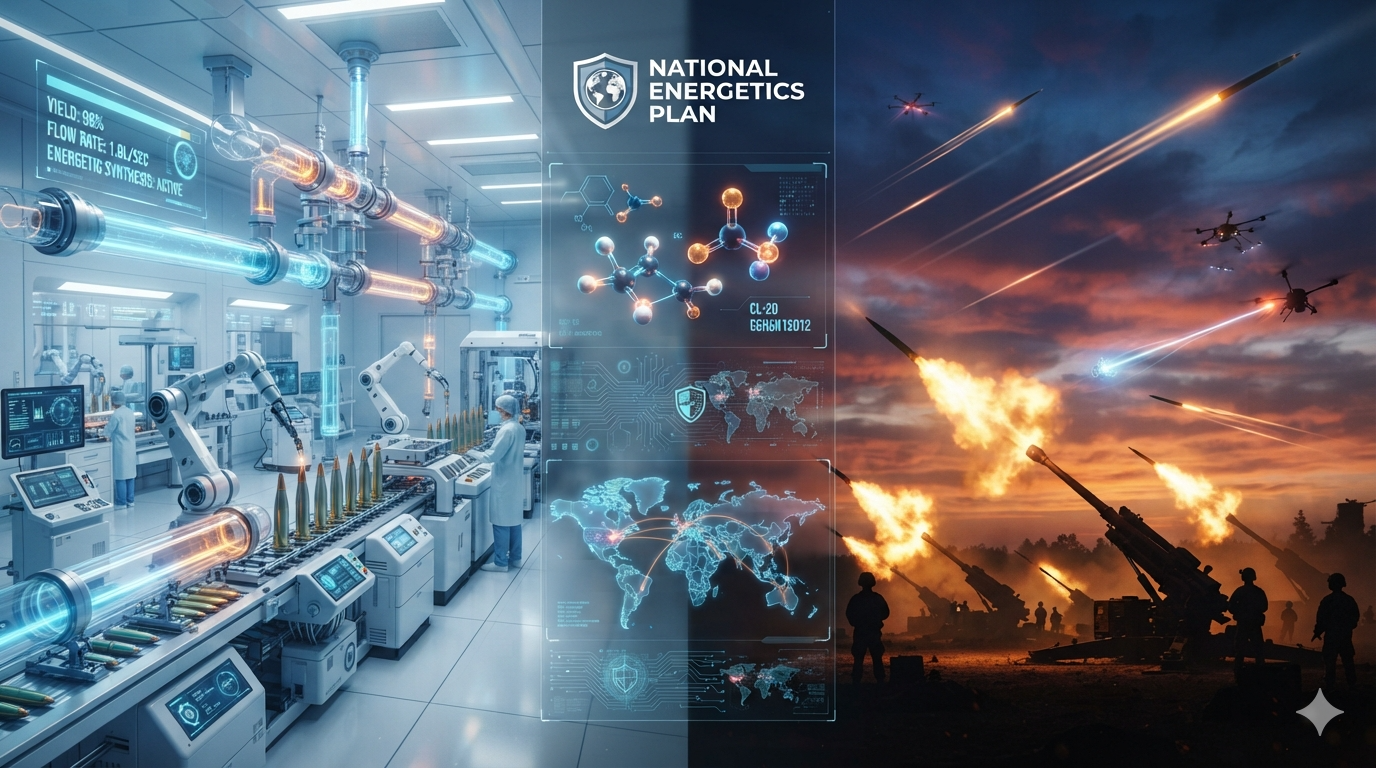
The New Energetics Revolution: How Advanced Propellants, Smart Manufacturing, and Industrial Innovation Are Reshaping Military Power
Introduction: The Strategic Importance of Energetics in Great Power Competition Behind every missile launch, artillery strike, hypersonic weapon, rocket motor, and precision-guided munition lies a critical but often overlooked technology domain—energetics. Explosives, propellants, pyrotechnics, and advanced energetic materials determine not only the range, speed, and lethality of modern weapons but also the ability of nations…
-

The Green Revolution 2.0: How Biotechnology Is Engineering a Sustainable Future for Climate, Industry, and Global Security
Introduction: Biotechnology Becomes a Strategic Technology for the Planet Biotechnology is undergoing its most profound transformation since the emergence of recombinant DNA technology nearly five decades ago. What began as a revolution in medicine has evolved into a foundational technology capable of reshaping global manufacturing, agriculture, energy systems, environmental restoration, and national security. Today, biology…
-

The Quantum Operating System Revolution: How QNodeOS Is Building the Software Foundation for the Quantum Internet
Introduction: Quantum Networking Enters the Software Era For decades, progress in quantum computing has been dominated by advances in hardware—superconducting processors, trapped ions, neutral atoms, photonic qubits, and diamond-based quantum systems. Yet despite rapid improvements in quantum hardware, one critical limitation has prevented the emergence of practical quantum networks: every experimental platform has required its…
-

Deploying Advanced AI at the Tactical Edge: Overcoming the Challenges of Real-Time Intelligence for Defense, Autonomous Systems, and National Security
Introduction: The New Battlespace for Artificial Intelligence Artificial intelligence is rapidly transforming modern military operations, industrial automation, and autonomous systems, but its greatest impact is emerging far from cloud data centers. The future battlespace increasingly depends on AI operating directly at the tactical edge—aboard unmanned aircraft, autonomous ground vehicles, naval platforms, satellites, wearable soldier systems,…
-

The Global Race for Space-Based Quantum Sensors: Revolutionizing Earth Intelligence, Space Exploration, and Strategic Security
Introduction: Quantum Sensors Become the Next Strategic Space Race The global competition for technological leadership in space is entering a new phase. After decades dominated by launch vehicles, satellite constellations, and communications infrastructure, attention is rapidly shifting toward space-based quantum sensing—a technology capable of measuring gravity, magnetic fields, acceleration, and time with accuracies previously thought…
-

DARPA’s MELT Program: Scaling High-Energy Laser Weapons for the Drone Swarm Era
Introduction: Directed Energy Becomes a Strategic Imperative The character of modern warfare is being reshaped by the rapid proliferation of inexpensive drones, autonomous swarms, loitering munitions, and cruise missiles. From Ukraine and the Red Sea to the Middle East and Indo-Pacific, military forces are confronting an increasingly unfavorable cost equation where intercepting a $5,000 drone…
-

DARPA’s LASSO Program: Building the Space Force’s Cislunar Intelligence Network for the New Lunar Economy
Introduction: Cislunar Space Emerges as the Next Strategic High Ground The strategic competition that once centered on Low Earth Orbit (LEO) and Geostationary Earth Orbit (GEO) is rapidly expanding into cislunar space—the vast region extending from Earth orbit to the Moon. Driven by NASA’s Artemis program, China’s International Lunar Research Station (ILRS), commercial lunar ventures,…
STRATEGIC SUB-MAGAZINES
Modern military power emerges from the interaction of platforms, people, doctrine, and integration across domains. The Defense & Military Systems magazine is structured into focused sub-magazines that examine how combat capability is built, sustained, and employed across air, land, sea, weapons, and human systems.
Cyber & Information Warfare
Industrial outcomes are shaped as much by incentives, policy, and market structure as by engineering. Price signals, investment cycles, and regulatory frameworks quietly determine which technologies scale, stagnate, or fail.
This sub-magazine examines how markets behave under strategic pressure—where capital flows, how demand signals distort decisions, and why some industries adapt faster than others.
Explore the Cyber & Information Warfare Sub-Magazine →
Security & Threat Management
Modern security is defined by persistence, coordination, and anticipation. This sub-magazine focuses on how threats are identified, mitigated, and managed across institutions, infrastructures, and societies.
Explore the Security & Threat Management Sub-Magazine →