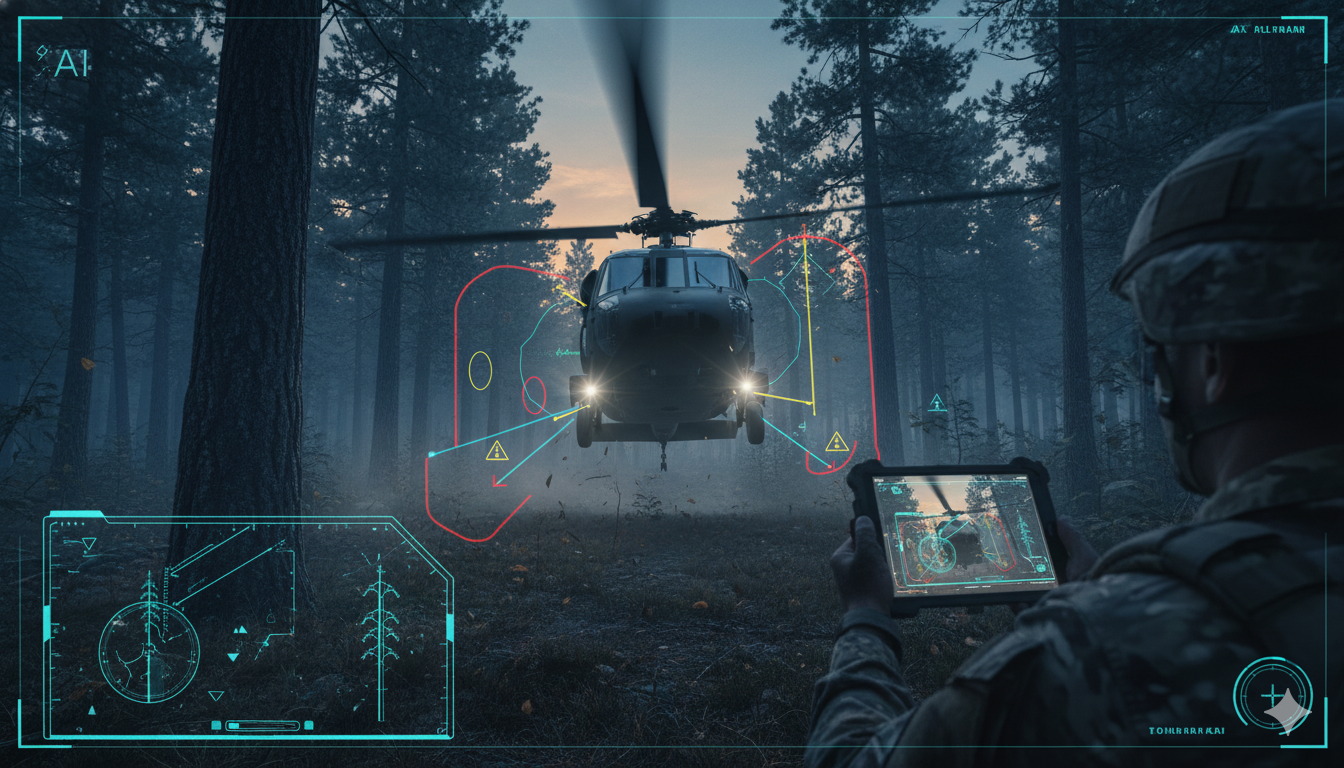

Imagine a UH-60 Black Hawk helicopter executing a complex mission—navigating low-level terrain, avoiding unexpected obstacles, and landing perfectly in a confined zone—with no one at the controls. This is no longer science fiction; it is the reality being built by DARPA’s revolutionary Aircrew Labor In-Cockpit Automation System (ALIAS) program.
For decades, military aircraft have grown more automated, yet they remain immensely complex to operate. In high-stress emergencies or demanding missions, pilot workload can become overwhelming. While avionics upgrades can help, they often cost tens of millions of dollars per aircraft, limiting both accessibility and scalability. ALIAS breaks this barrier. Its vision is strikingly simple: create a portable, drop-in kit that can be installed on virtually any existing aircraft, instantly transforming it into a highly automated or even fully unmanned platform. It is not merely an autopilot system but an AI-powered co-pilot designed to reduce crew workload, enhance mission performance, and dramatically improve safety.
What Exactly is ALIAS?
The technology aims to improve flight safety and performance and reduce the cognitive load on pilots and the number of onboard crew members with a customizable, drop-in, removable kit that would allow advanced automation to be easily added to existing aircraft.
At its core, ALIAS is built on three pillars of autonomy that promise to transform how we think about flight. The first is seamless integration. Instead of overhauling aircraft with costly redesigns, ALIAS is designed to “plug in” with minimal disruption, using interfaces that live inside the cockpit. This makes it a portable co-pilot that can step into a wide variety of aircraft and start flying almost immediately.
At its core, ALIAS functions as a “universal autonomy kit.” This modular system consists of advanced sensors, actuators, and AI-driven software that can be installed or removed without permanently altering the aircraft. Once in place, ALIAS can execute the entire mission cycle—from engine start-up and taxi to takeoff, flight, and landing. It is equally adept at handling contingency situations, executing emergency procedures faster than a human pilot. The system also relies on advanced sensing capabilities, including cameras, LIDAR, and other instruments, enabling it to detect and avoid obstacles such as wires, towers, and terrain even in degraded visibility conditions.
The second pillar is adaptability. ALIAS doesn’t just operate blindly — it learns. By drawing on existing procedural manuals, flight models, and operational data, the system can quickly acquire the knowledge it needs to fly different aircraft. This ability to scale and adapt is what makes ALIAS so powerful: it can be applied across fleets without years of customization.
The third pillar is human–machine teamwork. ALIAS isn’t meant to replace pilots but to elevate their role. Instead of being tied up with constant low-level tasks, pilots can act more like mission commanders — setting strategy, replanning when needed, and overseeing multiple aircraft at once, while ALIAS takes care of the precision and vigilance of flying. In this way, the system reimagines the cockpit as a partnership between human intuition and machine precision.
Stress is one of the most critical factors in combat, often shaping how people think, react, and communicate under pressure. For a system like ALIAS, which relies on voice commands, natural language, and touchscreen input, this presents a unique challenge. In high-stress situations, pilots may not always use precise terminology or may fall back on incomplete or emotional language. “We have to be able to deal with that—you have to handle stressful inputs like bad language or unexpected, out-of-domain commands,” explained Stuart Young, head of DARPA’s ALIAS program. The term “out of domain” refers to words or phrases that fall outside the limited, structured vocabulary the AI is trained to understand. While structured language makes translation and system response more reliable, DARPA is working to ensure ALIAS can adapt to the realities of combat communication, where clarity often competes with chaos.
Ongoing research is focused on reducing system size, refining ranging and collision-avoidance capabilities, and adding advanced functions such as detecting aircraft below the horizon or in degraded light conditions. These improvements would allow the system to calculate optimal trajectories with greater accuracy, ensuring that aircraft can safely avert potential collisions. Ultimately, the technology could act as a critical layer of defense within future air-traffic management frameworks, complementing tools such as Automatic Dependent Surveillance–Broadcast (ADS-B) transponders and ground-based radar systems that form part of the federal NextGen effort. The potential is especially strong for unmanned air systems and aircraft with reduced crew sizes, where autonomous safety layers are essential.
From Concept to Reality: Key Milestones
The ALIAS program has moved rapidly from concept to reality, with groundbreaking demonstrations at each stage. Development, led by performers such as Sikorsky (a Lockheed Martin company) and Aurora Flight Sciences, has unfolded in three distinct phases.
In the initial phase, Sikorsky successfully flew a commercial S-76 helicopter on a 30-mile fully autonomous mission, controlled entirely from a tablet interface. The second phase expanded the scope, proving the system’s portability by integrating it onto multiple platforms, including fixed-wing aircraft like the Cessna Caravan and Diamond DA-42, as well as additional rotary-wing platforms. During these trials, ALIAS demonstrated not only seamless portability but also its ability to respond effectively to simulated in-flight emergencies.
By the third phase, which began in 2019, attention shifted toward direct military applications. Sikorsky retrofitted a UH-60 Black Hawk with a fly-by-wire kit, laying the groundwork for full-scale demonstrations. In 2022, history was made when DARPA and Sikorsky flew a Black Hawk with no pilots on board, proving the concept of fully unmanned autonomy in one of the military’s most trusted platforms. Beyond complete autonomy, the program also showcased supervised autonomy. In this mode, Army pilots used tablet interfaces to command the helicopter through complex maneuvers such as low-level contour flying, obstacle avoidance, and automatic landing zone selection—all after only three days of training.
The Matrix Upgrade: Scaling Autonomy for the Army
In October 2024, Lockheed Martin’s Sikorsky business advanced the program further with a USD 6 million DARPA award to integrate its Matrix flight autonomy system into the U.S. Army’s experimental fly-by-wire UH-60M Black Hawk, designated MX. This aircraft will allow the Army’s Combat Capabilities Development Command (DEVCOM) to test autonomy across a spectrum of operations, from single-pilot assisted missions to fully uncrewed flights.
Scheduled for integration in 2025, the Matrix-enabled MX Black Hawk will serve as a testbed for scalable autonomy concepts, mission applications, and threat-avoidance technologies. It builds on years of innovation: Sikorsky’s Optionally Piloted Black Hawk flying lab first achieved a fully autonomous flight in 2018 and has since logged hundreds of autonomous flight hours.
Lockheed Martin showcased this progress at the AUSA 2024 conference, where executives in Washington, D.C. remotely directed an Optionally Piloted Black Hawk located in Connecticut. Using only a tablet and an encrypted datalink, the aircraft executed a representative uncrewed logistics mission in real time. Although safety regulations required crew members on board, they did not touch the controls, underscoring how the system enables complex missions without traditional piloting skills.
Sikorsky has already demonstrated Matrix autonomy across ten different aircraft types—including UAVs, cargo planes, and fighters—highlighting its adaptability and future role across services. As Rich Benton, Sikorsky’s vice president and general manager, emphasized, autonomy-enabled aircraft will reduce pilot workload, dramatically improve safety, and ensure that Army Aviation assets like the Black Hawk remain mission-relevant well into the 2070s.
Why It Matters: The Future of Military Aviation
The significance of ALIAS and its Matrix core extends far beyond eliminating the pilot from the cockpit. It fundamentally redefines their role. With autonomy systems, a two-pilot aircraft could be safely flown by a single operator, and a single-pilot aircraft could be transitioned into an optionally piloted platform. This flexibility opens up new dimensions in mission planning.
If successful, the initiative would allow the military to make better use of pilots’ time. It would also allow the military to get more use out of the aircraft if it could go on low-risk missions while pilots rested.
Looking ahead, the role of the pilot will evolve from flying a single aircraft to managing entire formations, aided by artificial intelligence to handle the complexities of their own flight. These formations could include both fixed-wing and rotary platforms, carrying out missions such as air-defense suppression or anti-armor attacks. The human pilot will be kept at relative safety by sending autonomous platforms into contested environments first, a vision aligned with the U.S. Army’s Future Vertical Lift (FVL) initiative and the U.S. Air Force’s Mosaic Warfare concept.
The technology also enables aircraft to be converted into unmanned systems for high-risk missions such as logistics resupply in contested areas or operations in environments too dangerous for human crews. In doing so, ALIAS becomes a cornerstone of the Pentagon’s vision of “Mosaic Warfare,” where a diverse mix of manned and unmanned assets work together as an adaptive, resilient force. In such scenarios, a single pilot could act as a mission commander for an entire formation of autonomous aircraft, dramatically multiplying effectiveness on the battlefield.
DARPA describes Mosaic Warfare as akin to assembling ceramic tiles to create a larger image: a vast network of manned and unmanned platforms working together as one. By flooding the battlespace with a mix of piloted aircraft and expendable autonomous drones, forces can overwhelm adversaries through sheer complexity. What once seemed a disadvantage—coordinating numerous platforms—becomes a decisive edge, transforming modern aerial combat into a collaborative, layered, and adaptive system of systems.
Equally important is safety. By continuously monitoring the aircraft’s health and environment, autonomy can execute emergency procedures with precision and speed, helping to prevent accidents related to human error, controlled flight into terrain, and degraded visual environments. In short, ALIAS enhances not just operational flexibility but also survivability.
The Human Factor: Building Trust in the Machine
Perhaps the greatest challenge for ALIAS is not technological but psychological. Trust between human operators and autonomous systems must be carefully cultivated. As Lt. Col. Philip Root of DARPA observed, the key question is: How does a pilot know when to trust the autonomy? ALIAS tackles this through a combination of intuitive design, transparent interfaces, and extensive pilot training. By delivering predictable, repeatable, and reliable performance, the system builds confidence in its role as an AI co-pilot—one that can be relied upon as much as, if not more than, a human crewmate.
What’s Next? Expanding the Fleet
With DARPA’s core program now completed, attention has shifted to transitioning ALIAS technology into operational service. The U.S. Army is actively exploring its integration on the UH-60 Black Hawk and evaluating its role within the Future Vertical Lift (FVL) program. The U.S. Navy is examining potential applications for platforms such as the CH-53K King Stallion heavy-lift helicopter. Meanwhile, the U.S. Air Force views ALIAS and Matrix as critical enablers of its vision for Mosaic Warfare, where layers of autonomous and manned systems operate in concert.
Conclusion: A New Era of Aviation
ALIAS, powered by Sikorsky’s Matrix autonomy system, represents a fundamental shift in the way we think about aircraft and autonomy. It demonstrates that advanced AI-driven autonomy does not require the development of billion-dollar next-generation aircraft. Instead, it can be integrated into today’s proven platforms, extending their utility and transforming them into intelligent, collaborative assets. As this technology transitions into service, it is poised to redefine not only how missions are executed but also how humans and machines work together in the skies.
See it in Action: Watch a video of the ALIAS-equipped Black Hawk performing autonomous maneuvers here.