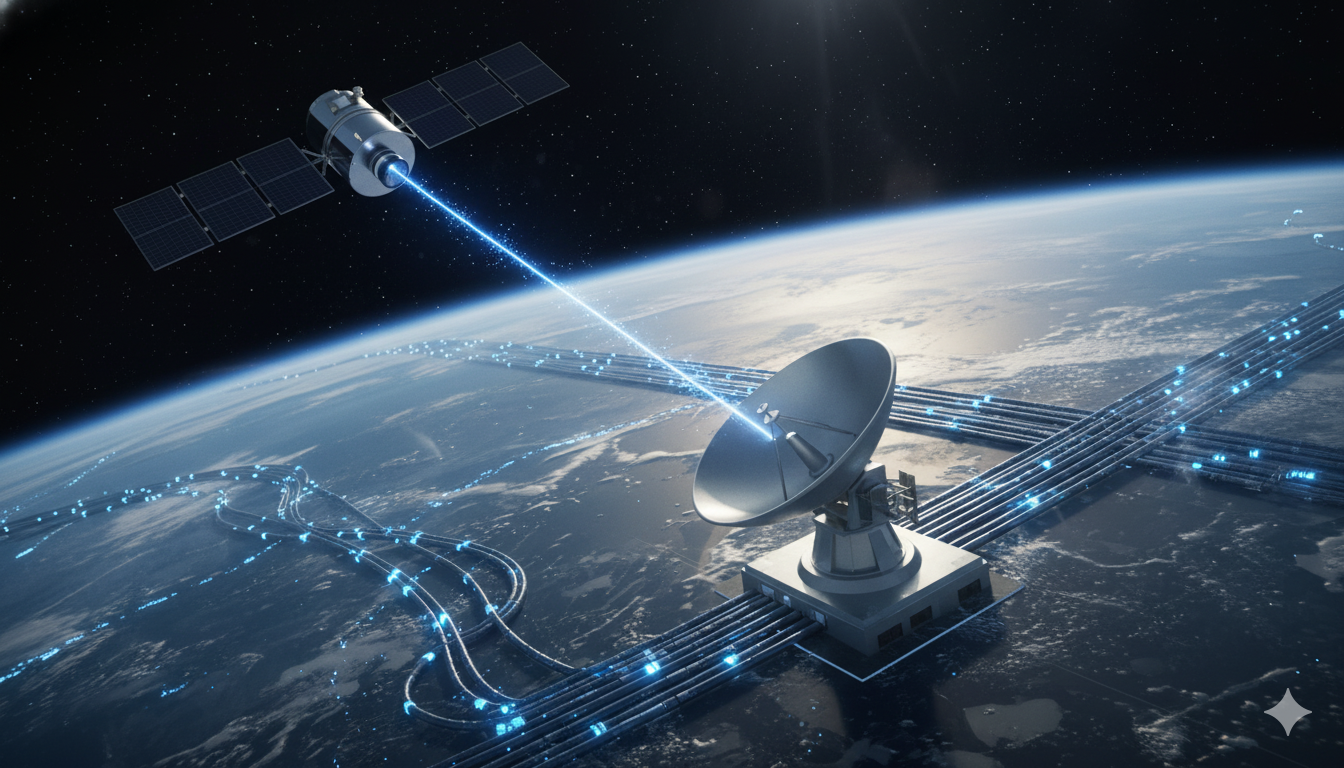
For decades, the promise of absolute data security has been the holy grail of cybersecurity. That promise is now being realized not in lines of code, but in the fundamental laws of physics. Quantum Key Distribution (QKD) is moving from laboratory experiments to operational networks, paving the way for a new era of ultra-secure communication for governments, militaries, and financial institutions.
This isn’t just an upgrade; it’s a revolution. And the race to build its backbone—a global quantum internet—is already underway.
The Core Principle: Security Guaranteed by Physics
Quantum Key Distribution (QKD) has emerged as one of the most promising applications of quantum technologies, providing a level of communication security that is theoretically unbreakable by conventional or quantum computers.
At its heart, QKD is a method for two parties—traditionally called Alice and Bob—to generate a shared, secret key used to encrypt and decrypt messages. Its unparalleled security stems directly from the rules of quantum mechanics. Each bit of the key is encoded onto a single particle of light, or photon. Because a photon cannot be split or copied, it is impossible for an eavesdropper to secretly duplicate the key during transmission.
The second safeguard comes from the Heisenberg Uncertainty Principle. Any attempt to measure or intercept the quantum signal inevitably disturbs it. This disturbance introduces errors, immediately alerting Alice and Bob to the presence of an intruder. The result is not just strong encryption, but detectable encryption—a system where users are instantly informed if their security is being challenged.
This ability to detect eavesdropping in real time makes QKD attractive for high-security sectors such as financial transactions, defense and military communications, electoral systems, government operations, and critical infrastructure protection.
The Challenge: Distance and Networks
The biggest hurdle for QKD has always been distance. Photons traveling through standard optical fibers are absorbed and scattered, limiting secure point-to-point links to about 300 to 500 kilometers.
Silica fibers exhibit minimal losses in the 1.3 μm and 1.55 μm bands, with the 1550 nm wavelength being especially favorable because it coincides with low attenuation and compatibility with InGaAs avalanche photodiodes (APDs) capable of single-photon detection. However, expanding QKD beyond laboratory and city-scale deployments into large-scale, multi-user networks requires overcoming this distance barrier. To overcome this, scientists are pursuing two complementary paths.
One approach is the development of quantum repeaters. Unlike traditional amplifiers, which would destroy the quantum state by copying it, these repeaters work by establishing entanglement over short segments and then “swapping” it to extend secure connections over long distances. China has already demonstrated this at scale with its 2,000-kilometer Beijing–Shanghai backbone network, a major step toward multi-user quantum networks.
The other path involves space-based links. The Earth’s atmosphere, despite its turbulence, is far less absorptive than fiber for certain wavelengths of light. This makes free-space optical channels, particularly those mediated by satellites, ideal for long-distance quantum communication. Pioneering experiments, such as Anton Zeilinger’s group transmitting quantum states over 143 kilometers between the Canary Islands, proved the concept. The launch of China’s Micius satellite marked a turning point, enabling the first intercontinental QKD demonstration and even facilitating a secure video call between Vienna and Beijing—something terrestrial fiber alone could not achieve.
The Cutting Edge: Solving the Interoperability Puzzle
In this context, quantum communication is transitioning from experimental proof-of-concept demonstrations to strategic national infrastructure, shaping the future of cybersecurity and geopolitics.
The next major challenge lies in developing global-scale QKD networks, which will require integrating satellite constellations, fiber-optic backbones, and free-space laser communication systems. This also raises the need for interoperability between heterogeneous quantum systems—from nodes operating at different wavelengths to hybrid architectures combining trapped ions, quantum dots, and solid-state devices.
The challenge lies in making these diverse systems compatible. Fiber-optic networks perform best at 1550 nanometers, the low-loss telecom wavelength, while many quantum memories and sensors operate in the visible range around 780 nanometers. This mismatch is like having devices that speak different languages. As researchers noted in Nature, interfacing fundamentally different quantum systems will be key to realizing robust hybrid quantum networks, capable of merging diverse advantages into a unified architecture.
Recent breakthroughs are bridging this divide. At ICFO in Spain, researchers have demonstrated quantum frequency conversion, successfully translating qubits between incompatible wavelengths while preserving the delicate quantum information. Their experiment involved transferring a state from rubidium atoms at 780 nm to praseodymium-doped crystals at 606 nm via a telecom channel at 1552 nm.
Miniaturization is also key. At ETRI in South Korea, scientists are developing chip-based polarization encoders, shrinking QKD technology into compact, scalable devices suitable for drones, vehicles, and eventually consumer electronics. Meanwhile, Heriot-Watt University is pioneering compact and autonomous ground receivers using novel two-dimensional detector arrays, transforming satellite QKD from costly telescope-based demonstrations into practical, commercially viable services.
The Global Race and Future Outlook
The race to develop quantum-secure networks is no longer a purely academic pursuit—it has become a matter of national strategy. Countries across the globe are investing heavily in QKD infrastructure, each driven by the twin imperatives of protecting sensitive information and maintaining technological leadership in an era of digital competition.
China has established itself as the undisputed frontrunner in deploying operational QKD networks. Its landmark achievement is the Beijing–Shanghai backbone, a 2,000-kilometer terrestrial QKD network that links major financial and political hubs. This backbone demonstrates how QKD can be scaled beyond point-to-point experiments into complex, multi-node infrastructures. China has also pushed the frontier of space-based QKD through its Micius satellite, launched in 2016. Micius enabled the world’s first intercontinental quantum key exchange and even facilitated a secure video call between Beijing and Vienna, marking the transition from theory to practical demonstration. By combining terrestrial fiber links with space-based assets, China is laying the foundation for a nationwide and eventually global quantum-secure communication system.
The United States has taken a different approach, focusing on deep research, system integration, and partnerships between government, academia, and industry. Under the National Quantum Initiative Act, the US has created a broad framework for advancing quantum technologies, including secure communications. Agencies such as the Department of Energy (DOE) and the National Institute of Standards and Technology (NIST) are spearheading large-scale testbeds to experiment with entangled photon distribution, quantum repeaters, and interoperability between classical and quantum networks. National labs—including Argonne and Los Alamos—are leading field trials of metropolitan-scale QKD systems, while commercial players are working on integrating quantum security into critical infrastructure like the energy grid and financial services. For the US, the priority is not only secure communication but also ensuring that quantum technologies remain a pillar of economic and military competitiveness.
Europe and the UK have carved out leadership roles in research excellence and component development. The European Union has launched the EuroQCI (European Quantum Communication Infrastructure) initiative, aimed at building a secure pan-European quantum network. Within this effort, countries like Germany, France, and Austria are conducting pioneering work on quantum repeaters, frequency conversion, and hybrid networking. The UK, through programs such as the UK Quantum Communications Hub, has emphasized commercial viability, supporting pilot projects that integrate QKD into financial trading systems and government communications. Institutions like ICFO in Spain and Heriot-Watt University in Scotland are developing critical building blocks—from frequency converters to compact satellite ground receivers—that make global-scale deployment feasible. Europe’s emphasis on interoperability and standards is particularly significant, as it positions the region to influence how quantum networks will be integrated into global telecommunications.
Russia is emerging as another important player in this race, focusing on developing homegrown QKD technology tailored to its national security needs. The Moscow-based company QRate has built one of Russia’s first fiber-based QKD systems, now preparing for formal certification—a crucial step before commercialization. Using the BB84 protocol with decoy states, the system transmits polarized light pulses at a rate of 312.5 MHz, highlighting its readiness for real-world deployment. A recent study evaluating the system revealed vulnerabilities in hardware, particularly in single-photon detectors, which could be exploited through techniques such as detector blinding or after-gate attacks. Countermeasures, including photocurrent monitoring, were proposed to close these loopholes. While the details of Russia’s cryptographic standards remain classified, the certification process provides insights into how the country is hardening its QKD systems for use in sensitive government, defense, and financial communications. By securing formal certification, Russia could become one of the few nations to operationalize QKD under its own regulatory framework.
India has also joined the global race, with growing momentum under its National Mission on Quantum Technologies and Applications (NM-QTA). Indian researchers have successfully demonstrated QKD over a 100-kilometer fiber link and free-space QKD between ground stations, marking significant milestones toward operational deployment. The Defense Research and Development Organisation (DRDO) and the Indian Space Research Organisation (ISRO) are collaborating to extend these capabilities to satellite-ground links. India’s strategy emphasizes both defense applications—such as secure battlefield communications—and civilian uses in banking and governance. By focusing on indigenous development, India aims to reduce reliance on foreign technology and build sovereign capability in quantum-secure communication.
Japan, meanwhile, is leveraging its technological expertise and space program to push QKD forward. Researchers at the University of Tokyo, in partnership with the Japan Aerospace Exploration Agency (JAXA), have conducted successful satellite-to-ground QKD demonstrations. Japan’s approach focuses on integrating quantum communications into its advanced telecommunications infrastructure and building trusted networks for both commercial and governmental use. Companies such as Toshiba have been at the forefront of QKD development, with systems already tested in metropolitan networks. Japan’s strength lies in bridging cutting-edge research with industrial deployment, positioning it as a strong contender in the Asia-Pacific quantum communications landscape.
Together, these efforts paint a picture of a multipolar race where each region leverages its strengths. China is demonstrating scale and deployment, the US is driving innovation and integration, Europe is shaping interoperability and standards, Russia is pursuing resilience through certification and national control, India is rapidly developing indigenous systems with a focus on defense and space, and Japan is translating its research leadership into practical commercial and satellite-based solutions.
The future quantum internet will almost certainly be a hybrid global architecture. Fiber networks will secure metropolitan and national communications, satellites will extend coverage across continents and oceans, and free-space optical links will bridge remote or hostile environments. The work being done today ensures that the most sensitive data—from diplomatic cables to financial transactions—will be protected not by mathematical complexity alone, but by the fundamental laws of physics.
The message is unmistakable: the dawn of quantum-secured communication is here, and nations are racing not just to participate, but to lead.
The future quantum internet will be a hybrid architecture. Fiber will secure metropolitan-scale communications for governments and banks, free-space links will connect remote regions and military outposts, and constellations of satellites will provide a global shield of quantum security accessible from virtually anywhere on Earth. The message is clear: the age of quantum-secured communication is dawning. The foundations being laid today will enable an internet where sensitive data is protected not by algorithms, but by the unbreakable laws of the universe itself.
Enabling Technologies for the Quantum Internet
Building a global quantum internet goes far beyond deploying fiber links or satellites—it requires a suite of enabling technologies that bridge the gap between laboratory experiments and real-world, scalable networks. These technologies are designed to overcome key challenges such as distance limitations, network interoperability, and integration with quantum memories.
Quantum Repeaters and Entanglement Swapping
One of the most important breakthroughs for long-distance quantum communication is the development of quantum repeaters. Unlike classical signal amplifiers, quantum repeaters do not copy quantum information but instead extend entanglement across multiple network segments through entanglement swapping. This technique allows two distant quantum nodes, such as quantum memories or processors, to share entanglement even if they are separated by hundreds or thousands of kilometers. Quantum repeaters are critical for transforming point-to-point QKD links into multi-node, large-scale quantum networks.
Hybrid Photon Sources
A central challenge in hybrid quantum networks is interfacing different quantum systems. Quantum memories, including trapped ions and atoms, typically operate with visible-light photons, while optical fibers and telecom networks are optimized for near-infrared photons. Researchers at the National Institute of Standards and Technology (NIST) have addressed this problem by generating entangled photon pairs of different colors—one visible and one near-infrared—using chip-based optical resonators. These entangled pairs allow visible-light quantum memories to connect seamlessly with long-distance fiber networks. This innovation enables scalable, hybrid networks where the advantages of multiple quantum platforms are combined.
Advanced Photonic Components and Miniaturization
Scalability also requires compact, efficient, and mass-producible components. Nano-engineered photonic devices, such as whispering gallery resonators and chip-based polarization encoders, are being developed to generate, manipulate, and detect single photons with high fidelity. These miniaturized components make it possible to integrate QKD and quantum networking hardware onto satellites, drones, or small-scale terrestrial nodes, opening the door for commercial deployment.
Satellite-Ground Quantum Links
Satellite-based QKD has proven essential for bridging distances that fibers alone cannot span. Projects such as China’s Micius satellite and experimental efforts by Heriot-Watt University demonstrate the importance of compact, lightweight, and affordable ground receivers. Coupled with advanced photonic devices, these systems enable reliable quantum communication between space and Earth, forming the backbone of a truly global quantum network.
Frequency Conversion and Interoperability
Finally, quantum frequency conversion is critical for linking heterogeneous systems that operate at different wavelengths. By “translating” qubits from one wavelength to another, researchers can connect quantum memories, fiber networks, and free-space optical links. This ensures that disparate quantum nodes, from solid-state memories to trapped ions, can communicate efficiently in a hybrid, multi-technology network architecture.
Together, these enabling technologies—quantum repeaters, hybrid photon sources, miniaturized photonic components, satellite-ground links, and frequency conversion—lay the foundation for scalable, interoperable, and secure quantum networks. Without these innovations, the vision of a global quantum internet, capable of securing communications for governments, militaries, financial institutions, and critical infrastructure, would remain out of reach.
Recent Breakthroughs and Innovations in Quantum Communication
The race to realize a global quantum-secured network is being propelled by several remarkable breakthroughs that address the long-standing challenges of distance, scalability, and interoperability. Recent innovations demonstrate how both academic and industry efforts are bringing the quantum internet closer to reality.
Daylight Free-Space QKD
In 2018, the Electronics and Telecommunications Research Institute (ETRI) achieved a major milestone by demonstrating free-space quantum key distribution (QKD) in daylight. Most earlier systems failed under sunlight due to photon noise, but ETRI’s system, which utilized a miniaturized polarization encoding chip, successfully transmitted keys over 275 meters with a secure key rate of 142.94 kbps and a quantum bit error rate of 4.26%. The compact, chip-based design is a critical step toward practical QKD deployment in drones, vehicles, and other mobile platforms, highlighting the move from lab-scale experiments to real-world applications.
Global Quantum Communication via Satellites
Italian researchers demonstrated that high-orbit satellites can support secure quantum communication over 20,000 km, far surpassing previous distance records. Using GLONASS satellites and ground stations, the experiment confirmed the feasibility of long-distance quantum exchanges at the single-photon level. High-orbit satellites offer longer visibility periods than low-Earth orbit satellites, enabling continuous quantum communication and the potential for globally secure navigation and communication systems. This milestone shows that space-based quantum networks are a practical path to worldwide coverage.
Next-Generation Ground Receivers
Complementing satellite advances, Heriot-Watt University is pioneering autonomous, affordable ground receivers for satellite QKD. Traditional receivers are costly and labor-intensive, but the new technology employs 2D spatial array detectors to simplify design, improve pointing accuracy, and reduce operational costs. This development is essential for the commercialization and widespread adoption of satellite QKD, providing a critical bridge between space-based quantum links and terrestrial networks.
Hybrid Quantum Networks
The ICFO research team recently demonstrated an elementary hybrid quantum network connecting two fundamentally different quantum nodes: a laser-cooled rubidium atomic cloud and a praseodymium-doped crystal. Through photon wavelength conversion (780 nm → 1552 nm → 606 nm) and time-bin encoding, the team successfully transferred quantum states between the nodes via optical fiber. This achievement solves a core challenge: interfacing heterogeneous quantum systems, a necessary step toward large-scale hybrid networks that integrate diverse quantum memories, processors, and communication channels.
Entanglement Across Colors
At the National Institute of Standards and Technology (NIST), researchers developed a method to create entangled photon pairs of different colors—one visible, one near-infrared—using chip-based whispering gallery resonators. Visible photons interact with quantum memories, while near-infrared photons propagate efficiently over long-distance fiber. This innovation enables entanglement swapping, a key component of quantum repeaters, and represents a scalable solution for linking quantum memories with telecom networks, bridging lab experiments with global quantum communication infrastructure.
These recent breakthroughs collectively illustrate a rapidly maturing quantum communication ecosystem. They address the critical hurdles of distance, hybrid system interoperability, daylight operation, and cost-effective deployment, moving the world closer to a fully operational quantum internet capable of providing secure communication on a global scale.
Conclusion: The Dawn of a Quantum-Secured World
Quantum key distribution and the emerging quantum internet represent a profound shift in how humanity will secure its most sensitive communications. Unlike classical encryption, which relies on mathematical complexity, quantum-secured networks leverage the unbreakable laws of physics, allowing users to detect eavesdropping in real time and ensuring a level of security that is fundamentally unprecedented.
The global race to build these networks is well underway. China has demonstrated large-scale terrestrial and satellite QKD deployments, the United States and Europe are advancing hybrid architectures and standards, Russia is pursuing certified national systems, and countries like India and Japan are rapidly developing indigenous solutions for both defense and civilian applications. These efforts reflect not just scientific ambition but also strategic imperatives in a world increasingly reliant on secure digital infrastructure.
At the heart of these advances are enabling technologies—quantum repeaters, entanglement swapping, hybrid photon sources, frequency conversion, and compact satellite-ground receivers—that make long-distance, multi-node quantum networks feasible. By bridging disparate systems and extending entanglement across continents, these innovations are laying the groundwork for a truly global, secure, and hybrid quantum communication network.
As research transitions from laboratories to operational networks, the dawn of a quantum-secured world is becoming a reality. Governments, financial institutions, and critical infrastructure will soon benefit from communication channels that are resilient not just to current cyber threats, but to the future challenges posed by quantum computing itself. The quantum internet promises a future where sensitive data is no longer vulnerable to interception or attack, and where security is guaranteed by the fundamental principles of nature.
The age of quantum-secured communication is not just approaching—it is already beginning, and the work being done today will define the foundation for the most secure digital networks the world has ever known.