
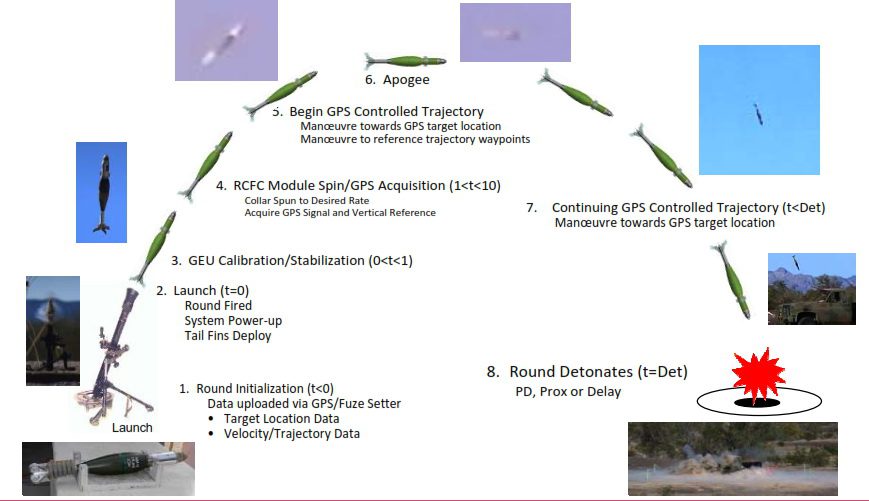

Gun-launched guided munitions are of tremendous interest to the U.S. Army. These technologies offer more accuracy, extended range through glide, more favorable terminal approach for lethality, and the ability to engage advanced threats like partially hidden (defilade) and moving ground and air targets. Current gun-launched guided munition technologies are limited to indirect fire against stationary targets on the ground.
Research conducted 10+ years ago was pivotal in providing capabilities of guided shells which could adjust its trajectory in flight to the U.S. Army. The M982 (Excalibur), fielded in the mid-2000s, is a guided artillery projectile which delivers the warhead to within about 10m of the target compared with traditional unguided artillery which have a delivery accuracy of about 200m.
The M1156 (Precision Guidance Kit) was introduced in the mid-2010s and is a low cost fuze-replacement guidance kit for stock-piled artillery munitions which delivers the warhead approximately 50m from the target. The concept of the spin-stabilized artillery fuze kit that M1156 performance relies on was initially published in the Journal of Spacecraft and Rockets in 1975. But even these shells, shot indirectly from miles away, are really suited to hit stationary targets.
DARPA under its Extreme Accuracy Tasked Ordnance (EXACTO) program has developed a self-steering bullet that can hit moving targets at long ranges with great accuracy. During successful live fire tests in Feb 2015, an experienced shooter using the technology demonstration system repeatedly hit moving and evading targets. Additionally, even a novice shooter using the system for the first time was able to hit a moving target. DARPA claims that it is the first 0.50 small caliber smart bullet technology, the size of bullet used in an M2 Browning machine gun, long rifles, and other heavy machine guns. The aim is to improve sniper effectiveness in acquiring moving targets in unfavorable conditions and enhance troop safety by allowing greater shooter standoff range and reduction in target engagement timelines.
But a new army research project aims to create technologies for small projectiles—bullets, mortar shells, handheld rockets—that can change their trajectory in mid-flight. This would also allow guided direct fire weapons can impose bigger stresses: the electromagnetic railguns that the U.S. military is developing, that could impart a force of 60,000 times gravity on projectiles.
The US Navy super-powerful electromagnetic railgun is targeted to to fire rounds at speeds up to Mach 7.5, which at 9,100 kilometers per hour, is more than seven times the speed of sound, and covers a distance of about 400 kilometers.The weapons are not only devastating in their speed, but at $25,000 per round are much cheaper than their explosive counterparts such as the Tomahawk or Harpoon, which can cost up to $1 million each. ‘The railgun is a true warfighter game changer,’ the Navy says. ‘Wide-area coverage, exceptionally quick response and very deep magazines will extend the reach and lethality of ships armed with this technology.’