

With the flat panel display having already been widely used more than 40 years, there have been many desired changes in the display technology, focusing on developing a lighter, thinner product that was easier to carry and store. A flexible display or rollable display is an electronic visual display which is flexible in nature, designed to be able to withstand being folded, bent and twisted as opposed to the traditional flat screen displays used in most electronic devices.
Through the development of rollable displays in recent years, scientists and engineers agree that flexible flat panel display technology has huge market potential in the future from e-readers, mobile phones and other consumer electronics.
Such screens can be rolled up like a scroll without the image or text being distorted. Flexible displays are useful in allowing the device to be stored in a smaller space, like a pocket while providing a screen size that is more enjoyable for the display of media. Flexible displays can make for better multitasking in mobile devices. In the case of smartphones, foldable displays can eliminate the need for a tablet as a secondary device for some.
Apple also has a patent for a foldable concept and is potentially expected by 2020-2021. Apple currently uses an OLED screen in certain phone models as well. And even though the fold isn’t seen, Apple still uses enthe flexible display to its advantage — bending the bottom half of the screen in on itself to eliminating the need of a bottom bezel.
Flexible tech can also be used to make ultra-thin displays without the fragility of glass screens. The massive wallpaper TV made by Samsung is very thin, yet you can watch it flex when picked up to no harm. Lenovo also has a prototype notebook with a foldable display as well as a prototype phone that folds into a smartwatch.
While the conventional electronics like computers and smartphones is built around silicon integrating billions of transistors and is manufactured using complex, costly and wasteful processes in multi-billion dollar foundries . The printed and flexible electronics aim to replace this by “organic” semiconductors which are long chains of thousands of repeating molecules (a plastic), made with materials based on carbon.
Organic semiconductors can be made to be soluble, and can be turned into an ink. This means it’s possible to print electronic circuits, with the potential to manufacture components as fast as printing newspapers. A printer would do this by applying different inks onto the film. As the inks dried, they would turn into wires, transistors, capacitors, LEDs and all the other things needed to make displays and circuits.
The potential benefits of printed and flexible electronics include thinness, lighter weight, greater durability, and the ability for conformal integration. The intrinsic scalability of printing as a manufacturing process is also of great advantage; the process lends itself to production runs of an arbitrary size. The concept appears to provide a likely path to truly all-embracing electronics. Printed and flexible electronics (PFE) have potential to revolutionize multiple markets—health care, environmental monitoring, displays, human-machine interactivity, energy, communication, and wireless networks.
Researchers at the University of Tokyo have developed “optoelectronic skin”, with an ultra-thin, flexible LED display that can be worn on the back of your hand. China has developed a new electronic paper, heralded as “the world’s first graphene electronic paper,” by Chen Yu, general manager of Guangzhou OED Technologies. The material can be used to create hard or flexible graphene displays, used in electronic products such as e-readers and wearable smart devices.
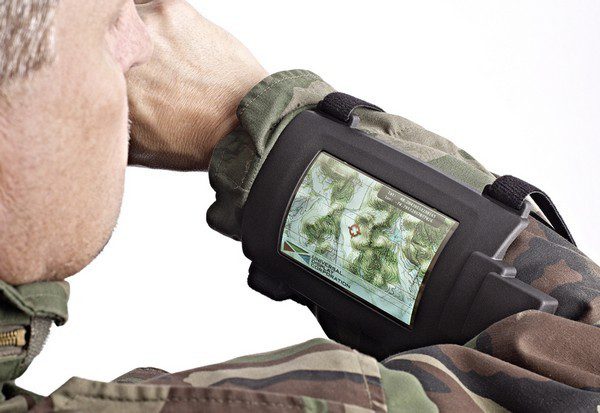
Rollable, foldable, and wearable displays are also expected to hit the military market in the near future. These capabilities will drastically aid in launching the design of rugged displays to eventually support virtual and augmented reality. “The future does continue to evolve toward that flexible, wearable display,” Steve Motter, vice president of business development at IEE, Inc. (Van Nuys, California) says. “In addition, the idea of virtual reality where the operator is wearing the display in an immersive environment is a huge area of development and investment in the display industry.”
The U.S. Department of Defense (DoD) has much interest in physical flexibility in electronic designs, to the extent that the DoD has made healthy investments in electronic innovator NextFlex. These investments include a recent $154 million award for an Army-led flexible electronics project. Formed in 2015, NextFlex is a consortium of companies, academic institutions, nonprofit organizations, and government organizations with a shared goal of advancing the U.S. position in flexible hybrid electronics (FHE) technology. The list is long and impressive, and includes Analog Devices, BAE Systems, Raytheon Technologies, WL Gore & Associates, Purdue University, and the University of Maryland.