
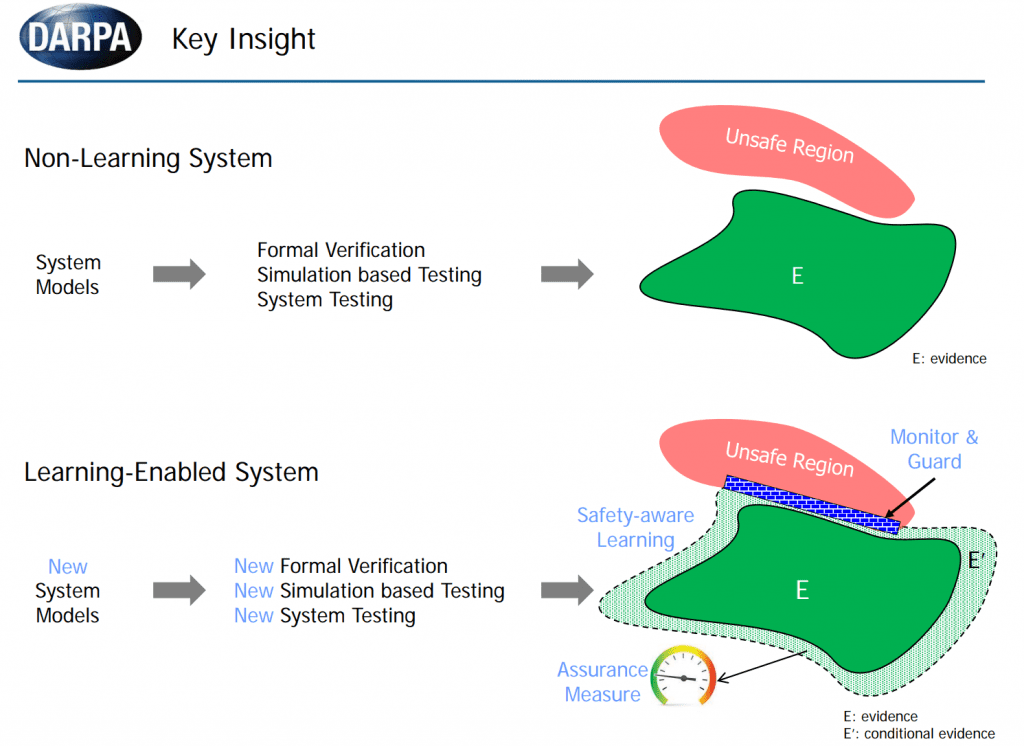

DARPA has launched a new research program called Assured Autonomy that aims to advance the ways computing systems can learn and evolve to better manage variations in the environment and enhance the predictability of autonomous systems like driverless vehicles and unmanned aerial vehicles (UAVs).
“Tremendous advances have been made in the last decade in constructing autonomy systems, as evidenced by the proliferation of a variety of unmanned vehicles. These advances have been driven by innovations in several areas, including sensing and actuation, computing, control theory, design methods, and modeling and simulation,” said Sandeep Neema, program manager at DARPA. “In spite of these advances, deployment and broader adoption of such systems in safety-critical DoD applications remains challenging and controversial.”
Autonomy refers to a system’s ability to accomplish goals independently, or with minimal supervision from human operators in environments that are complex and unpredictable. Autonomy delivers significant military value, including opportunities to reduce the number of warfighters in harm’s way, increase the quality and speed of decisions in time-critical operations, and enable new missions that would otherwise be impossible
Autonomous systems are increasingly critical to several current and future Department of Defense (DoD) mission needs. For example, the U.S. Army Robotics and Autonomous Systems (RAS) strategy report for 2015-2040 identifies a range of capability objectives, including enhanced situational awareness, cognitive workload reduction, force protection, cyber defense, logistics, etc, that rely on autonomous systems and higher levels of autonomy.