
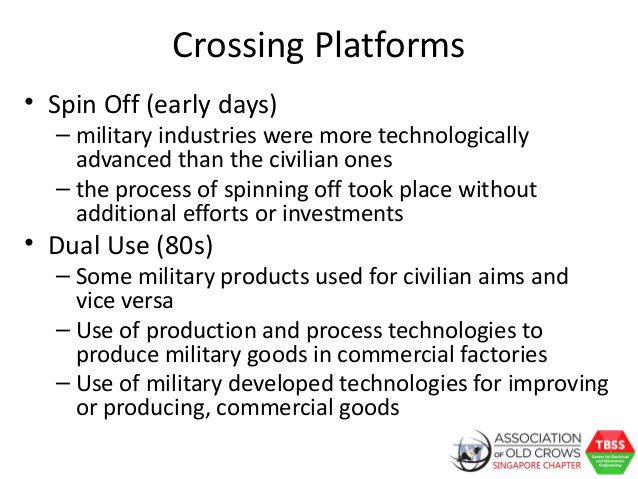

Many commercial technologies we use today can be traced to military from aircrafts to nuclear power, from semiconductors to computers. Duct tape was invented to protect ammunition cases from water during World War II. The internet grew out of a military research project. Navigation devices, such as Google Maps, rely on satellites created to guide fighter jets, warships and military forces. Global Positioning System (GPS) is based on network of satellites set up by the U.S. Department of Defense in the 1970s. Radars developed before World War II by military are now used in many civilian applications including air traffic control and weather forecasting. Invention of Jet engines and other aircraft technologies is now enabling the growth of Air travel. Drones which are becoming increasingly popular for surveillance and photography in commercial and civilian use can be traced to military.
However recently there has been declining trend in spinoffs.“Each year, the U.S. Air Force invests around $4 billion into research and development of new technology for its fleet of planes and jets. Yet most of the sophisticated military innovations developed in their research labs rarely cross over to the commercial market,” writes Alison Damast. In fact, the Air Force generates only a paltry $60,000 a year in outside licensing fees, says Vincent Lewis, director of the Crotty Center for Entrepreneurial Leadership at the University of Dayton’s School of Business Administration.
One reason of declining importance of spin-offs, is the growing applicative nature of military research; only very small percentage of budget is spent on basic research which might be expected to further commercial technologies. In addition, many technologies developed for use in military systems are often too costly or sophisticated for commercial application. US DOD is looking to accelerate the technology transfer to commercial markets.
DOD has selected the Air Force Research Laboratory’s Information Directorate to commercialize its command, control, communications, cyber and intelligence technologies that have been determined to be dual-use. These technologies, which have both civilian and military applications, will be available for license by New York-based entrepreneurs and existing aerospace, defense.
State-of-the-art military technology should be used in advanced civilian industries, said Russian President Vladimir Putin during a joint panel hosted by the Russian Academy of Sciences and the National Research Center Kurchatov Institute. “Today, we must ensure the use of cutting-edge military technology in advanced production spheres, just like nuclear energy came to be used in peaceful ways – constructing power plants, building ice breaking fleets, and so on,” President Putin said. Drawing upon its wealth of experience, the Russian head of state called for “making sure that our civilian science [program] becomes competitive on a global level.” “Russia should be among the leading countries in multiple research areas – first and foremost, in mathematics, which serves as the building block for a digital economy,” he stressed.
Chinese leader Xi has repeatedly stressed the importance of “military-civilian integration” as a core component of the country’s military development strategy. “Through in-depth development of military-civilian integration, military technologies are gradually applied in civilian fields, making high-tech equipment available to commercial markets. At the same time, we have also emphasized the importance of encouraging more civilian product suppliers to actively participate in the defense-building process,” said Dai Hao, Director-General of China’s Institute of Command and Control.
In December 2013, the European Council itself tasked the European Defence Agency and other bodies to better exploit civil-military synergies. The European council suggested “Desegmentation of civil and military research”, by allowing funding to flow from one side to the other, major spin-offs between defence and civil research could be achieved. “It is worth remembering that few technologies are military or civil by nature, especially at low technological readiness.