Home / Geopolitics, Strategy & Technological Rivalries / Beyond Daylight: The New Frontier of Solar Power That Works Around the Clock

Beyond Daylight: The New Frontier of Solar Power That Works Around the Clock

The global energy landscape is undergoing a seismic transformation. Rising demand, the urgency of decarbonization, and the declining availability of fossil fuels have made renewable energy not only desirable but essential. Solar power, in particular, has become the frontrunner, with photovoltaics (PV) now ranking as the cheapest source of electricity in history across much of the world.

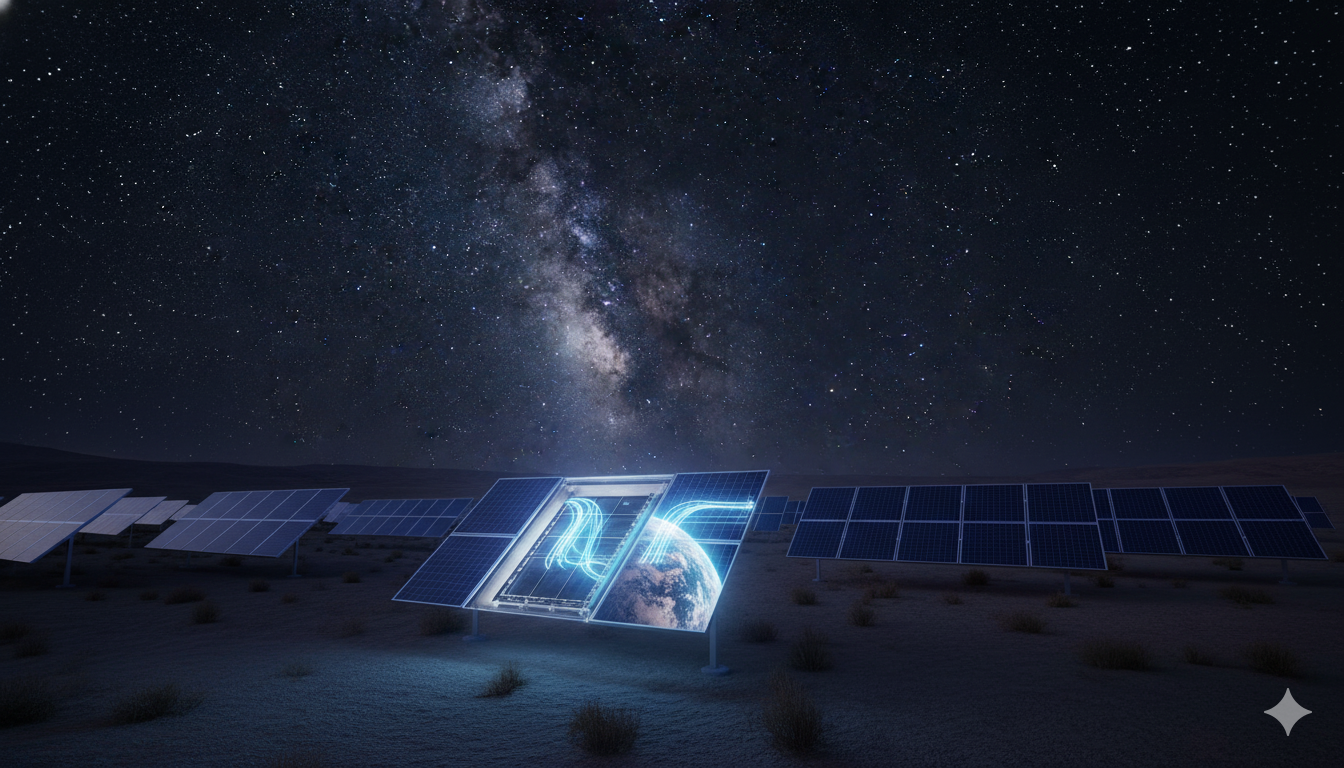
Yet, for all its promise, solar energy has faced one stubborn limitation: it only works when the sun is shining. The daily cycle of darkness interrupts generation just as energy use spikes in the evening. Batteries have provided a partial solution, storing excess daytime electricity for later use, but they remain costly and imperfect. Today, however, an entirely new approach is emerging. Researchers are developing solar technologies that can operate even in the absence of sunlight, generating electricity at night by harnessing the thermal dynamics of the Earth itself.

The Solar Resource: More Than Meets the Eye

Most people think of solar energy as the photons we receive during daylight hours, but the story is much broader. The Earth continuously absorbs and releases solar energy. Each day, roughly 173,000 terawatts of energy from the sun reach the planet. While nearly one-third of that is immediately reflected back into space, the rest is absorbed by the earth.

Every location on Earth receives sunlight at least part of the year. The amount of solar radiation that reaches any one spot on the Earth’s surface varies according to: Geographic location, Time of day, Season, Local landscape, and Local weather. Energy released from the Sun is emitted as shortwave light and ultraviolet energy.

Sunlight that reaches Earth’s surface and atmosphere is either absorbed or reflected.

Clouds, particles in the atmosphere, and reflective surfaces like snow-covered mountains immediately reflect 30 percent of that energy out into space. The rest of it ends up warming the land, oceans, clouds, atmosphere, and everything else on the planet. This energy is stored as heat, driving weather systems and sustaining life on Earth.

When the sun sets, this absorbed heat does not simply vanish. Instead, it is gradually released as long-wave infrared radiation into the cold void of space. Earth sends out about as much energy as it receives. This nightly cooling process is part of the natural balance of the planet’s energy cycle. It is also the phenomenon that scientists are now learning to capture for power generation. By turning this invisible heat flow into electricity, researchers are beginning to expand the boundaries of what solar energy can achieve.

The Breakthrough: Turning Night into Power

The possibility of generating electricity at night hinges on a process known as radiative cooling. On a clear night, surfaces exposed to the open sky cool down more quickly than the surrounding air because they emit their heat directly into outer space. This temperature difference between a surface and the air above it becomes a potential source of energy. Building on this principle, researchers around the world have begun developing experimental devices that convert radiative cooling into electricity.

Thermoelectric Generators – Stanford’s Innovation

At Stanford University, Dr. Sid Assawaworrarit and his team modified conventional solar panels to operate after dark. They incorporated a thermoelectric generator, a device that captures the heat flowing from warmer air to the cooler surface of a solar panel and converts it into electricity.

As it turns out, solar panels can kind of work in reverse; solar panels emit infrared radiation even in the absence of light. This takes the form of protons carrying heat away from the solar panel via wavelengths invisible to the human eye. On a clear day (when there aren’t any clouds in the sky to reflect infrared light back toward Earth) this heat transfer creates a temperature difference of a few degrees, which is the secret sauce to Assaworrarit’s device.

Their prototype produced around 50 milliwatts per square meter, which may seem small, but it demonstrated the viability of nighttime energy harvesting. Refinements such as reflective aluminum shielding further improved output, and the researchers estimate that reaching one to two watts per square meter is realistic. By using an aluminum plate to reduce the amount of heat that could escape from the edges of their solar panels, the team was able to multiply their technology’s generated energy nearly ten times.

While not sufficient for household-scale energy needs, this power could keep essential low-energy devices such as LED lights, mobile phones, or environmental sensors running overnight.

Thermoradiative Diodes – UNSW Sydney’s Discovery

Meanwhile, a more fundamental breakthrough is underway at the University of New South Wales (UNSW) in Sydney. There, researchers have developed a thermoradiative diode, a semiconductor device that functions like a solar cell in reverse. Instead of absorbing incoming sunlight, the diode generates electricity by emitting infrared radiation into the cold of space. This process, called thermoradiative power generation, capitalizes on the temperature differential between the warm Earth and the frigid void beyond our atmosphere.

Although the power output is currently minimal—about 100,000 times lower than that of a standard solar panel—the demonstration is a crucial proof of concept. It confirms that infrared emissions, a natural byproduct of the Earth cooling at night, can be directly converted into usable electricity. Researchers acknowledge the efficiency challenges but remain confident that further optimization of materials and device architecture will unlock much greater potential.

Together, the thermoelectric generator at Stanford and the thermoradiative diode at UNSW are charting new territory. By complementing one another, these approaches point to a future where solar power is no longer confined to daylight hours but becomes a continuous, around-the-clock energy source.

Why This Technology Matters

The immediate outputs of these prototypes are modest, but their implications are far-reaching. The ability to generate electricity at night could fundamentally change how we plan, distribute, and consume renewable energy.

At the grid level, nighttime solar opens the door to true twenty-four-hour renewable generation. This continuity could ease the pressure on energy storage systems, reducing the need for massive batteries and improving grid stability. By smoothing the natural peaks and troughs of solar power, nighttime generation could help align supply with demand in ways not previously possible.

For communities lacking access to reliable electricity, the impact could be even more profound. Nearly one billion people worldwide live without dependable grid connections. For them, small but steady amounts of electricity at night could enable lighting, communication, and even medical devices without the expense and maintenance of large storage systems. In this way, nighttime solar could help close the global energy access gap.

In advanced economies, the technology aligns perfectly with the growing need to power the Internet of Things. Billions of sensors, from agricultural monitors to weather stations and urban infrastructure, require tiny amounts of continuous power. By harvesting the Earth’s infrared emissions, these devices could operate indefinitely without battery changes, drastically reducing costs and maintenance burdens.

These opportunities reveal why nighttime solar is not merely an incremental improvement, but potentially a paradigm shift in renewable energy.

Potential Applications

The scope of nighttime solar power extends beyond terrestrial grids and communities. Early prototypes, though limited in output, suggest several promising applications.

One immediate application is in wearable technology. Devices such as fitness trackers, smartwatches, or medical monitors could one day be powered by thermoradiative devices that capture small amounts of body heat or ambient infrared radiation. This would reduce or even eliminate the need for frequent recharging, making wearables more user-friendly and sustainable.

Another transformative application lies in spacecraft and satellites. These platforms operate in extreme conditions, often relying on bulky battery systems to store energy when sunlight is unavailable. A thermoradiative power source could enable continuous electricity generation even in shadowed environments, reducing the weight and cost associated with current storage solutions. By enhancing efficiency and reliability, nighttime solar technology could play a crucial role in the future of space exploration.

From rural villages to orbiting satellites, the versatility of nighttime solar technology demonstrates its potential to redefine how and where we harness energy.

The Path Ahead

As with all groundbreaking innovations, the journey from laboratory success to real-world deployment is challenging. Efficiency improvements are critical, as both thermoelectric generators and thermoradiative diodes currently deliver only small amounts of power. Research into new semiconductor materials and device designs is already underway to address this limitation.

Cost and scalability also remain central hurdles. Competing with mature alternatives such as batteries requires not only scientific breakthroughs but also manufacturing innovations and economies of scale. For nighttime solar to achieve widespread adoption, it must integrate seamlessly with existing infrastructure, particularly with the photovoltaic panels and inverters already in use across the globe.

Despite these obstacles, the progress made so far is remarkable. In just a few years, the concept of solar power at night has moved from theoretical speculation to functioning prototypes. With continued research and development, the next decade could see this technology transition from niche applications to mainstream energy solutions.

Future Outlook and Conclusion

The development of solar panels and devices capable of generating electricity at night marks a pivotal advancement in renewable energy. While current efficiencies remain low, the promise of continuous, sustainable, and versatile power generation is too significant to ignore. Over the next five years, as researchers refine materials and optimize designs, nighttime solar is expected to expand beyond laboratories into real-world applications.

Its potential impact spans every scale—from powering personal wearables and sensors, to supplying rural communities with vital energy access, to supporting spacecraft far beyond Earth’s orbit. In the broader energy landscape, it could reduce our reliance on storage, stabilize renewable grids, and accelerate the global transition to a net-zero future.

Ultimately, the significance of nighttime solar is not just in the watts it produces today but in the possibilities it unlocks for tomorrow. By embracing the full spectrum of energy exchange between Earth and space, humanity is stepping into an era where renewable energy is not limited by daylight but flows continuously, as boundless as the universe itself.


References and Resources also include:

https://www.sciencedaily.com/releases/2022/05/220517112246.htm

https://www.extremetech.com/extreme/334021-stanford-engineers-have-gotten-solar-panels-to-generate-electricity-at-night

About Rajesh Uppal

Check Also

The World Quantum Race: A Global Surge of Quantum Technology Hubs and Centers

Quantum technology, once the stuff of science fiction, is rapidly becoming a cornerstone of future …

error: Content is protected !!