

Recent years have seen multiple new security challenges emerge in the maritime arena. Navies, coast guards and other maritime security agencies face a proliferation of security challenges. These include: illegal fishing of territorial waters; incursion of mineral exploitation across legal boundaries; maritime terrorism; narcotics smuggling; pollution as a result of shipping accidents or malpractice; trafficking of illegal immigrants; and avoidance of tax duties through smuggling.
Maritime security is understood as a state of affairs of the global maritime domain, in which international law and national law are enforced, freedom of navigation is guaranteed and citizens, infrastructure, transport, the environment and marine resources are protected. It includes protection against maritime security risks and threats, including the protection of critical maritime infrastructure, such as specific areas in ports and port facilities, off-shore installations, energy supply by the sea, underwater pipelines, seabed cables, as well as the promotion of scientific research and innovation projects.
Maritime security provides advanced technology to detect hazards and communicate with officials. It also renders services that help to combat potential threats. The different types of maritime security include port and critical infrastructure security, coastal surveillance and vessel security. The technologies and systems used for maritime security include access control, communications, detectors, geographic information systems, screening and scanning, smart containers, supervisory control and data acquisition (SCADA), surveillance and tracking and weather monitoring among others.
“Access to timely and accurate information and intelligence is crucial for the establishment of a common maritime awareness picture which in turn leads to better operations and a more efficient use of scarce resources,” says EU’s Maritime security strategy. Integration of different data sources in the maritime domain on the basis of existing national and international law is a key task, resulting in a better understanding of what is happening at sea. The more information is aggregated and integrated, the more complete is the maritime picture created and more value is delivered to the operational end-users, in a cost efficient way.
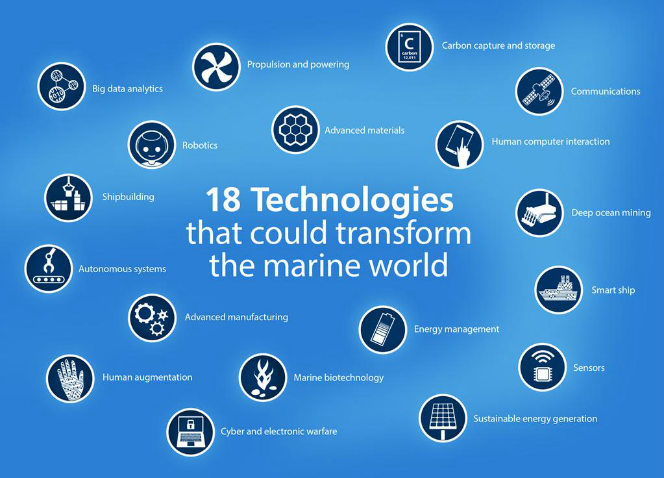
GMTT2030, a report produced in 2015 jointly by University of Southampton – Lloyd’s Register – Qinetiq, identified 18 technologies that are likely to shape the future of the marine and maritime sectors up to 2030. Some of these technologies are already established with the prospect of further modifications and improvements. Other technologies are in their infancy and have the potential to revolutionise, possibly disruptively, the way in which vessels are propelled.