

Radars have emerged as most effective sensors for long range detection and tracking of military targets under all weather, day/night conditions. Radar is an essential electronic system for any military force, whether at land, sea, or in the air. Over the years military radar technology has gradually moved to higher frequencies, smaller antennas, and solid-state amplification in place of the triodes and magnetron vacuum tubes of the early radar systems. Over the past 30 years, radar systems have improved performance due to advances in technology, such as phased-array radars, active electronically scanned array (AESA) technology, and synthetic aperture radars (SARs).
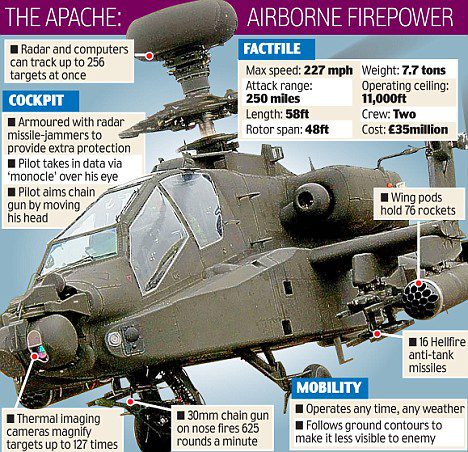
Northrop and Lockheed Martin have developed together a well-known radar system, the AN/APG-78 “Longbow” fire-control radar system. Using Ka-band frequencies, the compact radar system has an effective detection range of 8 km. Fielded on the U.S. Army’s Apache AH-64D attack helicopter, the Longbow radar features low probability of intercept and can detect and locate multiple moving and stationary targets. It works in conjunction with the millimeter-wave-guided HELLFIRE Fire and Forget missile to lock onto a target before or after launch.
For more than a decade, the LONGBOW FCR has enabled Apache aircrews to automatically detect, locate, classify and prioritize multiple moving and stationary targets on land, air and water in all weather and battlefield conditions to the maximum range of the Longbow missile (8 kilometers). It can scan an area searching for potential targets presenting to the aircrew the top 16 of 100 targets in less than 6 seconds. It enables rapid, multi-target engagement in all weather, over multiple terrains and through battlefield obscurants.
The Apache LONGBOW system is a proven force multiplier that has been battle-proven in Operation Enduring Freedom and Operation Iraqi Freedom. In the days of fighting against the hordes of “Russian tanks”, the AH-64D (and now the AH-64E) would “hide behind” hills, hovering so the Longbow disk is just looking over the ridge. It can then spot an enemy tank, lock-onto it, and then pop-up and fire a few Hellfire anti-tank missiles and then re-hide.