

Decades of innovation — driven almost entirely by DoD and the Defense Industrial Base — have kept the United States at the forefront of modern military capability. Further the free-market structure of the economy, vibrant venture capital ecosystems, world-class universities, and government support of R&D were other dominant factors combined to form the most innovative ecosystem in the world.
However recently, China is rapidly modernizing its military and closing its gaps with western countries. It is also challenging west in exploitation of new technologies including AI, quantum, 5G, IoT, Nanotechnology and electric vehicles. CHINESE leader Xi Jinping has laid out his plans for world domination with a 30-year plan to transform the country and surpass the US to become the biggest global superpower. Former US energy secretary Steven Chu has even observed that China is ahead of America in areas ranging “from wind power to nuclear reactors to high-speed rail”. China is also catching up fast in artificial intelligence, genetic engineering, 5-G broadband technology and the “Internet of Things.” Some of its achievements include a gigantic 500m-aperture spherical telescope, the launch of the world’s first hacker-proof quantum satellite and the development of world’s fastest supercomputer – the new Sunway Tianhe-1A. China is also challenging US in many critical military domains like Space, Cyber, Air and Sea.
One of the critical components of Chinese innovation strategy is military civil integration which China’s leaders believe will help China continue its rapid defense modernization without creating too great a drag on its economy. Chinese leader Xi has repeatedly stressed the importance of “military-civilian integration” as a core component of the country’s military development strategy. “Through in-depth development of military-civilian integration, military technologies are gradually applied in civilian fields, making high-tech equipment available to commercial markets. At the same time, we have also emphasized the importance of encouraging more civilian product suppliers to actively participate in the defense-building process,” said Dai Hao, Director-General of China’s Institute of Command and Control.
Worried by it’s narrowing military lead over the adversaries like Russia and china, In November 2014, then–Secretary of Defense Chuck Hagel announced a new Defense Innovation Initiative, which included the Third Offset Strategy. Hagel said, “This new initiative is an ambitious department-wide effort to identify and invest in innovative ways to sustain and advance America’s military dominance for the 21st century.” The goal of DII was identifying new and innovative technologies that will be agile, flexible and ready to confront and defeat aggression from any adversary anytime, anywhere—with a smaller and leaner force structure. It aims to “pursue innovative ways to sustain and advance our military superiority for the 21st Century” by finding “new and creative ways to sustain, and in some areas expand, our advantages even as we deal with more limited resources.”.
Now, it is the commercial sector that is defining the leading edge of technology and innovation. New waves of emerging commercial technologies have caused quick advancement within the defense sector. As noted by Tom Foldesi, DIU’s commercial engagement director, one-third of worldwide R&D was tied to the Department of Defense in the 1960s. That percentage has since tanked to 3.7 percent.
The challenge was to find a better way than Chinese top-down, government-managed effort , more in conformity with Silicon Valley model of innovation and to the American values. Some of the strategies evolved by DOD to spur innovation involved attracting companies that don’t usually work with the military, inspire creative thinking inside and outside the Defense Department ,strengthening its collaboration with tech firms, entrepreneurs, and start-ups and crowdsourcing. During Association of the United States Army (AUSA) Annual Meeting, Secretary of the Army Ryan McCarthy said: “the intent is to move from the Industrial Age processes to the Information Age, leveraging data as a strategic asset and utilizing private sector technology.”
To the Pentagon, dual-use technology offers an attractive means of drawing new players into the military fold, while also leveraging the more rapid development that happens on the commercial side. But the model is evolving, said Mike Madsen, director of strategic engagement with the government’s Silicon Valley outreach hub Defense Innovation Unit. With DoD, “it takes two years to get to a ‘yes,’ when a lot of companies need a ‘no’ in 30 days because they don’t have the capital,” he said. “So we flipped it. Now we start with the DoD problem set and take it out to industry. And we’ve lowered a lot of the barriers to entry — we negotiate [intellectual property] for each contract, we negotiate auditability, we move quickly. We look to award prototype contracts in 60 to 90 days.” One of the salutary effects of a moderate regulatory environment for new entrants will be to allow for the organic emergence of a greater degree of comfort and cultural understanding between Silicon Valley and the Pentagon.
Other DOD arms devised their own strategies to spur innovation. The Space and Naval Warfare Systems Center Atlantic said it wants to take better advantage of technology developed outside of the defense contracting industry. Plenty of companies are building products for the private sector that could have uses in the military, the agency says. SPAWAR, as the agency is known, plans to spend as much as $100 million on their technology. And while it doesn’t have specific projects in mind just yet, it’s looking to address a broad swath of needs: cyberwarfare and cloud computing, data analysis and the Internet of things, among others. The agency will hire a firm to recruit companies working in those areas. That firm will be tasked with “expanding the field of companies that we leverage technologies from,” said Bill Deligne, SPAWAR’s deputy executive director in Charleston.
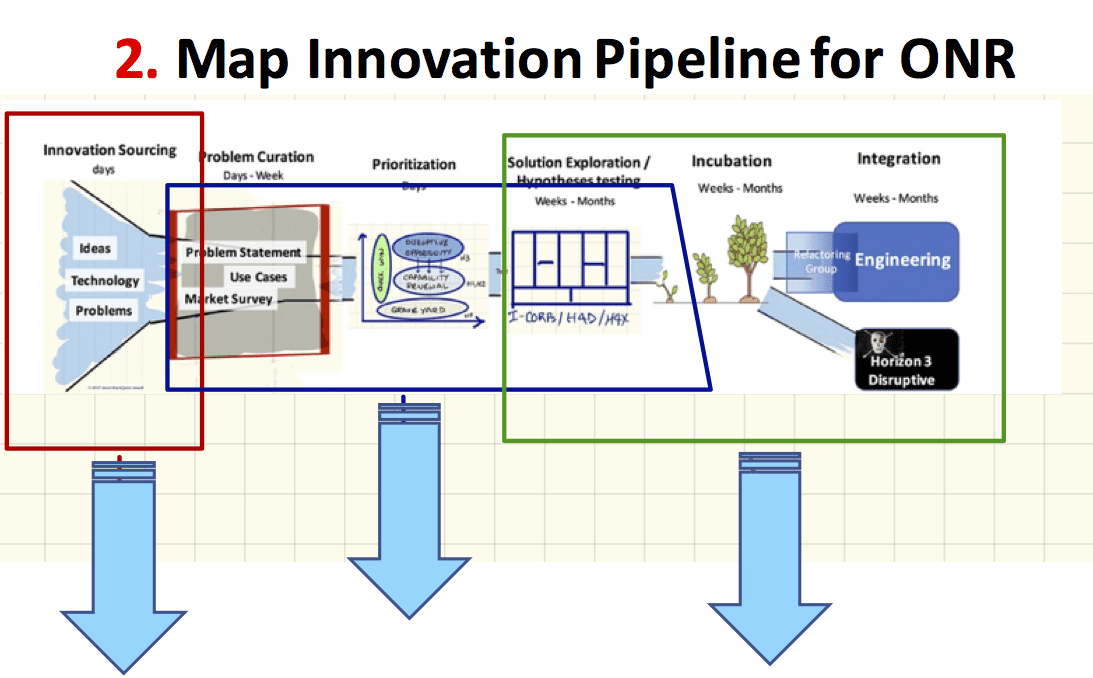
ONR has launched an initiative , the Concept Challenge, under which the organization is asking literally anyone who believes they have an idea for a technology that could help the Navy and Marine Corps deter conflict and win wars to submit one-page summaries for possible adoption into ONR’s research portfolio. Rear Adm. David Hahn, head ONR said the criteria for the challenge is broad, by design: candidates could include anything from a brand new technology the Navy has not yet examined to new ways of combining existing systems that fit into future war fighting concepts.
In Dec 2018, The U.S. Army announced the Army Expeditionary Technology Search – xTechSearch program. The Army is seeking innovative, paradigm-breaking technologies from the nontraditional defense community to support modernization priorities.
Recently the department is taking new steps to ingest new technologies and accelerate modernization efforts, including creation of the Close Combat Lethality Task Force (CCLTF), Joint Artificial Analysis Center (JAIC), and Army Futures Command; and others pushing new strategies for advancing cloud, artificial intelligence, cybersecurity, and digital modernization.
However, the military’s ultimate goal is to achieve dominant military capability and readiness under a wide range of possible future scenarios. There are many factors contributing to military capability and readiness and therefore innovation demands improvement in many of factors such as budgets, processes, cultures, and training to innovation and tactics, techniques and procedures (TTPs).
DoD organizations need to rely upon a talent base that is creative, entrepreneurial, and possesses the capacity to solve problems and continuously learn and adapt to new roles. A new ecosystem of mission partners with their own innovation infrastructures must be able to federate problems and solutions across the enterprise and lead successful digital transformations at scale, writes MG George Franz (USA, Ret.) is a former director of operations for the U.S. Cyber Command .