
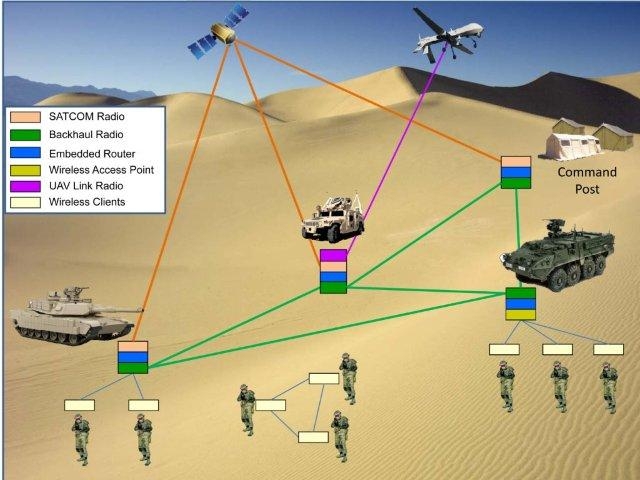

The modern battlespace is an irregular, against a tech-enabled enemy, and within urban environments and/or complex terrain. Traditional communications infrastructure like cell phone towers are centralized therefore vulnerable to single point failures such as physical damage to their central server, or compromised by a cyber-attack. During disasters like earthquakes, tsunamis and nuclear disasters, infrastructure can be rendered unusable. Therefore a tactical network should be able to be resilient to node failures and operate with little or no backbone infrastructure.
Mobile Ad-Hoc Network (MANET) is an infrastructure less wireless network of autonomous collection of mobile nodes (Smart phones, Laptops, iPads, PDAs etc.) that distribute coordination and control. All the nodes are free to move and organize themselves into a network. These devices collaborate with each other to offer the essential network functions in a distributed manner. In a MANET, a node functions both as a host and as a router to forward the packets in appropriate direction.
All the mobile nodes can communicate each other directly, if they are in other’s wireless links radio range. Since MANETs allow ubiquitous service access, anywhere, anytime without any fixed infrastructure they can be widely used in military battlefields, crisis management services, classrooms and conference halls etc. MANETs offer several significant advantages to a military force; they support radio links in operational areas lacking either a fixed infrastructure or line-of-sight communications. A MANET’s ability to self-form and self-manage eliminates the need for intensive central management of network links, thus reducing support personnel and equipment requirements in forward located areas.
“A MANET of a thousand nodes could support an entire battalion without the need for manual network setup, management and maintenance that comes from ‘switchboard’-era communications,” said Mark Rich, DARPA Program Manager. “This could provide more troops with robust services such as real-time video imagery, enhanced situational awareness and other services that we have not yet imagined.”