
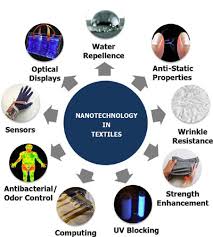

Wearable electronic textiles (e-textiles) have become a focus of significant research interest due to their potential applications in sportswear, military uniforms, environmental monitoring and health care. Smart textiles are defined as textiles that can sense and react to environmental conditions or stimuli, from mechanical, thermal, magnetic, chemical, electrical, or other sources. They are able to sense and respond to external conditions (stimuli) in a predetermined way.
Smart fabric is a traditional fabric with added interactive functionality such as power generation or storage, sensing, radio frequency functioning, human interface elements and/or assistive technology. There have been enormous efforts in incorporating electronic components to make e-textiles for various applications such as sensors, energy storage devices, transistors and photovoltaic devices.
The past few years have seen the introduction of a number of wearable technologies, from fitness trackers to smart watches but with the increasing use of smart textiles, wearables are set to become ‘disappearables’ as the devices merge with textiles, according to a new report from Cientifica. Unlike today’s ‘wearables’ tomorrow’s devices will be fully integrated into the the garment through the use of conductive fibres, multilayer 3D printed structures and two dimensional materials such as graphene.
With the help of nano-materials, nano-biotechnology, and nano-electronics, electronic components such as actuators, control units, and sensors, are embedded into smart textiles. The textile-based materials, equipped with nanotechnology and electronics, have a major role in the development of high-tech miltary uniforms and materials. Active intelligent textiles ystems, integrated to electronics, have the capacity of improving the combat soldiers performance by sensing, adopting themselves and responding to a situational combat need allowing thecombat soldiers to continue their mission. Meantime, smart technologies aim to help soldiers do everything they need to do with a less number of equipment and a lighter load.