
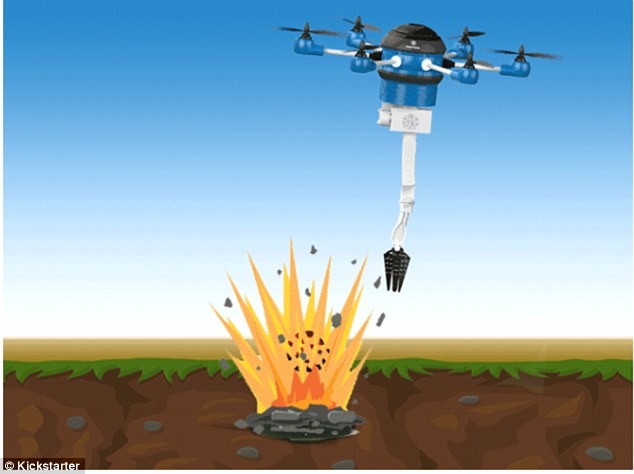

Several countries suffer from the existence of millions of buried landmines in their territories. These landmines have indefinite life, and may still cause horrific personal injuries and economic dislocation for decades after a war has finished.
Landmines, improvised explosive devices (IEDs), and other homemade bombs struck 6,461 people worldwide in 2015, killing at least 1,672, according to a report by the International Campaign to Ban Land Mines and Cluster Munition Coalition. Survivors are often left with devastating injuries. In a study published in BMJ Open, 70 percent of people hit by IEDS in Afghanistan required multiple amputations. According to the UN Mine Action Service, landmines kill 15,000–20,000 people every year (mostly children) and maim countless more across 78 countries.
IEDs were responsible for approximately two-thirds of U.S. and Coalition casualties suffered in Iraq and Afghanistan. Civilian casualties from IEDs number in the tens of thousands. A Navy explosive ordnance disposal expert with multiple tours in Iraq and Afghanistan characterized the influence of IEDs on the conduct of operations in those countries this way: “No other weapon shaped the battlefields in Iraq and Afghanistan like the IED. It required that troops charged with enhancing population security confine themselves to massive, armored vehicles and travel at high rates of speed or plow through farmers’ fields to avoid roads entirely. It slowed dismounted troops forced to sweep with metal detectors and divert around empty intersections. It partitioned Baghdad with 12-foot high concrete walls and caused a fertilizer shortage for farmers in Afghanistan. It was the only insurgent weapon that could cause mass civilian casualties, undermining local governance, the credibility of counter-insurgent efforts, and ensuring a steady stream of atrocities — of the horrors of intervention — could be broadcast globally.”
Demining efforts cost US 300–1000 USD per mine, and, for every 5000 mines cleared, one person is killed and two are injured. Thus, clearing post-combat regions of landmines has proven to be a difficult, risky, dangerous and expensive task with enormous social implications for civilians. The demining has two contexts, the military and the humanitarian. The main aim of the military is cleaning the path where the soldiers are going to walk through. Instead the humanitarian must clear the zone of mines to ensure the life of every member of the community who lives close to the danger region. “There are literally millions of anti-personnel mines in the ground in places where people need to grow food, or need to walk to the nearest well, or simply go about their daily business – shelter under a tree from the Sun,” explains Bill Lionheart, a mathematician at the University of Manchester in the UK.
Many technologies have been employed in detection of landmines from metal detectors to ground penetrating radar, acoustic and Electric Impedance Tomography (EIT) to Infrared Imaging Systems. Each technique is suitable for detection under some conditions depending on the type of the landmine case, the explosive material, and the soil.
Robotic vehicles and drones are also being increasingly employed for mind detection and clearing, to reduce the risk to the personnel. Detecting mines is an ideal application for small mobile robots, and Carnegie Robotics is making it easier by adding (supervised) autonomy to its Standoff Robotic Explosive Hazard Detection (SREHD) robot.
Three new Nato scientific technologies designed to detect and clear improvised explosive devices (IEDs) have been successfully tested in Florence, Italy. Developed in the framework of Nato’s Science for Peace and Security (SPS) Programme, the three technologies include a semi-autonomous robot for mines and IED detection, a lightweight mine detector, and a handheld detector for dirty bombs.