

The advancement of Sensors, Communications and Radars have given rise to Electronic Warfare, which encompasses, in all battle phases, military actions involving the use of EM energy to determine, exploit, reduce or prevent hostile use of EM spectrum and the actions, which retain friendly use of the EM spectrum. The three constituents of EW are referred as Electronic Attack (EA), Electronic Protection (EP) and Electronic Support (ES). EA is the electronic countermeasure which includes jamming and deception of enemy radars, electro optic and communication systems.
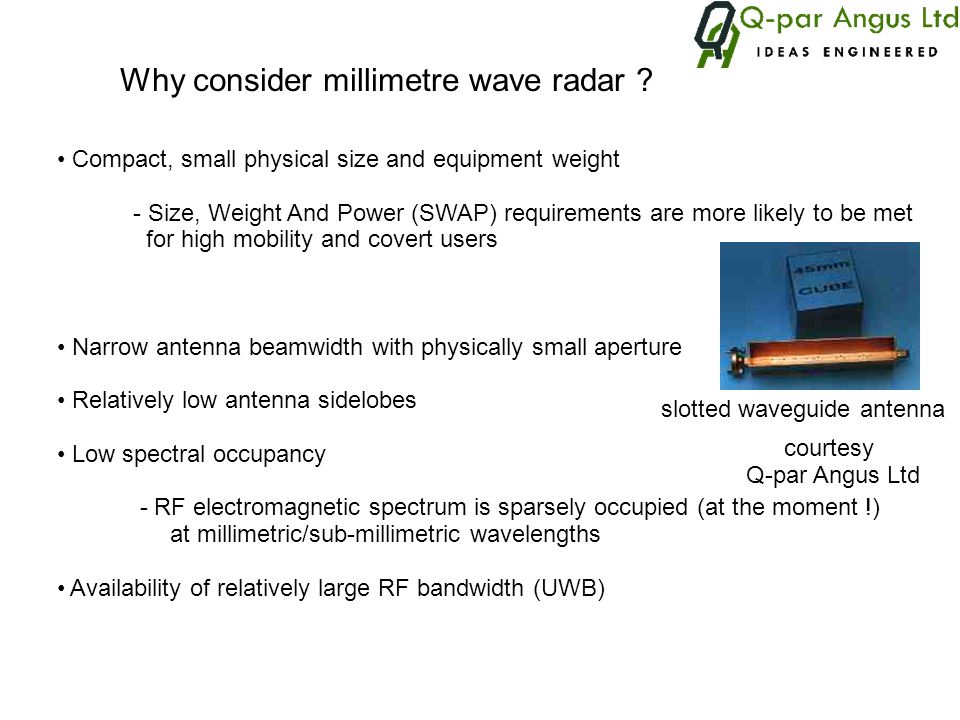
The need for higher data rates for network-centric capabilities and the increasing demand for data transmission to support situational awareness is driving the move to higher RF frequencies millimetre waves or EHF. EHF encompasses a wide waveband of frequencies that the International Telecommunications Union, the UN organisation regulating international use of the radio spectrum, classifies as going from 30 GHz to 300 GHz. EHF wavelengths can typically measure from 10 mm down to 1 mm. This is in stark contrast to the high frequency (HF) waveband (3–30 MHz) with its wavelengths of between 10 m and 100 m. The move to higher RF frequencies (60 GHz, 94GHz) is dictated by the need to optimise SWaP-C (size, weight, power, cost) and is driven by cost effective semiconductor devices.
EHF has comparatively more transmission space available. V/UHF has become progressively more cluttered as global cellular communications have proliferated over the past two decades, a demand which is likely to increase in the future. “The thing about this band is that it is not very cluttered,” said David Stupples, a professor at the School of Mathematics, Computer Science and Engineering at the Department of Electrical and Electronic Engineering at City University, London, and the international board director of the Association of Old Crows EW advocacy group.
Another area which is driving adoption of millimetre waves are 5G technologies to meet dramatic traffic growth over the next decade. 5G mobile networks are expected to achieve higher capacity increases compared to 4G networks, with considerably higher-speed data rates. Given that current mobile phones operate in frequencies between 0.8 to 2.5 GHz, they are capable of download speeds of only 230 Mbps. Therefore, mobile devices operating in the millimeter-wave band are essential to cope with the higher-speed data transmissions required from 5G. Additional radio spectrum would be available at millimetre wave frequencies from 30 GHz to 300 GHz will provide 10 times more band¬width than the 4G cellular-bands.
For military communications, the use of millimetre-wave technologies has been driven by satellite communications. Modern Militaries are deploying multibeam Ka band communications satellites to provide gigabytes per second capacity as well as reductions in system size. EHF is typically only used for satellite communications, with the Pentagon’s Advanced EHF satellite constellation an example of EHF on the battlefield. (US Air Force)
The 5G may be also employed by military for terrestrial communications. Although armed forces around the world tend to rely on conventional HF, Very High Frequency (VHF: 30–300 MHz), and Ultra High Frequency (UHF: 300 MHz to 3 GHz) tactical radios for ground-to-ground and ground-to-air/air-to-ground communications, a migration of tactical communications into EHF in the future would require new COMINT systems to collect commuications intelligence
Military also has increasing interest in making broader use of the millimeter wave frequency band for communications on small mobile platforms where narrow antenna beams from small radiating apertures provide enhanced communication security. For example DARPA’s 100G program is developing the technologies and system concepts to project fiber-optic-class 100 Gb/s capacity via airborne data links anywhere within the area of responsibility (AOR). The goal is to create a 100 Gb/s data link that achieves a range greater than 200 kilometers between airborne assets and a range greater than 100 kilometers between an high-altitude long-endurance aerial platforms (at 60,000 feet) and the ground.
Another factor is employment of millimetre wave based seekers in missiles. While optical systems (visible and IR) require clear atmospheric conditions for reliable operation, MMW imaging is relatively immune to weather conditions such as cloud, fog, snow, and light rain. The seeker can operate in low visibility and contaminated battlefield conditions, and is not susceptible to battlefield obscurants such as smoke, dust, flares and chaff.