
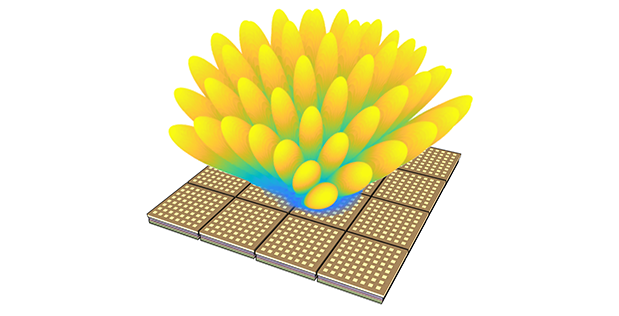

Expanded mission areas and the implementation of additional data routing resulting from future warfighting capabilities place more demand on data distribution services in the form of higher data bandwidths and reduced latencies. These demands require improvements in Radio Frequency (RF) spectrum utilization and advances in antenna technologies. Digital array antenna technology promises to enable these improvements by dramatically increasing operational flexibility.
Today’s critical DoD applications such as radar, communications and electronic warfare use antenna arrays to provide unique capabilities, such as multiple beam forming and electronic steering. Phased radio frequency (RF) arrays use numerous small antennas to steer RF beams without mechanical movement. Their lack of moving parts reduces maintenance requirements and their advanced electromagnetic capabilities, such as the ability to look in multiple directions at once, are extremely useful in the field. They also provide with increased range and power, agility and sensitivity, reliability and multi-function capability. The development of much of the enabling advanced electronics pushed phased array technology up through X- and Ku-band.
Military has increasing interest in making broader use of the millimeter wave frequency band for communications on small mobile platforms where narrow antenna beams from small radiating apertures provide enhanced communication security. For example DARPA’s 100G program is developing the technologies and system concepts to project fiber-optic-class 100 Gb/s capacity via airborne data links anywhere within the area of responsibility (AOR). The goal is to create a 100 Gb/s data link that achieves a range greater than 200 kilometers between airborne assets and a range greater than 100 kilometers between an high-altitude long-endurance aerial platforms (at 60,000 feet) and the ground.
Phased-arrays operating at millimeter wave–or very high frequencies–are already an active area of research by the emerging 5G cellular market. Commercial applications are primarily solving the “last mile” problem, where consumers are demanding more bandwidth for high-throughput applications over relatively short ranges at predetermined frequencies and with minimal obstacles to user discovery. DoD platforms create far more complex communications environments than commercial environments. Often separated by tens or even hundreds of nautical miles, today’s military platforms are moving in three dimensions with unknown orientations. This environment is creating unique beamforming challenges that can’t easily be solved by applying current communications approaches.
“Imagine two aircraft both traveling at high speed and moving relative to one another,” said DARPA program manager Timothy Hancock. “They have to find each other in space to communicate with directional antenna beams, creating a very difficult challenge that can’t be solved with the phased-array solutions emerging in the commercial marketplace.” To expand the use of millimeter wave phased-arrays and make them broadly applicable across DoD systems, many technical challenges must be addressed, including wideband frequency coverage, precision beam pointing, user discover and mesh networking.
DARPA launched the Millimeter-Wave Digital Arrays (MIDAS) program in Jan 2018 that aims to develop element-level digital phased-array technology that will enable next generation DoD millimeter wave systems. Advances in element-level digital beamforming in phased-array designs is enabling new multi-beam communications schemes—or the use of several beams receiving and transmitting in multiple directions simultaneously—to help significantly reduce node discovery time and improve network throughput. “While critical to the next generation of phased-arrays, today’s digital beamforming is limited to lower frequencies, making the resulting arrays too large for use on small mobile platforms,” said Hancock.
To reduce the size of the arrays, advances in millimeter wave technology will help push the frequency of operation to higher bands, bringing the capabilities of directional antennas to small mobile platforms. “Through MIDAS, we are seeking proposals that combine advances in millimeter wave and digital beamforming technologies to create radios that will deliver secure communications for our military,” said Hancock.
There are many DoD applications that would benefit from millimeter wave phased arrays. These include a wide variety of short-range, high-data rate and long-range, low-data rate communication links for air-to-air and air-to-ground scenarios. The ability to support legacy commercial and military satellite communication bands to geosynchronous satellites is also important. Additionally, there is growing interest in the use of Ka- through V-band for low-earth orbit satellite constellations to provide connectivity to ground users.