Modern military, security, and industrial capabilities do not fail because of individual components—they fail at interfaces, integration points, and architectural constraints. This sub-magazine analyzes complex systems as complete architectures rather than isolated parts.
IDST Intelligence Briefings
System-of-systems analysis, integration challenges, design trade-offs, lifecycle constraints, and resilience assessment
Why This Sub-Magazine Exists
Most analysis isolates individual components. Real-world performance, however, is shaped by interfaces, integration logic, and architectural constraints. This sub-magazine exists to expose those deeper structural realities.
What We Track
- System integration and interoperability
- Architectural bottlenecks and dependencies
- Modularity vs monolithic design choices
- Reliability, redundancy, and failure modes
Latest Analysis & Intelligence
-

Satellite Constellations: A New Architecture for Space
Satellite Constellations: The New Architecture of Space A deep look into how vast networks of small satellites are revolutionizing communication, defense, and exploration — building the backbone of a connected and resilient space future. Introduction: A New Orbital Era Satellite constellations—networks of multiple satellites operating in coordinated orbits—are revolutionizing how we observe, communicate, and interact…
-

Securing the Future: Quantum Random Number Generator (QRNG) for Post-Quantum Cryptography, Mobile and IoT Security, and Ultra-Secure Military Communications
Quantum Random Number Generators (QRNGs) are transforming cybersecurity by delivering truly unpredictable entropy, securing IoT, post-quantum encryption, and military communications against quantum threats. Introduction: Why Quantum-Grade Randomness is Now Essential With the looming threat of quantum computers capable of breaking conventional encryption algorithms, a shift in cybersecurity strategy is no longer optional—it’s imperative. At the…
-
The Future of Genetic Engineering: DNA Printing and Gene Synthesis Revolution
Revolutionizing Biotechnology: DNA Printing & Gene Synthesis Unlock Infinite Possibilities Discover how DNA printing and gene synthesis are redefining medicine, agriculture, and industry with unprecedented precision and accessibility. Introduction The field of biotechnology is undergoing a paradigm shift with the emergence of DNA printing and artificial gene synthesis technologies. These groundbreaking innovations are transforming our…
-
Pioneering Micro Propulsion Technologies: Empowering Microsatellite and Nanosatellite Constellations for Autonomous Missions
Micro Propulsion Technologies: Powering the Next Generation of Smallsat Autonomy Explore how innovative micro propulsion systems are enabling small satellites to revolutionize space exploration with agility, autonomy, and sustainability The exploration of space is undergoing a dramatic transformation, thanks in large part to the rise of microsatellites and nanosatellites—collectively known as smallsats. These compact spacecraft…
-
DARPA’s Quantum Laser: A New Frontier in Military-Grade Photonics
DARPA’s Quantum Laser: A New Era in Military-Grade Photonics Harnessing quantum entanglement, DARPA’s next-gen laser promises unmatched stability, precision, and resilience — redefining the future of defense and communication. Introduction DARPA’s groundbreaking project to develop a military-grade quantum laser represents a significant leap forward in laser technology. Unlike conventional lasers that rely on stimulating electrons…
-
Building the Future of AI Sustainably: Shared GPU Infrastructure in Green Data Centers
Building the Future of AI Sustainably: Shared GPU Infrastructure in Green Data Centers How suburban green data centers and shared GPU services are reshaping AI—delivering cost savings, cutting carbon, and accelerating innovation. Introduction: The AI Boom and Its Hidden Costs As artificial intelligence (AI) becomes the backbone of innovation across industries—from healthcare and finance to…
-
ANGSTRM Project: Pioneering Next-Generation Rad-Hard Memory for Strategic Space Applications
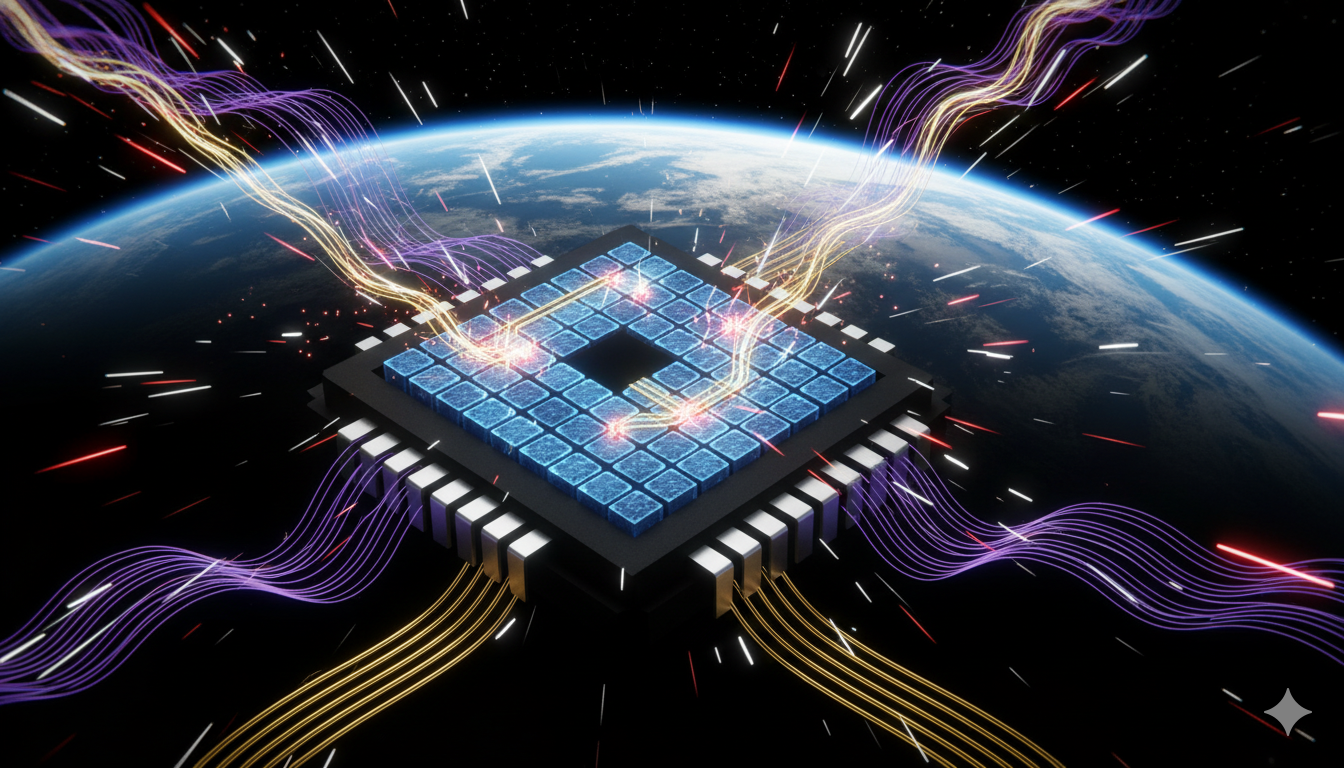
Introduction The ANGSTRM project is an ambitious initiative by U.S. Space Force researchers aimed at revolutionizing memory technology for military space and strategic systems. By combining advanced radiation hardening techniques with state-of-the-art CMOS and memory technologies, the project seeks to scale memory density far beyond what is possible with a single chip. This breakthrough is…





Related Domains & Cross-Cutting Themes
Defense & Military Systems • Critical & Emerging Technologies • Industry & Manufacturing • Autonomous & Infrastructure Systems
Explore the Space Technology, Defense & Exploration Magazine →