Neutrinos: Invisible Power, Unseen Defense
From limitless clean energy to tracking nuclear threats, neutrinos are emerging as the invisible force shaping the future of warfare and intelligence.
Neutrinos—often described as “ghost particles”—are some of the most mysterious and elusive particles in the universe. Produced in nuclear reactions within stars, supernovae, and even human-made reactors, these nearly massless, electrically neutral particles can pass through miles of solid matter without any significant interaction. Every second, trillions of neutrinos travel through the Earth, completely unnoticed.
For decades, neutrinos have been studied primarily for their role in fundamental physics and cosmology. However, recent breakthroughs suggest that neutrinos could have game-changing strategic and military applications, from limitless renewable energy to nuclear weapons detection and neutralization.
Neutrinos are among the most enigmatic particles in the universe—near-massless, chargeless, and capable of passing through entire planets without interaction. Trillions of these ghostly particles are produced every second by nuclear reactions in the sun, traveling at nearly the speed of light. Despite their abundance, neutrinos remained largely ignored for practical applications due to their elusive nature. However, recent discoveries confirming that neutrinos possess mass have opened new frontiers in scientific research, with profound implications for energy generation, physics, and space exploration.
In recent years, neutrino research has captured increasing attention, particularly in the field of clean energy. Holger Thorsten Schubart, CEO of the Neutrino Energy Group, has been at the forefront of this movement, advocating for the use of neutrinos as an alternative energy source. German media outlets, including Frankfurter Allgemeine Zeitung, Deutsche Presse-Agentur, and Der Spiegel, have highlighted groundbreaking discoveries at the IceCube Neutrino Observatory in Antarctica, where scientists have observed faint blue flashes—evidence of neutrinos interacting with our planet.
Neutrinos as an Infinite Energy Source
One of the most promising applications of neutrinos is in renewable energy generation. Since neutrinos are produced in immense quantities by the sun and cosmic rays, researchers are exploring ways to capture and convert neutrino energy into usable electricity. According to researchers, the sheer volume of neutrinos passing through Earth daily carries more energy than all remaining fossil fuel reserves combined. If successfully harnessed, technologies such as the proposed Neutrino Power Cube could revolutionize the energy landscape, offering a decentralized, unlimited, and sustainable power source without the need for conventional transmission infrastructure.
Neutrino-Based Energy Harvesting
Recent advancements in neutrinovoltaic technology, pioneered by the Neutrino Energy Group, aim to harness the kinetic energy of passing neutrinos and convert it into usable electrical power. Unlike conventional renewable energy sources such as solar and wind, which depend on environmental conditions, neutrinovoltaic systems operate continuously, 24/7, making them a potentially revolutionary energy source.
One of the most promising breakthroughs in this field is the development of graphene-based nanomaterials, engineered to absorb and convert neutrino energy into electricity. These materials leverage quantum effects to amplify the energy transfer process, paving the way for highly efficient energy harvesting. Additionally, researchers have proposed Neutrino Power Cubes, compact theoretical devices that could enable decentralized energy production, reducing dependence on traditional power grids.
If successful, neutrino-powered generators could redefine the global energy landscape. They hold the potential to eliminate reliance on fossil fuels, provide sustainable energy solutions for remote military outposts, and power deep-space missions indefinitely, where traditional energy sources are impractical. While neutrinovoltaic technology is still in its early stages, ongoing research continues to drive innovation, bringing us closer to a future where neutrinos contribute to the world’s energy needs.
China’s Underground Neutrino Observatory: Advancing Global Neutrino Research
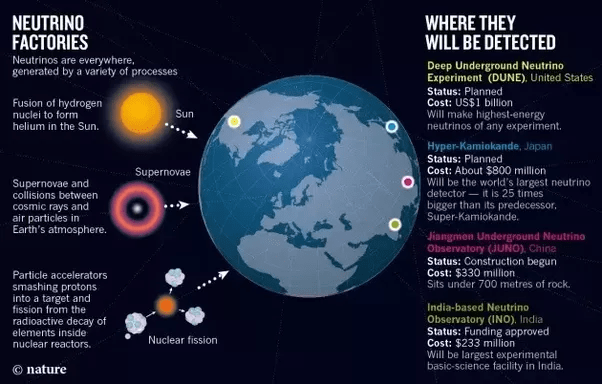
China has made a groundbreaking investment in neutrino research through the development of the Jiangmen Underground Neutrino Observatory (JUNO) in Guangdong province. Located 700 meters below ground, JUNO is strategically positioned to reduce interference from cosmic rays, thereby enabling high-precision measurements of neutrino oscillations—a critical process that reveals how neutrinos change their properties as they travel. These measurements are vital for advancing our understanding of the fundamental structure of matter and the evolution of the universe.
This observatory is a major international collaboration, bringing together more than 600 scientists from 17 countries. A primary goal of JUNO is to determine the neutrino mass hierarchy, a key mystery in particle physics that could unlock new insights into the early universe. However, the observatory’s scope extends far beyond this objective. By studying neutrinos from solar, atmospheric, and supernova sources, JUNO aims to unravel the processes behind stellar evolution and cosmic phenomena. Simultaneously, it contributes to research into dark matter, potentially helping to identify unknown components of the universe that have eluded detection through traditional means.
JUNO’s contributions are not limited to theoretical physics; they also hold immense potential in applied science. The observatory will play a role in developing technologies for neutrino-based energy harvesting, which could lead to novel forms of clean energy. Additionally, JUNO’s capabilities may enhance monitoring of nuclear reactors, providing new tools for energy management and security compliance.
Beyond scientific discovery, JUNO could have strategic and military applications. By improving the precision of nuclear monitoring systems and laying the groundwork for neutrino-based secure communication, the data and technologies emerging from JUNO may one day contribute to global security. With its state-of-the-art infrastructure and ambitious scientific agenda, JUNO is positioning itself as a world-leading center for neutrino research—impacting fields ranging from astrophysics and energy to defense and geopolitics.
Neutrinos in Military Communication and Intelligence
Neutrinos, with their ability to pass through matter without obstruction, could revolutionize military communication and intelligence operations. Unlike conventional signals, neutrino-based transmissions would be immune to interception, jamming, or physical barriers, offering unprecedented security and reliability in defense applications.
1. Ultra-Secure Submarine Communication
2. Neutrino-Based Battlefield Reconnaissance
Challenges and Future Prospects
While neutrino technology holds remarkable potential for transforming energy generation, military communication, and nuclear security, its practical application is constrained by significant scientific and engineering obstacles. Realizing its promise will demand major breakthroughs in areas such as neutrino detection sensitivity, system miniaturization, and the generation of high-energy neutrino beams.
One of the most fundamental challenges stems from the nature of neutrinos themselves. These particles interact with matter only through the weak nuclear force, making them exceptionally difficult to detect. Current detection systems rely on massive, stationary observatories—such as IceCube in Antarctica—which span kilometers and require hundreds of deeply buried sensors in specialized environments. Scaling down these detectors while preserving their sensitivity is a daunting task, especially when considering mobile, field-deployable applications for submarines, aircraft, or satellites.
Miniaturization poses another major hurdle. For neutrino technology to be viable in tactical military scenarios, sensors must be compact, durable, and power-efficient. However, existing systems are anything but. The sheer size and infrastructure required for today’s observatories make them impractical for operational use in real-time conflict or surveillance missions. Engineers must find ways to create portable neutrino detectors that can maintain performance without the luxury of underground shielding or kilometer-wide arrays.
Equally challenging is the creation of high-energy neutrino beams, particularly for theoretical applications like weaponized fission disruption. To influence nuclear materials, such beams would need to reach energy levels far beyond what current particle accelerators can produce. Estimates suggest that a functional system would require a muon storage ring over 1,000 kilometers in diameter and consume around 50 gigawatts of power—roughly equal to the entire energy demand of a developed nation like the UK. The infrastructure, cost, and energy demands of such a system remain well beyond today’s technological and economic capabilities.
Despite these challenges, the rapid pace of advancement in related fields offers reason for optimism. Continued innovation in quantum computing, nanotechnology, and AI-driven signal processing may eventually unlock the ability to overcome these technical barriers—paving the way for a new era of neutrino-enabled defense systems.
Future Prospects and Potential Solutions
Despite the formidable technical and scientific challenges, there is growing optimism that ongoing advancements across multiple disciplines could accelerate the development of practical neutrino-based systems for military and strategic use. As breakthroughs continue in physics, computing, and materials science, technologies once considered theoretical are inching closer to feasibility.
Quantum computing offers a promising path forward by dramatically enhancing the ability to process and interpret complex neutrino signals. With the capability to manage vast datasets and model particle interactions in real time, quantum processors could unlock faster and more accurate neutrino detection—potentially making real-time monitoring achievable even in field conditions. Similarly, artificial intelligence is poised to revolutionize signal filtering and background noise reduction. Machine learning algorithms, trained on massive datasets, could reliably identify the rare and faint interactions that define neutrino behavior, significantly increasing detection precision.
Nanotechnology also holds immense potential in overcoming one of the biggest barriers: sensor size. Advances in graphene-based and metamaterial sensor design may yield compact, energy-efficient detectors that could be embedded into satellites, submarines, or mobile platforms. These innovations would pave the way for neutrino applications that are portable and operationally flexible—critical for both tactical military use and strategic monitoring.
Meanwhile, research in particle accelerator technology continues to explore methods for generating high-energy neutrino beams in smaller, more focused systems. While we are still far from achieving the massive infrastructure currently required, incremental advances could eventually enable the creation of compact, directed neutrino sources capable of non-invasively disabling nuclear assets.
Though the widespread deployment of neutrino-powered energy, communication, and defense systems remains a long-term goal, the technological foundations are steadily falling into place. If current progress continues, the 21st century could very well witness the emergence of a new class of military tools—powered not by visible force, but by the invisible power of the universe’s most elusive particle.
Conclusion: The Dawn of Neutrino Warfare and Defense
Neutrinos, once considered mere curiosities of particle physics, are now being explored for groundbreaking military and strategic applications. From powering the battlefield with limitless energy to detecting and neutralizing nuclear threats, neutrinos could revolutionize warfare, intelligence, and defense.
While many of these applications remain theoretical, ongoing research in neutrinovoltaics, neutrino communication, and neutrino-based security systems is steadily pushing the boundaries of what is possible. As global powers invest in neutrino technology, the world may soon witness a paradigm shift in military strategy, redefining how conflicts are fought—and prevented—in the 21st century.
References and Resources also include:
http://www.hydrogenfuelnews.com/neutrino-energy-teslas-legacy-einsteins-theory-and-the-potential-of-neutrinos-to-deliver-endless-clean-energy/8537544/
https://www.newscientist.com/article/dn3734-neutrino-beam-could-neutralise-nuclear-bombs/