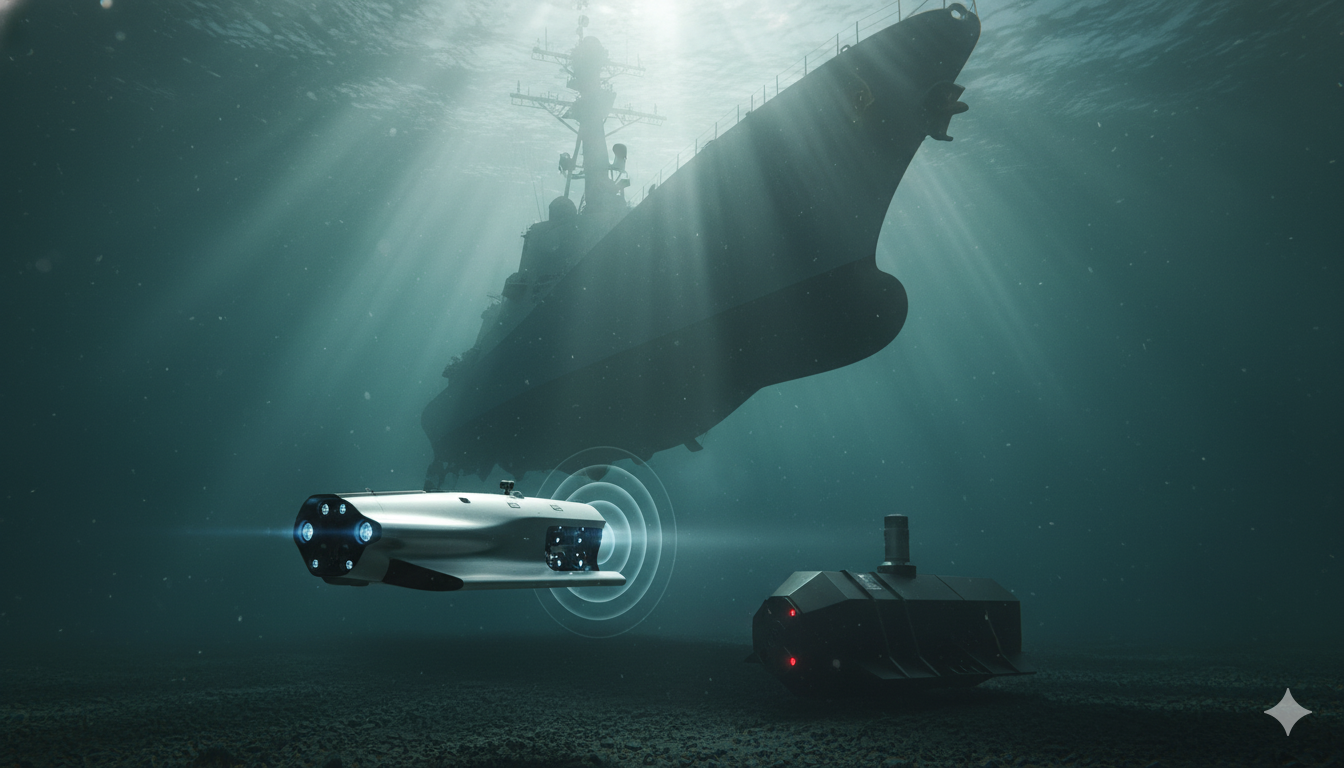

Beneath the waves lurks one of the oldest and most potent asymmetric threats in naval warfare: the sea mine. But the mines of today are not the simple contact explosives of World War II. They have evolved into stealthy, smart, and devastatingly lethal systems that can lie in wait for years, listening for the precise acoustic, magnetic, and pressure signature of a high-value target. This evolution is driving a parallel revolution—a desperate global race to develop autonomous robots and unmanned systems that can find and neutralize these hidden dangers without risking human lives.
The Scale of the Threat: A Hidden Ocean of Explosives
The Old Ways Won’t Work: Why Mine Hunting Had to Change
For decades, naval forces relied on traditional mine countermeasures (MCM). Specialized ships called minehunters used hull-mounted sonars to detect suspicious objects, while minesweepers towed acoustic or magnetic devices designed to mimic ship signatures and trigger mines. These methods were painstakingly slow, exposed sailors to extreme danger, and risked losing multi-million-dollar vessels to hidden explosives.
The new imperative, as Capt. Danielle George of the U.S. Navy’s unmanned and small combatants office explained, is to improve speed, accuracy, and cost-effectiveness while keeping human operators out of the minefield. This shift has ushered in an era where robotics, artificial intelligence, and distributed unmanned systems are at the heart of naval mine warfare.
Three core goals define the future of counter-mine warfare technology: increasing the speed at which mines can be cleared, enhancing the accuracy of detection systems, and driving down the cost of operations. Meeting all three simultaneously is critical, as navies seek to neutralize minefields quickly in contested waters, minimize false positives that slow missions, and deploy solutions at scale without unsustainable expense.
Mine Countermeasures
Mine Countermeasures (MCM) encompass both mine-hunting and minesweeping, each playing a vital role in securing sea lanes. Mine-hunting remains the safest and most effective approach, particularly against modern influence mines. Dedicated MCM vessels employ variable-depth and hull-mounted sonars to locate threats, followed by neutralization using remotely operated vehicles (ROVs) or, in some cases, deep-sea divers. Minesweeping, on the other hand, leverages influence techniques—acoustic, magnetic, and pressure signatures—to trigger mines, or mechanical methods to sever moored mine cables, allowing them to surface for controlled detonation.
The field is rapidly evolving with the integration of autonomous systems. Advances in autonomy, underwater navigation, endurance, and sensor technologies are transforming Autonomous Underwater Vehicles (AUVs) into frontline MCM assets. These platforms can be deployed in swarms, covering wider areas more quickly and reducing the risk to crewed vessels. By combining machine learning with high-resolution sonar, AUVs are improving classification and reducing false positives, a long-standing challenge in mine warfare.
The Robotic Answer: The New Triad of Mine Countermeasures
The modern approach to mine countermeasures is evolving into a triad of unmanned systems—air, surface, and underwater robots working in concert. This layered architecture is designed to exploit the unique strengths of each domain, allowing navies to detect, classify, and neutralize mines faster and with far less risk to human crews.
Unmanned Surface Vessels (USVs) have emerged as the “motherships” of this ecosystem. Platforms like Textron’s Common Unmanned Surface Vessel (CUSV) and Atlas Elektronik’s ARCIMS act as robotic workhorses, capable of towing advanced sonar systems such as the AQS-20 and AQS-24 at higher speeds than manned ships. Their ability to cover vast areas quickly makes them ideal for the initial sweep of minefields. Beyond detection, these USVs can deploy mine-neutralizing payloads and serve as communications relays, linking underwater and airborne assets into a cohesive network.
Beneath the surface, Autonomous Underwater Vehicles (AUVs) play the role of hunters. Autonomous Underwater Vehicles (AUVs) are becoming a cornerstone of modern reconnaissance and mine countermeasures (MCM). Increasingly viewed as integral components of future naval task forces, AUVs allow navies to clear wider areas while keeping personnel and high-value platforms out of the danger zone. Unlike crewed vessels, unmanned systems can operate continuously without fatigue, unaffected by harsh conditions such as darkness, heat, or extended missions. This persistent capability not only enhances force protection but also significantly accelerates clearance rates by maintaining round-the-clock operations.
AUVs like the Bluefin-9/12 and Knifefish are equipped with high-resolution sonars such as Sonardyne’s Solstice, enabling them to scan and map the seabed with precision. The real breakthrough lies in onboard processing power: with Automatic Detection and Classification (ADAC) now possible in real time, AUVs can identify mine-like objects on the spot. This advancement slashes mission timelines from days to hours, transforming mine countermeasure operations into faster, more adaptive campaigns.
US Navy
The U.S. Navy has charted a distinct course in mine warfare by integrating a comprehensive suite of air, surface, and underwater unmanned systems into the Littoral Combat Ship (LCS) mine countermeasures package. These platforms work in unison to detect, classify, and neutralize mines across different environments. Key technologies include the AN/AQS-20A towed minehunting sonar for real-time seabed mapping, the Airborne Laser Mine Detection System (ALMDS) on MH-60S helicopters for near-surface threats, and the Airborne Mine Neutralization System (AMNS) for eliminating bottom and moored mines. Complementing these is the COBRA multispectral imaging system, deployed on MQ-8 Fire Scout UAVs to scan surf and beach zones, as well as Textron’s Common Unmanned Surface Vessel (CUSV), which underpins the Unmanned Influence Sweep System (UISS) to defeat acoustic and magnetic mines.
Neutralization capabilities extend beyond detection to include SeaFox remotely operated vehicles, the expendable Barracuda system, and Navy EOD divers, ensuring redundancy and flexibility. Together, these systems provide an end-to-end mine countermeasure architecture that enables the LCS to conduct clearance missions without placing manned ships inside the minefield. This shift reflects a broader Navy goal: to leverage modular unmanned technologies that enhance speed, safety, and adaptability while reducing operational risk in contested littoral waters.
From above, airborne systems provide critical reconnaissance and strike capability. The COBRA system, deployed on MQ-8 Fire Scout drones, uses multispectral imaging to detect mines in the surf and beach zones—areas especially dangerous during amphibious assaults. Once mines are detected, the final blow often comes from expendable neutralizers such as BAE’s Archerfish or Atlas SeaFox. These remotely operated vehicles are guided to the mine, visually confirm its presence, and place charges to destroy it—all while operators remain safely miles away.
The US Navy’s Coastal Battlefield Reconnaissance and Analysis (COBRA) system is a pivotal airborne mine detection payload designed to secure amphibious assault routes. Integrated onto the MQ-8 Fire Scout unmanned helicopter, the COBRA Block I system employs a sophisticated multispectral imaging sensor to detect and pinpoint surface-laid mines and obstacles in the critical surf and beach zones. Its high-resolution camera, mounted on a stabilized gimbal, uses a spinning six-color filter wheel to capture data across spectral bands invisible to the human eye, enabling it to distinguish camouflaged threats that would otherwise go unnoticed. Following a mission, the collected data is analyzed at a ground station to generate detailed threat maps, providing commanders with vital intelligence before launching an assault.
A key limitation of the initial deployment was its restriction to daytime operations. To overcome this, the Navy has pursued development of a “Night Time” capability through a Small Business Innovation Research (SBIR) initiative. The goal is to integrate a compact, low-power broadband illuminator onto the Fire Scout, enabling the COBRA sensor to function effectively in darkness. While technologies like RGB/IR lasers, LEDs, and strobes have been explored, engineering a solution that is both powerful enough for illumination and sufficiently robust for deployment remains a technical challenge. Once fully operational with 24/7 capability, COBRA will serve as an integral component of the Littoral Combat Ship’s mine countermeasures package, dramatically enhancing the safety and mobility of naval expeditionary forces.
Together, this triad of unmanned systems represents a paradigm shift in naval mine warfare. By combining the speed and reach of USVs, the precision of AUVs, and the agility of airborne platforms, navies can counter mine threats with greater safety, efficiency, and scalability than ever before.
Buried Mine Detection: The Last Frontier
One of the most persistent challenges in mine warfare is detecting buried mines, hidden under layers of sediment. Traditional sonars struggle in this environment, and until recently, only trained marine mammals such as dolphins were consistently effective at locating them. Modern development programs, however, are breaking through this barrier. The U.S. Navy’s Knifefish UUV, based on the Bluefin-21, is equipped with a specialized low-frequency broadband sonar capable of penetrating the seabed to detect small, dense objects. Operating at depths of up to 275 meters, Knifefish offers buried mine detection at a speed of 3 knots, a capability critical for future high-end conflicts. This represents a leap forward in addressing what has long been considered the “holy grail” of mine countermeasures.
Global Collaboration and Competition
The revolution in mine countermeasures is not confined to one navy—it is unfolding as a global effort shaped by both collaboration among allies and intense rivalry with adversaries. Modern mines pose a universal challenge, threatening sea lanes, naval forces, and amphibious operations, and no single nation can afford to ignore the problem. As a result, countries are pooling resources to accelerate innovation, even as strategic competitors quietly refine their own mine warfare arsenals.
In the United States, the Littoral Combat Ship (LCS) Mine Countermeasures (MCM) package anchors this effort, integrating the CUSV, the AQS-20 sonar, and airborne detection systems into a modular toolkit.
The AQS-24B and its successor, the AQS-24C, represent the cutting edge in high-speed mine-hunting sonar systems. Building on the legacy AQS-24A, the B-variant’s integration of a High-Speed Synthetic Aperture Sonar (SAS) in 2017 marked a significant leap forward, delivering unparalleled resolution for detecting, classifying, and localizing seabed mines at speeds up to 18 knots—far surpassing traditional methods. This towed system, which also incorporates a laser line scanner for optical identification, has proven its worth from both MH-53E helicopters and unmanned surface vessels (USVs), logging thousands of operational hours in critical areas like the Arabian Gulf. The newer AQS-24C continues this evolution, with enhancements focused on deeper operational depths, improved optical sensors, and refined deployment-and-retrieval systems specifically designed for integration with the Littoral Combat Ship’s (LCS) mine countermeasure (MCM) mission package.
The future of mine warfare is unmanned and networked. The AQS-24 systems are now central to the Navy’s strategy of deploying sensors from robotic platforms like Textron’s Common Unmanned Surface Vessel (CUSV). This shift removes sailors from the minefield and enables persistent, round-the-clock operations. The ultimate goal is to create a rapid “detect-to-engage” chain. Here, sonars like the AQS-24C or Raytheon’s AQS-20—which boasts synthetic aperture and forward-looking sonars—will first identify mines. Then, an autonomous neutralizer, such as the Barracuda (a compact, self-propelled ordnance), will be dispatched to destroy the target, a process estimated to be ten times faster than legacy systems. This integrated, unmanned approach is not only revolutionizing the U.S. Navy’s MCM capabilities but is also generating significant interest from allied nations in Europe and the Indo-Pacific seeking to counter the growing global mine threat.
Barracuda’s semi-autonomous design and expendable nature directly address the growing sophistication of adversarial mines, providing a low-risk, high-precision means to hunt and neutralize threats before they can deny access to key waters. Together, these capabilities reflect a broader U.S. strategy: to combine modularity, speed, and autonomy in order to stay ahead in the robotics race beneath the waves.
Europe is pursuing a collaborative approach to future MCM operations.
European partners are advancing just as aggressively. The UK and France, through their joint Maritime Mine Counter Measures (MMCM) program, have created a world-leading “toolbox” of unmanned systems, from USVs and AUVs with multi-aspect sonar to ROVs controlled from portable operations centers. This flexible, scalable approach is intended not just for national defense, but also for coalition task forces—ensuring seamless operations across NATO waters.
In 2014, six nations—including Belgium, Germany, the Netherlands, Norway, Estonia, and Sweden—launched a joint research initiative to develop next-generation modular MCM systems. The result has been the MMCM program, led by France and the UK and developed by Thales and its partners. Unlike traditional single-role minehunters, MMCM emphasizes a “toolbox” approach, combining unmanned surface vehicles, autonomous underwater vehicles equipped with SAMDIS sonar, and remotely operated neutralization systems.
The concept is fully expeditionary: systems can be deployed from dedicated vessels, hybrid platforms, or even shore-based operations centers. With its open architecture and ability to integrate artificial intelligence for automatic detection and classification, MMCM is designed not just for today’s mine threat, but as a future-proofed system that can evolve as new technologies mature. France and the UK have already committed to fielding eight complete systems, making MMCM a blueprint for multinational cooperation in mine warfare.
Similarly, Australia’s Project SEA 1778 emphasizes deployability over dedicated platforms, with containerized, fly-in systems designed for rapid integration aboard allied vessels, an innovation tailored to the Indo-Pacific’s vast maritime domain.
Meanwhile, NATO and the European Defence Agency are investing in multinational projects to enhance interoperability and accelerate shared development. These efforts are meant to counter a simple reality: adversaries like Russia, China, and Iran continue to invest heavily in advanced mine warfare. Russia retains one of the world’s largest stockpiles of naval mines, while China views mines as central to its Anti-Access/Area Denial (A2/AD) strategy in the South China Sea. Even North Korea and Iran rely on mines as cost-effective tools to offset superior naval power.
This dual dynamic—collaboration among allies and rivalry with adversaries—defines the future of mine warfare. On one side, Western navies are building interoperable robotic fleets, anchored by systems like Barracuda, to safeguard sea lanes and ensure freedom of navigation. On the other, strategic competitors are counting on the enduring lethality of mines to complicate and delay allied operations. The contest is no longer just about who can build the biggest fleets, but about who can outpace the other in fielding smarter, faster, and more autonomous countermeasures.
European Collaboration: Forging a Unified, Unmanned Mine Warfare Front
The European Defence Agency (EDA) is spearheading a collaborative effort to revolutionize mine countermeasures (MCM) across the continent, moving decisively away from traditional, crewed vessels towards integrated networks of unmanned systems. This shift addresses a critical asymmetric threat: the staggering cost and time disparity where mine clearance is estimated to be ten times slower and more expensive than mine laying. European projects are focused on developing interoperable, autonomous “toolboxes” that can be deployed from a variety of host ships, ensuring navies can clear sea lanes rapidly while keeping personnel safely out of the minefield.
A flagship example of this next-generation capability is the ATLAS Remote Combined Influence Minesweeping System (ARCIMS) by Atlas Elektronik UK. This system centers on a versatile Unmanned Surface Vessel (USV) that can be configured for multiple roles. It can tow a minesweeping payload to emulate ship signatures and detonate influence mines, or it can be equipped with mine-hunting sonars and remotely operated vehicles (ROVs) for detection and neutralization missions. Its modular, proven design offers a flexible and cost-effective solution to counter a wide spectrum of mine threats.
The most ambitious testament to European cooperation is the Franco-British Maritime Mine Countermeasures (MMCM) program. This joint initiative has produced a fully integrated, stand-off MCM system where all components are unmanned. The suite includes an Unmanned Surface Vehicle (USV) as a command and deployment hub, Autonomous Underwater Vehicles (AUVs) equipped with advanced synthetic aperture sonar for hunting, and a Remotely Operated Vehicle (ROV) for final identification and neutralization. Operated from a portable command center on land or aboard a ship, the entire system is linked by a resilient mix of satellite, radio, and acoustic communications, enabling real-time data sharing with expert analysis centers far from the danger area. This program sets a new standard for future MCM, proving that a distributed, robotic fleet is not just a concept but an operational reality.
Royal Navy Deploys Autonomous Fleet to Counter Modern Mine Threats
The British Royal Navy is pioneering a new era of mine warfare with the introduction of its first fully autonomous minesweeping system, designed to neutralize sophisticated digital mines that render traditional methods obsolete. Developed by Atlas Elektronik UK under a £16 million contract, the system represents a fundamental shift from crewed, dedicated vessels to flexible, unmanned platforms that can be rapidly deployed anywhere in the world.
The system centers on the 11-meter Hussar, an unmanned mothership that commands and coordinates a fleet of smaller Coil Auxiliary Boats (CABs). These CABs are engineered to replicate the unique magnetic, acoustic, and pressure signatures of full-sized warships, tricking advanced digital mines into detonating harmlessly. This approach allows for the safe clearance of sea lanes without ever endangering personnel. The entire system is road-transportable and can be operational within hours of arrival, providing the Royal Navy with an expeditionary capability to protect critical shipping routes, harbors, and amphibious assault pathways.
This initiative is a cornerstone of the Royal Navy’s broader Mine Countermeasures and Hydrographic Capability (MHC) programme, which aims to replace legacy platforms with a suite of integrated unmanned systems. By removing sailors from the minefield and leveraging autonomy, the Navy not restores a critical sweeping capability but also sets the foundation for a future fleet where heterogeneous robotic systems—air, surface, and underwater—work together seamlessly to ensure maritime access in contested environments.
Project SEA 1778: The Royal Australian Navy’s Leap into Modern Mine Warfare
Project SEA 1778 marks a fundamental shift in the Royal Australian Navy’s (RAN) approach to mine countermeasures (MCM), moving from dedicated, vulnerable vessels to a flexible, containerized, and unmanned system. This initiative is phasing out the legacy Huon-class minehunters in favor of a deployable “toolbox” of technologies that can be rapidly integrated onto various host ships, including the Canberra-class Landing Helicopter Docks (LHDs), Arafura-class Offshore Patrol Vessels (OPVs), and future Hunter-class frigates. The core objective is to provide organic MCM capability that can keep pace with a deploying task group, clearing a path to the beach for amphibious assaults while keeping sailors at a safe distance from the minefield.
The system’s effectiveness hinges on a integrated suite of manned and unmanned platforms. The cornerstone is a family of Bluefin Robotics UUVs (9-inch and 12-inch models), equipped with Sonardyne Solstice Multi-Aperture Sonar for high-resolution seabed imaging and automatic target recognition software from SeeByte. These autonomous vehicles can conduct prolonged missions to hunt and classify mines. For sweeping known influence mines, the system employs unmanned surface vessels (USVs) towing the Thales Australian Minesweeping System (AMAS), a proven magnetic and acoustic sweep. Once a threat is identified, the RAN can choose the best neutralization method: the expendable Atlas Elektronik SeaFox one-shot mine destroyer for rapid engagement, or the Rotinor Black Shadow diver delivery vehicle for more delicate, diver-placed charges, all initiated by a secure Command Initiated Detonation System (CIDS).
By adopting this modular, unmanned approach under Thales Australia’s leadership, the RAN achieves three critical goals: enhanced strategic mobility, as the entire capability can be containerized and airlifted to any task group; superior force protection, by removing personnel from the mine danger area; and increased operational tempo, as unmanned systems can work continuously in shifts to clear lanes faster than traditional methods. Project SEA 1778 transforms MCM from a slow, specialized task into a agile, integrated function of a modern fleet.
Thales Pathmaster: Next-Generation Unmanned Mine Countermeasures
Thales has unveiled Pathmaster, one of the most advanced unmanned mine countermeasure (MCM) systems currently in development. Designed for deployment from shore, dedicated mine countermeasure vessels, or virtually any naval platform, Pathmaster embodies the shift towards modular and expeditionary capabilities. At its core is the SAMDIS high-resolution synthetic aperture sonar, which provides multi-aspect imaging from three different angles, significantly improving classification accuracy against mine-like objects. This technology, successfully evaluated by France’s defence procurement agency, also underpins the joint French–UK Maritime Mine Countermeasures (MMCM) program, where it enables operators to detect and classify mines with unprecedented clarity.
By pairing advanced sonar with unmanned surface and underwater vehicles, Pathmaster eliminates the need for crewed ships to enter contested waters. Its modularity also allows it to integrate seamlessly into broader MCM toolboxes, giving navies a flexible, scalable option to counter the evolving mine threat.
BAE Systems’ Archerfish: The Precision Killer for Underwater Mines
BAE Systems’ Archerfish represents a critical leap in mine neutralization, transitioning from area sweeping to precision engagement. This remotely operated underwater vehicle (ROV) functions as a single-shot, expendable neutralizer, designed to be deployed from surface ships, helicopters, or unmanned underwater vehicles (UUVs). Its core mission is to provide a standoff capability, allowing operators to identify and destroy mines from a safe distance without placing divers or valuable platforms at risk. Once launched from its cradle, a fiber-optic tether provides real-time data and control, guiding the Archerfish to its target with pinpoint accuracy.
The system’s effectiveness lies in its multi-sensor approach and targeted lethality. It uses high-frequency sonar for initial acquisition and tracking, followed by low-light video for final positive identification of the mine. This ensures a high degree of confidence before engagement. Upon confirmation, Archerfish fires a shaped charge warhead designed to achieve a “full order detonation”—a controlled explosion powerful enough to neutralize even modern mines built with insensitive munitions (IM) that are resistant to accidental detonation. This method is not only safer but also drastically more efficient, reducing mine clearance time by a factor of four compared to traditional methods.
Selected as the Common Neutralizer for the U.S. Navy’s Airborne Mine Neutralization System (AMNS), the Archerfish is integral to the future of American mine countermeasures. It is being qualified for deployment from MH-60S helicopters operating from Littoral Combat Ships (LCS), forming the crucial “kill” component of an end-to-end detect-to-engage chain. By delivering a precise, cost-effective, and safe solution, Archerfish ensures that naval forces can rapidly clear sea lanes and assault pathways, thereby upholding fleet mobility and operational security in contested waters.
\