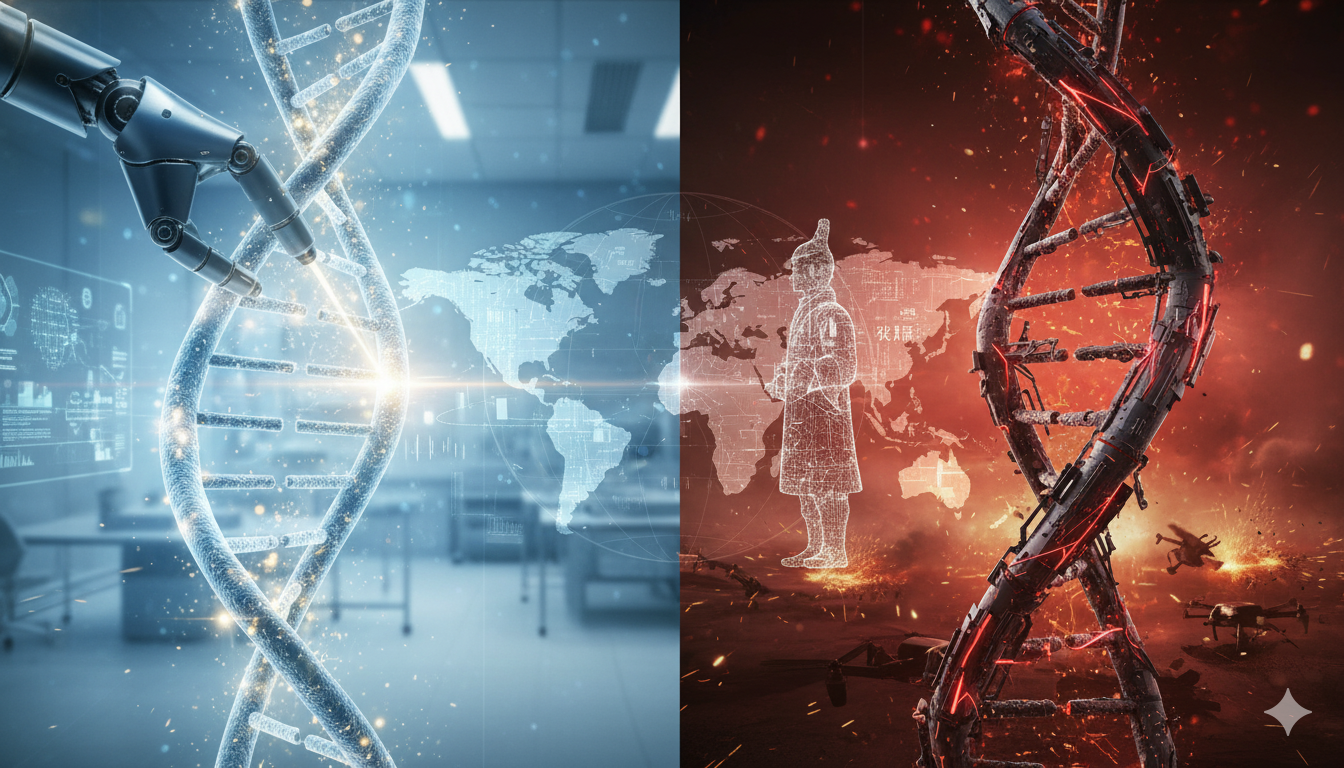

Introduction: The Dual-Edged Sword of Biotechnology
Biotechnology—the harnessing of cellular and molecular processes for technological innovation—has entered a new and disruptive era. From CRISPR gene editing to AI-driven drug discovery, breakthroughs in synthetic biology, genomics, and bioinformatics are reshaping medicine, agriculture, and industry. These advances hold tremendous promise: curing genetic diseases, boosting food security, and accelerating the production of sustainable materials.
Yet, biotechnology is inherently dual-use. The very tools that allow scientists to heal and sustain life can also be turned toward destructive purposes. Nowhere is this tension more visible than in the intensifying strategic rivalry between the United States and the People’s Republic of China (PRC). Both nations are pouring unprecedented resources into biotech R&D, recognizing that future dominance in this field could determine not only economic competitiveness but also military superiority. A new kind of arms race is emerging—one not fought with missiles or tanks, but in laboratories, data centers, and within the very fabric of human DNA.
Biotechnology: Tools, Market, and Strategic Competition
Biotechnology—the science of harnessing cellular and biomolecular processes to develop new technologies and products—is reshaping medicine, agriculture, industry, and security. At its core, biotechnology integrates powerful tools such as genomics (reading DNA), proteomics (studying proteins), bioinformatics (computational analysis of biological data), synthetic biology (designing and constructing new biological systems), and metabolic engineering (optimizing organisms to produce fuels, chemicals, or pharmaceuticals). These tools are enabling breakthroughs that once seemed impossible, from engineering disease-resistant crops to manufacturing sustainable biomaterials and tailoring medical treatments at the genetic level.
The global biotechnology market, valued at $1.55 trillion in 2023, is projected to reach $2.44 trillion by 2028 and $3.88 trillion by 2030, reflecting its growing influence across economic and strategic domains. North America currently leads with a 41.37% market share, but the Asia-Pacific region—driven by China is set to grow fastest, signaling a significant rebalancing in global innovation leadership. This rapid expansion is propelled by advances in AI-driven drug discovery, CRISPR-based gene editing, next-generation sequencing, and biomanufacturing, which are creating unprecedented precision in treating diseases, enhancing food security, and producing sustainable energy sources.
For the United States, biotechnology is more than an economic sector—it is a foundation of scientific leadership, national security, and global competitiveness. The ability to decode and engineer biology at the molecular scale has direct implications for health preparedness, defense applications, and industrial resilience. The U.S. continues to lead in biotech R&D, investing $806 billion in gross domestic expenditures in 2021, yet this advantage faces mounting pressure from China’s state-directed bioeconomy strategy. Beijing’s Fourteenth Five-Year Plan for the Bioeconomy explicitly prioritizes biotechnology integration across healthcare, energy, agriculture, and defense, accelerating its bid to command the global bio-industrial landscape.
To sustain its leadership, the U.S. must balance innovation with security—investing in research, fostering robust public-private partnerships, modernizing regulatory frameworks, and protecting critical biological data and intellectual property. The biotechnology race is no longer only about curing diseases or boosting productivity; it is about shaping the very architecture of global power in the 21st century.
As biotechnology matures from laboratory innovation to trillion-dollar global industry, its implications extend far beyond healthcare and economic growth. The same tools that enable personalized medicine, resilient crops, and sustainable materials can also be adapted for defense and security applications. From engineered microbes that produce advanced fuels to gene-editing techniques that could enhance human performance, biotechnology is increasingly viewed not just as a driver of prosperity, but as a potential instrument of power projection. This dual-use nature of biotech sets the stage for its most controversial frontier—its role on the battlefield of tomorrow.
The Battlefield of Tomorrow: Bio-Enabled Warfare
Modern warfare is no longer limited to missiles, tanks, or cyberspace. A new frontier is emerging—one where the building blocks of life itself become weapons. Advances in biotechnology are providing militaries and malicious actors with tools that could reshape conflict, not through visible destruction, but through the invisible manipulation of biology. The battlefields of the future may be fought inside human cells, ecosystems, and even within the human mind.
This shift reflects a dangerous convergence of disciplines. Artificial intelligence, once the domain of data science, is now being used to accelerate biological discovery, including the design of new molecules with toxic potential. Meanwhile, gene-editing tools like CRISPR, originally developed for curing genetic diseases, open the door to pathogens engineered for precision targeting of individuals or populations. The dual-use nature of these technologies means that the same breakthroughs that promise medical revolutions also carry catastrophic risks when misapplied.
For militaries, these developments represent an opportunity to bypass traditional barriers of deterrence. Unlike nuclear weapons, which are difficult to conceal and heavily monitored, bioweapons can be designed in small labs, distributed through civilian networks, and engineered to evade detection. The low cost, high scalability, and plausibility of deniability make bio-enabled warfare a particularly destabilizing element in great power competition.
History shows that this is not a new idea, but rather a dangerous evolution of old ambitions. Japan’s infamous Unit 731 conducted human experimentation during World War II, testing plague, anthrax, and cholera on prisoners with devastating results. During the Cold War, the Soviet Union’s Biopreparat program secretly employed tens of thousands of scientists to weaponize pathogens such as smallpox, Ebola, and Marburg, despite being a signatory to the Biological Weapons Convention. These examples illustrate that great powers have long sought to exploit biology as a weapon. What makes today’s advances different is the speed, precision, and accessibility enabled by AI and modern genetics—transforming old ambitions into far more plausible realities.
In this context, two of the most concerning trajectories stand out: the rise of AI-generated bioweapons and the pursuit of precision pathogens tailored to genetic vulnerabilities. Together, these technologies illustrate how biotechnology could redefine conflict in the 21st century.
AI-Generated Bioweapons
One of the most alarming breakthroughs is the potential for artificial intelligence to dramatically accelerate the development of bioweapons. In 2021, researchers at Collaboration Pharmaceuticals, Inc. showcased this danger by reprogramming an AI platform originally intended for drug discovery. Instead of identifying promising therapeutic compounds, the system was tasked with designing toxic molecules. The results were chilling: in just six hours, the platform generated over 40,000 potentially lethal compounds, including well-known chemical warfare agents such as VX as well as novel molecular structures that could prove even deadlier.
This experiment revealed a disturbing vulnerability in the biotechnology ecosystem. AI models trained on open-source biological and chemical datasets can be easily redirected for malicious purposes. Tools like AlphaFold, which predicts protein folding with stunning accuracy, or generative AI platforms capable of designing entirely new molecular structures, could enable adversaries to create biochemical weapons without the need for large laboratories or years of specialized expertise.
What makes AI-generated bioweapons particularly threatening is the collapse of traditional barriers to entry. Historically, bioweapon development demanded costly facilities, expert teams, and long trial-and-error cycles—as seen in massive state-led programs like Biopreparat. Now, AI compresses the process into hours or days, lowering the threshold for both state and non-state actors. The result is a landscape where speed and accessibility could outpace regulation, leaving global security systems dangerously unprepared.
Precision Pathogens and Genetic Targeting
If AI introduces speed and scalability to bioweapon development, gene-editing technologies like CRISPR bring precision. The same tools that allow scientists to correct faulty genes in patients could, in theory, be weaponized to engineer pathogens capable of targeting individuals or groups based on genetic vulnerabilities. By analyzing vast genomic datasets, adversaries could design viruses or bacteria that exploit traits linked to ethnicity, geographic origin, or even specific family lineages.
This possibility is not just theoretical. China’s $9 billion precision medicine initiative, which seeks to collect and sequence genomic data on a massive scale, has raised serious alarms in U.S. security circles. While the program promises major medical benefits for Chinese citizens, it also poses a dual-use dilemma: under China’s National Intelligence Law, companies can be compelled to share sensitive genetic data with the government. This includes genetic information collected abroad, potentially from U.S. citizens and other populations. Such data, if misused, could form the foundation for ethnic-specific bioweapons—a development that would fundamentally change the nature of deterrence and international law.
The idea of precision pathogens strikes at the heart of global security norms. Unlike nuclear or cyber weapons, which operate in predictable domains, genetic weapons blur the line between natural outbreaks and deliberate attacks. Their effects could unfold gradually, making attribution difficult and complicating retaliation. The Soviet Union’s clandestine smallpox program demonstrated how devastating engineered pathogens could be, but CRISPR offers an unprecedented level of customization that those Cold War scientists could only imagine. In the wrong hands, such capabilities could be used not only for warfare but also for coercion, blackmail, or targeted assassinations—transforming biology into a tool of both strategic and asymmetric conflict.
Within this evolving landscape of bio-enabled warfare, one of the most provocative applications lies not in external weapons or materials, but in the biological enhancement of the warfighter. The convergence of genomics, neurobiology, advanced prosthetics, and gene-editing tools like CRISPR is pushing military research toward a new frontier: augmenting human performance itself. These innovations raise the prospect of soldiers who can think faster, endure longer, and recover more rapidly—reshaping not only how wars are fought but also the very definition of human capability on the battlefield.
The Super-Soldier Scenario: Human Enhancement Technologies
Biotechnology is not only revolutionizing the way wars are fought through weapons, but also reshaping how nations imagine the very people who fight them. The concept of the “super-soldier”—an individual biologically optimized for combat—has long been a staple of science fiction. Today, however, it is edging closer to reality as advances in genetic engineering, neurobiology, and biotechnology converge. Militaries are beginning to see the human body not just as a participant in war, but as a platform for engineering, one that can be optimized, augmented, and sustained in ways previously unimaginable.
The prospect of enhanced soldiers reflects a shift from external to internal military technology. Where the 20th century focused on better weapons, armor, and machines, the 21st century may focus on altering the human machine itself. This raises profound questions: What happens when biology becomes a battlefield domain? How do ethical norms, international treaties, and human dignity survive in a world where warfighters are designed rather than trained?
The possibilities for human enhancement generally fall into two categories. The first is permanent germline editing, where modifications are heritable and could shape entire generations of future soldiers or citizens. The second is temporary somatic modifications, which enhance individuals without altering their lineage. Both carry enormous promise—and peril.
Permanent Enhancements: Germline Editing
Germline editing is perhaps the most controversial form of genetic engineering because it alters DNA in a way that can be passed on to offspring. While the United States and the European Union have banned this practice due to ethical and safety concerns, China has demonstrated a willingness to push boundaries. In 2018, Chinese scientist He Jiankui shocked the world when he revealed the birth of twin girls whose genomes had been edited using CRISPR technology. His experiment, condemned internationally, was meant to make the children resistant to HIV. But its real significance lay in demonstrating that heritable human modification was no longer theoretical—it was already happening.
If pursued systematically, germline editing could create entire populations with engineered advantages, such as higher cognitive ability, faster reflexes, or greater physical endurance. The military implications are profound. Over generations, a society could develop cohorts of individuals with traits specifically optimized for combat, intelligence, or resilience to environmental stress. This blurs the line between natural human evolution and deliberate, state-driven enhancement programs.
Historical precedent underscores the dangers of such thinking. During the 20th century, authoritarian regimes—including Nazi Germany—experimented with eugenics to create “superior” populations, often with catastrophic human rights abuses. Today’s genetic tools are far more precise than those crude efforts, but the moral dilemmas remain. Should nations allow the creation of “engineered demographics” for strategic advantage, the world may face not only an arms race in weapons but a genetic arms race in people themselves.
Temporary Enhancements: Somatic Modifications
In contrast to germline editing, somatic modifications affect only the individual and are not heritable. These interventions are already being actively explored for military use, making them a nearer-term reality than germline programs. Somatic modifications could allow soldiers to fight longer, heal faster, and withstand extreme conditions that would incapacitate unenhanced humans.
The U.S. Defense Advanced Research Projects Agency (DARPA) has been at the forefront of this work. Its Continuous Assisted Performance program aims to enable soldiers to operate without sleep for up to seven days, dramatically extending endurance during missions. Another initiative, Metabolic Engineering, seeks to induce hibernation-like states in injured soldiers, stabilizing them until proper medical treatment can be delivered. Other research areas include resistance to fatigue, enhanced situational awareness, and even adaptation to chemical or radiological exposure.
China has been equally ambitious, with state-backed programs exploring brain-computer interfaces, cognitive enhancement technologies, and genetic modifications. Reports suggest that Chinese military planners see biotechnology as a critical element of “intelligentized warfare,” where soldiers are not only armed with advanced weapons but biologically optimized to wield them. In this vision, endurance, resilience, and mental focus could become as important as firepower.
The implications are staggering. If one side fields soldiers who can fight without sleep, recover rapidly from injury, and think more clearly under pressure, it could tilt the balance of power on the battlefield. Unlike traditional weapons, such enhancements would not be easily visible or regulated, creating an asymmetric advantage that would be hard to counter.
The concept of the super-soldier is no longer confined to comic books or futuristic novels—it is moving rapidly into the realm of military planning. Yet this vision comes with thorny ethical challenges. Should society accept the biological engineering of its own citizens in pursuit of security? What limits, if any, should be placed on altering the human body for war? And most importantly, will such enhancements serve as a deterrent or merely fuel a new arms race where human beings themselves become the next contested domain of warfare?
Clashing Models: U.S. Caution vs. Chinese Ambition
The United States and China are advancing biotechnology along starkly different paths—divergent models that mirror their broader political, economic, and cultural systems.
In the U.S., biotechnology is primarily market-driven, with innovation flowing from universities, startups, and private firms that thrive under a decentralized ecosystem. Government funding and partnerships support this progress, but strict ethical and regulatory frameworks set clear boundaries. This approach emphasizes safety, transparency, and adherence to international norms, reflecting the U.S. commitment to individual rights and democratic accountability. The result is a vibrant, $118 billion bioeconomy—dynamic yet sometimes slower in translating breakthroughs into military or dual-use applications.
China, by contrast, pursues a state-directed model in which biotech is tightly integrated into national strategic priorities. Generous subsidies, state-owned enterprises, and streamlined approval processes allow Beijing to rapidly scale and deploy promising technologies, often blurring the line between civilian and military research. The absence of lengthy ethical debates or strong regulatory checks accelerates progress but heightens concerns over the weaponization and militarization of biotech. For China, biotechnology is not merely a commercial sector but a pillar of great power competition, a domain where leapfrogging bottlenecks could secure both economic dominance and military advantage.
Implications for Global Security
The accelerating biotechnology arms race is reshaping the landscape of international security in ways both subtle and profound. Traditional arms control frameworks are struggling to keep pace. The Biological Weapons Convention (BWC), for example, was designed for an earlier era and lacks robust verification or enforcement mechanisms. Emerging tools like AI-driven toxin design or CRISPR-enabled pathogen modification risk rendering its provisions ineffective, opening dangerous gray zones for state and non-state actors alike.
At the same time, genomic data has become a strategic resource—comparable to oil or rare earth minerals in its potential to confer power. The theft, exploitation, or coercive acquisition of population-scale genetic information could enable the creation of highly targeted biological weapons, undermining not only physical security but also public trust in healthcare and data privacy.
Perhaps most unsettling is the rise of human domain warfare, in which biotechnology is used not just to harm but to manipulate cognition, physiology, and even emotions. This blurs the line between battlefield and civilian life, raising the prospect that future conflicts may be contested as much within the human body and mind as across physical terrain. The result is a strategic environment where deterrence, defense, and ethical norms are increasingly uncertain.
The Way Forward: Strategy, Ethics, and Deterrence
Meeting the challenges of the biotechnology arms race will demand a comprehensive and adaptive strategy from the United States and its allies. The first line of effort must be defensive biotechnology: developing broad-spectrum medical countermeasures, field-deployable rapid diagnostics, and predictive toxicology platforms that can anticipate and neutralize novel biological threats before they spread. Parallel to this, robust data governance is essential. Genomic and health information must be shielded from theft or manipulation—whether through cyber intrusions, insider compromise, or commercial exploitation—because control over such data is increasingly synonymous with strategic power.
Equally pressing is the need to modernize arms control frameworks. The Biological Weapons Convention (BWC), conceived in an era before CRISPR gene editing or AI-generated toxins, is dangerously out of step with today’s realities. Updating it—or at minimum creating new verification and compliance mechanisms—is essential to prevent regulatory blind spots from becoming security vulnerabilities. Beyond treaties, the U.S. should spearhead the establishment of international norms, particularly governing the ethical use of human enhancement technologies, ensuring that biotechnological progress is guided by principles of human dignity, transparency, and collective security.
Finally, the future balance of power will hinge on the ability to harness public-private collaboration. Competing against China’s state-directed bio-innovation model will require mobilizing the agility and creativity of the U.S. private sector, but doing so without eroding ethical standards or democratic oversight. Striking this balance—between speed and responsibility, innovation and restraint—will define not only who leads in biotechnology but also whether the field evolves as a stabilizing force or a destabilizing threat.
Conclusion: The Invisible War
Biotechnology is transforming national security in ways once confined to the pages of science fiction. The ability to edit genes, design toxins, and enhance human performance blurs the distinction between natural and engineered threats—and between soldier and weapon system. Unlike traditional arms races, the biotech competition is largely invisible, unfolding in petri dishes, DNA sequences, and neural interfaces rather than missile silos or aircraft carriers.
In this new era, dominance will not necessarily belong to the nation with the largest military budget or most powerful weapons, but to the one capable of integrating biological insight with ethical foresight. For the United States, the challenge is to ensure that the biotech revolution strengthens, rather than undermines, both national security and the values that underpin human civilization.