
In today’s world, where cyber threats are growing in sophistication and critical infrastructures face unprecedented vulnerabilities, secure communication has become a matter of national and global security. The advent of quantum computing further heightens this urgency, as conventional encryption methods risk being rendered obsolete, exposing sensitive information to potential breaches.
In response, China has emerged as a pioneer in developing advanced quantum communication technologies, leveraging Quantum Key Distribution (QKD) through its ambitious satellite program. At the heart of this effort is the Micius satellite, a pioneering platform that has already delivered historic demonstrations and set the stage for a future of “unhackable” communication.
China’s quantum satellites are not just experimental achievements—they represent a transformative leap in both ground and space network infrastructure. By enabling theoretically unhackable communication channels, these satellites promise to redefine cybersecurity, protect critical systems, and establish a foundation for a future quantum internet. This article delves into the milestones of China’s quantum satellite program and examines the profound implications for global communications, technological leadership, and national security.
The Looming Quantum Threat
Modern cybersecurity relies heavily on encryption algorithms designed to protect sensitive data from unauthorized access. Methods like RSA and ECC form the backbone of everything from online banking to government communications. These systems are secure because classical computers struggle to solve the complex mathematical problems they are based on. However, the rise of quantum computing threatens to upend this security paradigm. Quantum processors, with their ability to perform vast numbers of calculations simultaneously, could break conventional encryption in a fraction of the time, exposing sensitive information and critical infrastructures to catastrophic breaches. A quantum computer of sufficient size will be capable of executing Shor’s Algorithm, factorization of large prime numbers in hours or days compared to classical computer that would take billions of years of computing time to complete.
The stakes extend far beyond individual privacy or financial data. Critical systems such as power grids, telecommunications networks, and transportation infrastructure could all be compromised in a quantum-enabled attack. Even highly classified military communications would be vulnerable. The potential for disruption underscores an urgent need for quantum-resistant security solutions. In this context, China’s development of satellite-based Quantum Key Distribution offers a proactive approach—creating communication channels that leverage the principles of quantum mechanics to detect and prevent eavesdropping, effectively making them unhackable and future-proof against quantum threats.
China’s Quantum Vanguard: The Micius Satellite
A defining strength of quantum cryptography lies in its reliance on Heisenberg’s uncertainty principle. This principle ensures that any attempt by an eavesdropper—commonly referred to as “Eve”—to intercept and measure quantum transmissions between two parties, Alice and Bob, will inevitably disturb the quantum states being transmitted. These disturbances manifest as an unusually high error rate in the data Bob receives, signaling the presence of unauthorized interference. In this way, Quantum Key Distribution (QKD) provides a built-in alarm system against eavesdropping attempts. In essence, QKD creates a communication channel that is theoretically unhackable: the very act of observing the key would alter it, providing a built-in security alarm and guaranteeing the integrity of the encrypted information.
Fiber-optic QKD systems are already commercially available but remain limited to a few hundred kilometers due to current detector and fiber technology. While trusted relays can extend distances, they introduce security vulnerabilities, and quantum repeaters—needed for true long-distance entanglement—are still in early development. To overcome these limitations, satellite-based QKD offers the most practical solution, enabling secure communication across intercity, intercontinental, and even global scales.
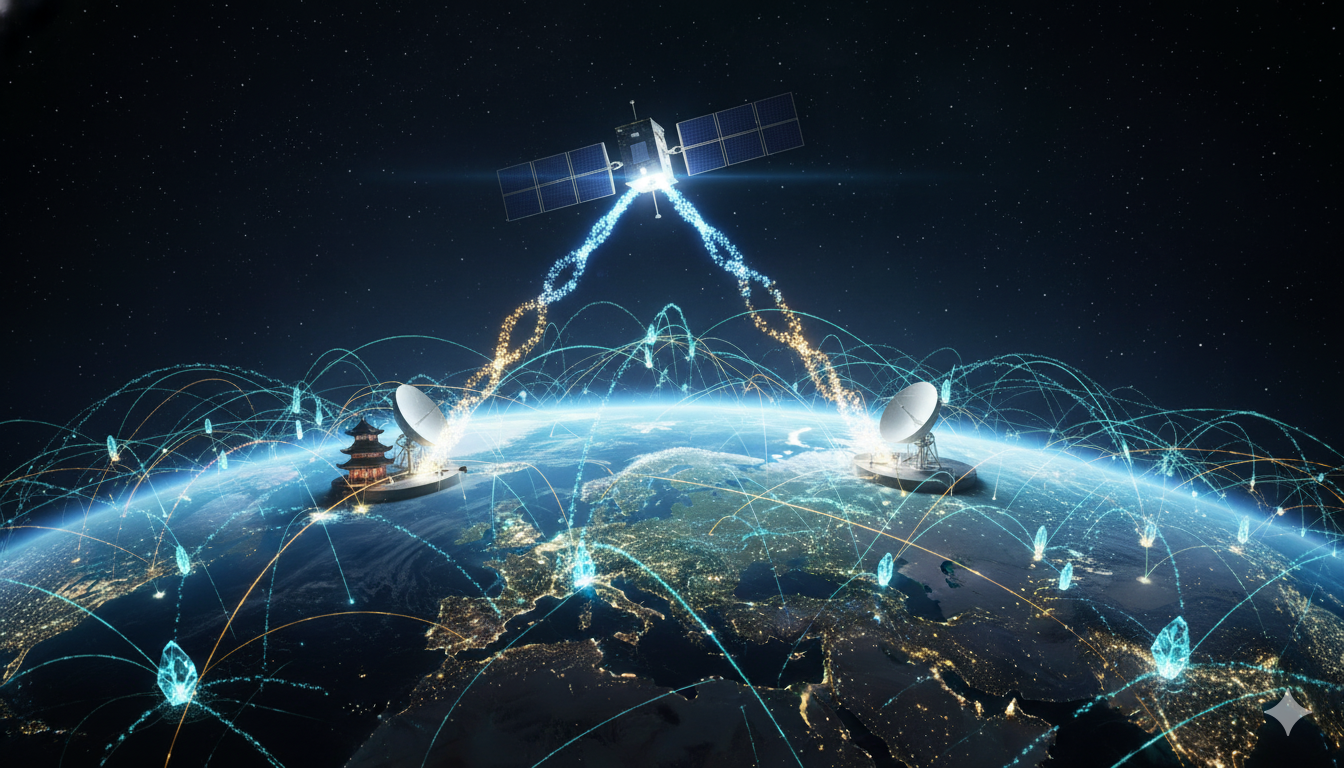
Many other countries like United States, Canada, Japan, and some EU countries are all racing to develop quantum communication networks as they are virtually un-hackable. Launched in 2016, the Micius satellite—officially called Quantum Experiments at Space Scale (QUESS)—marks the centerpiece of China’s quantum ambitions. Unlike conventional satellites that transmit classical data streams, Micius is designed to harness the laws of quantum mechanics to secure those streams through Quantum Key Distribution (QKD). The Micius satellite generates pairs of entangled photons—twinned particles whose properties remain intrinsically linked regardless of the distance between them. These photons are transmitted to separate ground stations on Earth, where the measurement of one photon instantly determines the state of its twin, allowing the stations to share a secret encryption key with complete precision. What sets QKD apart is its inherent ability to detect eavesdropping. Any attempt to intercept or measure the photons during transmission inevitably disturbs their quantum state. This disturbance is immediately detectable by the communicating parties, rendering the compromised key useless. Photons are ideal for propagating over long-distances in free-space and are thus best suited for quantum communication experiments between space and ground.
The process begins with the creation of entangled photons, particles whose states remain linked no matter how far apart they are. These photons are transmitted to separate ground stations, where the measurement of one immediately defines the state of the other, allowing the two stations to share a secret encryption key. Crucially, any attempt to intercept or measure the photons during transmission alters their state, making eavesdropping instantly detectable. This unique property of quantum mechanics makes QKD not just secure, but theoretically unhackable.
By harnessing this property, QKD elegantly solves one of the most persistent challenges in cryptography: how to securely transport encryption keys over long distances. Even if keys are transmitted through potentially compromised or hostile channels, their authenticity and integrity can be unambiguously verified upon receipt, making interception not only futile but immediately detectable.
Groundbreaking Achievements: From Theory to Reality
The Micius satellite has transformed quantum security from a theoretical possibility into a functioning reality, marking milestones that once seemed confined to the laboratory. Among its most celebrated achievements was the successful distribution of entangled photon pairs across a record-breaking 1,200 kilometers between ground stations. This breakthrough demonstrated that quantum entanglement, the very foundation of secure quantum communication, can be reliably sustained over vast distances.
Chinese scientists successfully distributed entangled photons across 1,200 kilometers—the longest entanglement ever demonstrated between Earth and space—proving that quantum links can extend far beyond the limits of terrestrial fiber networks. Micius also achieved groundbreaking demonstrations, including quantum teleportation of photon states over 1,400 kilometers and the world’s first intercontinental quantum-encrypted video call in 2017 between Beijing and Vienna, spanning 7,400 kilometers. Encryption keys generated and transmitted through quantum channels secured the communication, making the call immune to interception and proving the feasibility of a truly global quantum network. These achievements showcased the satellite’s ability to support secure, unhackable communication, laying the foundation for a future global quantum communication network.
Securing Critical Infrastructure: The Power Grid
Building on these successes, China has integrated quantum encryption into its most vital infrastructure. The technology has been deployed to secure command-and-control communications for the world’s largest power grid, ensuring resilience against cyberattacks that could one day be amplified by quantum computers.
China’s Mozi satellite has not only advanced scientific frontiers but has also demonstrated practical applications by securing the world’s largest power grid. Using entanglement-based Quantum Key Distribution (QKD), Mozi provides a secure channel between remote command centers and the power grid’s operational systems. This ensures that sensitive command-and-control data is protected from interception or cyberattacks. By extending quantum encryption to critical infrastructure, China has shown how quantum technologies can directly strengthen national resilience in the face of evolving cyber threats.
Mobility and Miniaturization: The First Mobile Quantum Ground Station
More recently, China has advanced the flexibility and reach of quantum networks by deploying mobile ground stations capable of linking with satellites on demand, even in remote areas. These mobile units extend the practical application of quantum communication beyond fixed laboratories and city networks, allowing real-world use cases in disaster response, military operations, and field communications.
A major milestone came in January 2020, when China successfully linked Mozi with the world’s first mobile quantum ground station. Weighing just over 80 kilograms, the portable station represented a dramatic leap from the original 10-ton version used at the satellite’s launch. Compact enough to be mounted on a vehicle, the new station reduced manufacturing costs while enhancing deployment flexibility. This breakthrough made it possible to bring secure quantum communications into field operations, with potential applications in both civilian emergency response and military operations. The mobile station has already been integrated into Jinan’s experimental quantum communication network, which connects to the Beijing–Shanghai backbone, reinforcing China’s leadership in creating the first large-scale, secure quantum network.
Expanding Reach: Toward Medium and High Earth Orbit
While Mozi operates in low Earth orbit, China’s ambitions extend much further. Plans are underway to launch quantum satellites into medium and high Earth orbits, allowing longer communication windows and wider coverage. China is also preparing higher-orbit quantum satellites to complement Micius, which currently operates in low Earth orbit. By moving to medium and high Earth orbits, future satellites will remain visible to ground stations for longer periods, drastically increasing the number of secure key exchanges possible per orbit. At the same time, efforts are underway to merge satellite-based QKD with China’s 2,000-kilometer terrestrial fiber-optic quantum backbone, creating a hybrid architecture that could eventually extend across continents.
This expansion would address one of the current limitations of low-orbit satellites, which can only transmit keys for a few minutes per pass. However, the move to higher orbits introduces new technical challenges, such as the need for micro-vibration suppression to ensure the stability and accuracy of quantum key transmissions. Researchers are also exploring how China’s future space station, Tiangong, could host upgraded quantum experiments, enabling continual improvements and more ambitious missions.
Together, these achievements highlight how Micius has not only validated the scientific foundations of quantum communication but also accelerated its transformation into a strategic technology with global implications.
China’s leadership in quantum communications did not end with the success of Micius. Building on that milestone, the Chinese Academy of Sciences (CAS) completed the Beijing–Shanghai Quantum Communication Backbone in 2017—a 2,000-kilometer fiber-optic network that today serves as the backbone of terrestrial quantum security in the country. The ambitions of China’s quantum program extend well beyond a single satellite. Already, a 2,000-kilometer quantum fiber-optic network links major Chinese cities, while the 2,600-kilometer space-based link established by Micius expands coverage even further. Together, they form the backbone of an emerging hybrid terrestrial–satellite quantum network.
In 2022, China launched Jinan-1, a small experimental satellite aboard a Lijian-1 rocket, which demonstrated miniaturized quantum key distribution (QKD) technologies—an important step toward more cost-effective and scalable systems.
Looking forward, China is preparing next-generation quantum satellites positioned in medium- to high-Earth orbits. Unlike low-Earth orbit spacecraft such as Micius, which pass overhead in minutes, these satellites will provide longer contact times for secure key exchanges. Equipped with a 600 mm telescope for photon transmission, they are designed to work in tandem with LEO satellites, enabling a constellation-based architecture for wide-area and eventually global quantum coverage.
Looking ahead, China plans to deploy a fleet of medium- and high-Earth orbit quantum satellites. These platforms will extend communication windows, broaden coverage, and make possible a seamless, global quantum service.
Beyond Micius: Toward a Global Quantum Internet
The ultimate vision is a worldwide quantum internet, one that would not only safeguard communications but also enable revolutionary applications such as quantum cloud computing, distributed sensing networks, and synchronized global observatories. Unlike today’s encryption, which can be broken with enough computing power, quantum encryption promises theoretical immunity from decryption. For governments, businesses, and individuals alike, such a network could provide unmatched protection for sensitive information in an increasingly hostile digital environment.
Beyond Earth: Quantum Communication with the Moon
Looking ahead, China’s ambitions stretch even further into space. Pan Jianwei and his team have proposed future experiments to test whether entanglement can be distributed between Earth and the Moon. One idea involves placing a quantum satellite at a gravitationally stable point in the Earth–Moon system, enabling secure interplanetary communications. Such an achievement would not only mark a scientific milestone but also pave the way for secure quantum links in deep-space missions and lunar colonization efforts.
China has also emphasized its willingness to pursue international cooperation, signaling openness to joint projects on building quantum constellations that could one day secure communication for the entire planet. However, CAS’s new long-term space science roadmap shifts its focus toward astrophysical frontiers such as dark matter, black holes, and exoplanet research. This suggests that follow-up efforts to the Quantum Experiments at Space Scale (QUESS) program will be pursued under separate initiatives.
While China has set the pace, other players are now entering the race. The European Space Agency is funding projects to build a continental-scale quantum communications network, including efforts led by Thales Alenia Space. Germany launched Qube, a CubeSat mission aboard a SpaceX Falcon 9 in 2022 to test QKD in orbit. Meanwhile, the United States is advancing its own efforts, with Boeing targeting 2026 for the launch of a small quantum networking satellite. Together, these developments signal that quantum-secure communication is shifting from pioneering experiments toward a competitive, multipolar domain of space technology.
Geopolitical and Military Implications
The strategic implications of China’s progress are profound. Quantum-secured communications could provide military forces with unbreakable command-and-control channels, ensuring information superiority in regional conflicts or global operations. Even as adversaries develop anti-satellite weapons or electronic jamming techniques, the encrypted links established through quantum cryptography would remain secure, preserving the integrity of vital data flows.
China’s military strategists see quantum communication not merely as a scientific breakthrough but as a decisive enabler of future warfare. “China is completely capable of making full use of quantum communications in a regional war,” noted Pan Jianwei, the country’s leading quantum scientist. He emphasized that the long-term goal is to deploy relay satellites capable of providing secure quantum communication and command coverage across the entire armed forces. Defense analysts share this view. Matthew Luce of the Defense Group Inc.’s Center for Intelligence Research and Analysis remarked that a functional satellite-based quantum communication network would allow the People’s Liberation Army (PLA) to project power far beyond its borders without fear of adversaries intercepting sensitive communications.
Modern militaries depend heavily on satellites for intelligence gathering, navigation, and wide-area communications between command centers and frontline troops. Yet, these assets are highly vulnerable to cyberattacks, jamming, and anti-satellite (ASAT) weapons. Ironically, China itself has been investing in advanced counter-space capabilities, including electronic warfare systems, directed-energy weapons, and kinetic ASAT technologies, designed to degrade adversary satellite networks. By fielding its own satellite-based quantum cryptography, however, China could achieve information superiority—ensuring the resilience of its command and control systems while denying the same advantage to rivals.
Although Beijing has not disclosed the overall budget for these programs, estimates reported in Chinese media suggest that constructing a quantum-secure communication network would cost roughly ¥100 million (about £10 million) for every 10,000 users. For the PLA, the potential payoff is immense: a hardened, unhackable backbone for military communications in an era where dominance in information systems increasingly defines victory on the battlefield.
Equally significant is China’s ability to shape the international standards and protocols for quantum communication. By being the first to operationalize such a system, it gains a decisive influence over how the next generation of secure networks is built and governed. This influence is not merely technological but geopolitical, giving China leverage in setting the rules of engagement for future cyberspace security.
Challenges and the Global Race
Despite its impressive lead, China’s quantum initiative faces formidable challenges. Maintaining the precise alignment necessary to send photons from orbit to ground-based receivers requires extraordinary accuracy. Atmospheric turbulence and cloud cover frequently disrupt transmission, making reliability a persistent hurdle. Current systems also have limited bandwidth, suitable for generating encryption keys but not for transmitting large volumes of data.
Meanwhile, other nations are accelerating their efforts. The United States is investing in both quantum computing and communication technologies through initiatives that explore space-based and ground-based systems. The European Union is building a secure continental network that integrates terrestrial and satellite quantum links. Japan has begun experimental satellite-based QKD missions, while Canada and the United Kingdom are developing research networks and working with private partners to test practical applications. Although these countries have yet to deploy a fully operational space-based quantum network, their ongoing projects demonstrate that a competitive, multi-national race is underway, emphasizing that quantum communication is poised to become a central element of global cybersecurity.
Conclusion: A Secure, Connected, and Quantum Future
China’s quantum satellite program signifies a paradigm shift in securing communication networks against cyber threats and the impending challenge of quantum computers. By harnessing the principles of quantum mechanics, China is not only addressing current cybersecurity challenges but is also future-proofing communication systems.
China’s Micius satellite represents more than a milestone in physics—it signals the dawn of a new era in cybersecurity. By demonstrating the world’s first operational space-based quantum network, China has proven that unhackable communication is not just a vision of the future but a reality in the making. The successful deployment of quantum satellites demonstrates China’s commitment to leading the quantum era, where secure and unhackable communication networks pave the way for a more resilient and interconnected world.
The challenge for other nations is stark: they must innovate, collaborate, and invest to ensure that quantum communication develops as a collective safeguard for global security, rather than remaining the exclusive strategic advantage of a single state. The quantum race is already underway, and its outcome will shape the very foundations of the 21st-century security architecture.
As cyber threats grow in scale and sophistication, China’s advances in quantum communication provide a glimpse of what the future may hold—a world where secure, unhackable networks underpin both civilian and military infrastructure. The integration of quantum communication into global systems offers not only the promise of stronger defenses against espionage and cyberattacks but also the possibility of a more resilient and interconnected international order. The choices made now, by China and its peers, will determine whether quantum technology becomes a tool for shared stability or a new axis of geopolitical competition.
References and Resources also include: