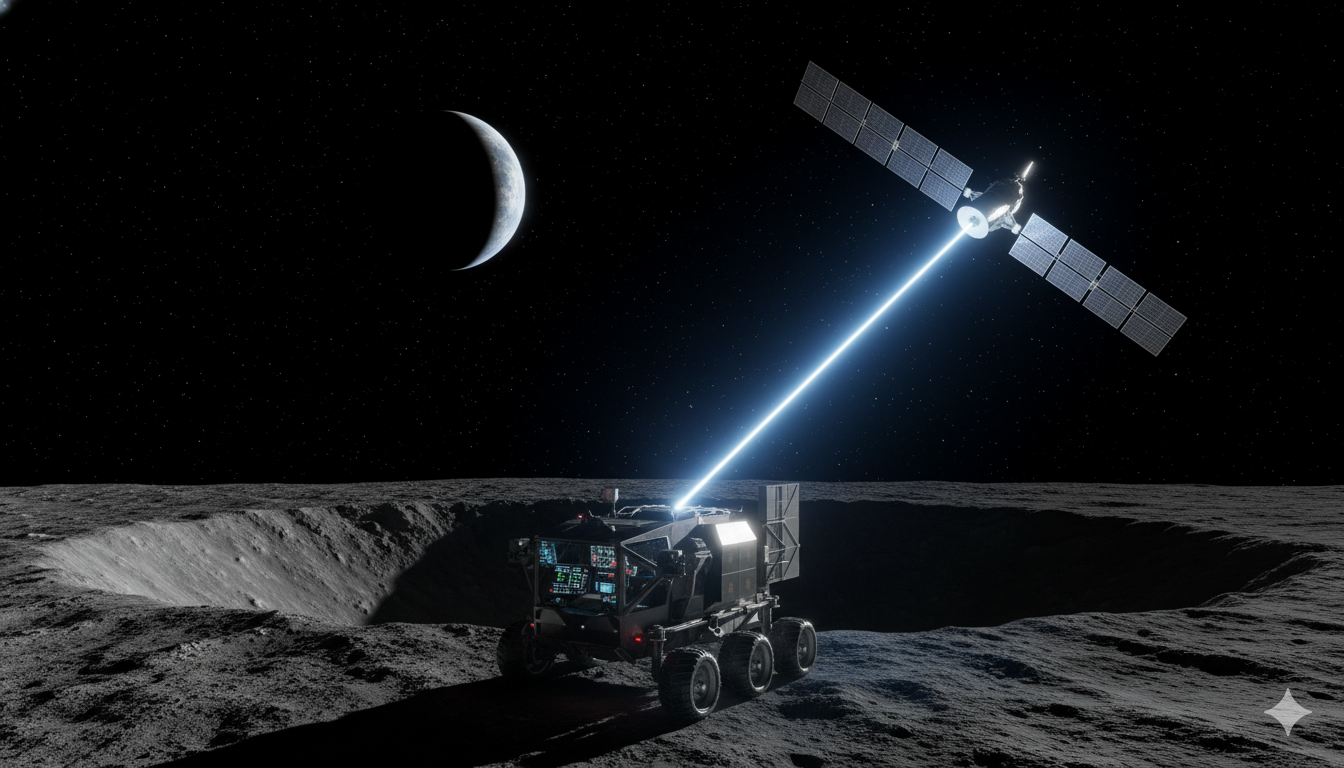

Imagine a future where a rugged lunar rover, its solar panels plunged into the deep freeze of a two-week lunar night, doesn’t power down. Instead, it receives a steady, invisible beam of energy from a satellite overhead, giving it the power to keep exploring. This isn’t science fiction—it’s the promising concept of a Lunar Power Satellite Network, a potential game-changer for humanity’s future on the Moon and beyond.
The Energy Barrier of the Lunar Night
For decades, lunar exploration has been constrained by one fundamental challenge: energy. The lunar night lasts about 14 Earth days, with temperatures plummeting to -130°C (-208°F). Solar-powered equipment cannot survive this period without massive, heavy, and unreliable battery systems. As a result, energy limitations have restricted what we can accomplish on the Moon, from continuous scientific research to establishing a permanent human presence. The solution may lie in creating an off-world power grid—beaming energy directly to where it is needed, when it is needed.
How a Lunar Power Network Could Operate
The foundation of this concept lies in wireless power transmission (WPT), potentially via tightly focused lasers or microwaves. The vision begins with a constellation of satellites orbiting the Moon, each equipped with powerful solar panels that harvest unimpeded sunlight. Unlike ground-based systems that depend on the lunar day, these satellites would enjoy continuous exposure to the Sun.
Once harvested, the solar energy would be converted into concentrated laser beams and directed with extraordinary precision toward receivers on the lunar surface. These receivers—often designed as rectennas or specialized photovoltaic cells—would then convert the laser light back into electricity. From there, rovers, habitats, and scientific instruments could operate continuously, untethered from the cycle of light and dark that has long defined lunar missions.
Why This Could Change Everything
A lunar power grid could transform the way we approach exploration and settlement. The most immediate benefit is continuous operations. Rovers would no longer have to endure long hibernations during the lunar night, scientific experiments could run without interruption, and human habitats could remain fully active regardless of the day-night cycle.
Equally important is the ability to bring power to places sunlight never reaches. The permanently shadowed craters at the lunar poles, rich in water ice and other resources, could finally become accessible through targeted energy beaming. This would unlock new opportunities for exploration and resource extraction, turning inhospitable regions into gateways of possibility.
Another advantage lies in mission design. By removing the need for oversized batteries and heavy power systems, spacecraft and landers could be launched with reduced mass, lowering costs and increasing flexibility. Over time, such a network could become the backbone of a lunar economy. With reliable, scalable energy available on demand, industries such as in-situ resource utilization, 3D-printed construction using lunar regolith, and water-to-fuel processing could all flourish. The Moon would not merely be a place to visit, but a hub of activity and innovation.
Finally, the implications extend well beyond the Moon itself. The technology perfected in a lunar power grid could one day support Mars missions or deep-space transport vessels, powering ion drives and remote outposts. In this sense, the Moon would serve not only as humanity’s first settlement beyond Earth but also as a proving ground for interplanetary exploration.
Real-World Progress Toward the Vision
This idea is no longer confined to theoretical studies. Concrete progress is underway through both international space agencies and ambitious private ventures.
The European Space Agency (ESA) has launched the Moonlight program, which aims to establish a constellation of five satellites orbiting the Moon. Four of these will provide navigation services, while a fifth will deliver high-speed communications, linking the Moon and Earth in real time. In March 2025, ESA signed a major contract with Viasat to design the communications system, which includes satellites, ground stations, and lunar terminals. Initial capabilities are planned for 2028, with full operations by 2030. At the same time, Thales Alenia Space is developing four elliptical orbit navigation satellites that will enable precise landings, autonomous rover navigation, and interconnected lunar operations. While the Moonlight system does not yet beam power, it provides the essential communications and navigation backbone for a future lunar power grid to function safely and reliably.
Meanwhile, the private sector is pushing the idea of lunar power beaming closer to reality. Volta Space Technologies, a Montreal-based startup, has unveiled its LightGrid concept—a satellite network designed to harvest solar energy in orbit and transmit it directly to the lunar surface using high-precision lasers. The system would deliver power to rovers, landers, and future lunar infrastructure through compact receivers called LightPorts, enabling continuous energy supply even during the two-week lunar night or inside permanently shadowed craters.
Volta has already demonstrated laser power transmission across distances of up to 850 meters on Earth and aims to achieve space-to-space power transfer tests by 2026. The LightGrid concept is designed to be scalable and subscription-based, allowing multiple lunar missions to share the power infrastructure. In this way, it could function much like a utility grid on Earth, dramatically lowering the cost and complexity of sustaining operations on the Moon.
Challenges Still Ahead
The road to a fully functional lunar power grid is not without obstacles. Precision targeting is one of the foremost challenges, as beams must be aimed over vast distances with both efficiency and safety in mind. Energy conversion—from sunlight to electricity, to laser transmission, and back again—must be highly efficient to ensure viability. Heat management also presents a serious hurdle, as high-powered lasers generate significant thermal loads both in orbit and at surface receivers. Beyond engineering issues, deploying and maintaining a satellite constellation around the Moon will demand substantial investment, international coordination, and logistical innovation.
A New Dawn for Lunar Infrastructure
The dream of beaming power across the lunar surface is now edging closer to reality. ESA’s Moonlight initiative is building the communications and navigation infrastructure, while Volta Space Technologies is pioneering direct laser power delivery through its LightGrid system. Together, these efforts point toward a future where the Moon is no longer a place of intermittent operations, but a fully functional hub for science, industry, and exploration.
By mastering off-world power infrastructure, humanity is not simply extending exploration but laying the foundation for settlement. A lunar power grid represents a leap toward turning the Moon into a permanent base of operations—and a vital stepping stone to the wider solar system.