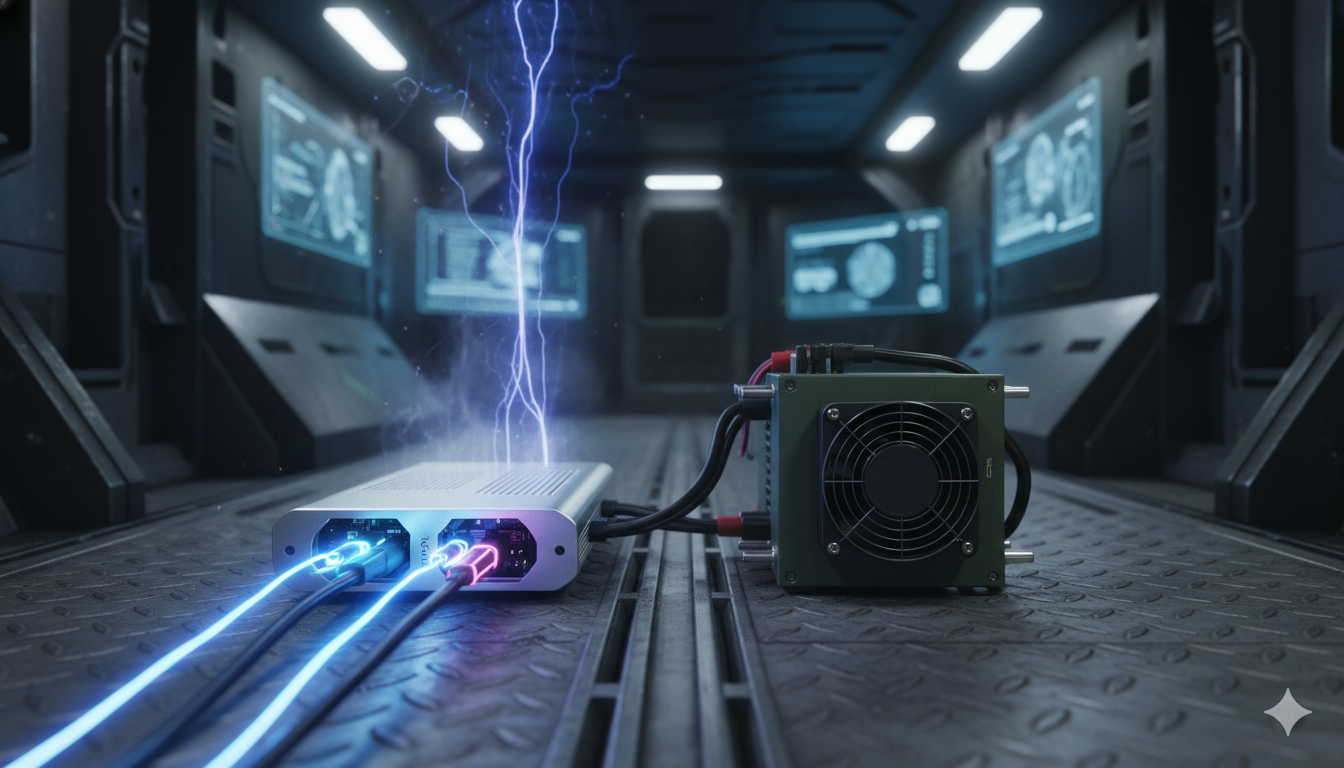

When it comes to the global shift toward electrification, most of the attention is placed on batteries and motors. These two components are often celebrated as the engines of change, driving the move toward sustainable and efficient mobility. Yet, quietly positioned between them lies an equally vital system—the traction power inverter. Acting as both the brain and nervous system of an electric drivetrain, it plays an indispensable role in ensuring that energy flows precisely where and when it is needed.
The traction inverter converts the direct current (DC) from a battery into alternating current (AC), which is essential to spin the motor and propel the vehicle. It also manages regenerative braking, flipping the process to transform AC back into DC to recharge the battery during operation. Its efficiency dictates not just how far a vehicle can go, but also how reliably it performs under demanding conditions. Now, a breakthrough inverter technology designed for the U.S. Army is reshaping what military vehicles can achieve. This innovation, known as PICHOT (pronounced pea-ko), is rewriting the rules of performance, efficiency, and resilience on the battlefield.
Power Electronics: The Hidden Enabler
Power electronics is emerging as the cornerstone of the electric and hybrid-electric revolution, acting as the vital bridge between traditional propulsion systems and advanced electrified technologies. These systems encompass a suite of devices—inverters, converters, and motor drives—all designed to ensure seamless energy transfer and distribution across batteries, fuel cells, combustion engines, and electric propulsion components. By enabling precise control over power flow, power electronics not only optimize performance but also enhance safety, reliability, and efficiency—factors that are indispensable in both automotive and aerospace applications.
At the heart of this transformation lies the adoption of Wide-Bandgap (WBG) semiconductors such as Silicon Carbide (SiC) and Gallium Nitride (GaN). Unlike conventional silicon, these materials can operate at higher voltages, frequencies, and temperatures while minimizing energy loss. This makes power electronic devices lighter, smaller, and far more efficient—attributes that are critical whether you’re building an electric car for mass adoption or an electric aircraft where every kilogram counts.
Among these technologies, inverters take center stage. They are the workhorses of electric propulsion, converting direct current (DC) from batteries or hydrogen fuel cells into finely tuned alternating current (AC) for high-performance motors. Recent advances in multi-level inverter architectures provide greater precision in voltage and current control, ensuring optimal efficiency across diverse operating conditions—from the stop-and-go cycles of urban driving to the high-power demands of takeoff and cruising flight.
Closely linked are motor drives, which convert electrical energy into mechanical power. Beyond efficiency, modern drives enable advanced functionalities such as regenerative braking (or energy recovery during descent in aviation), where energy that would otherwise be wasted is captured and stored for later use. This closed-loop approach not only boosts efficiency but also strengthens the resilience of hybrid and fully electric systems.
Of course, ensuring safety and reliability in these high-voltage, high-power systems requires next-generation protection technologies. Mechanical circuit breakers are too slow for the demands of electric vehicles, so solid-state circuit breakers—capable of halting thousands of amps in microseconds—are becoming the industry standard.
Equally critical are Battery Management Systems (BMS), which govern charging and discharging cycles to maximize efficiency and lifespan. A well-designed BMS balances performance and endurance, ensuring that vehicles—whether cars, trucks, or aircraft—operate efficiently across all phases of use, from acceleration and climb to steady cruising and braking or descent.
Finally, no discussion of power electronics is complete without addressing thermal management. Electric and hybrid systems generate significant heat, and controlling this thermal load is vital to ensure safety and long-term reliability. From automotive cooling loops to advanced aviation heat dissipation systems, effective thermal management underpins the viability of electric propulsion.
Together, these innovations in power electronics—and especially inverters—form the backbone of electrified transportation, enabling the shift from visionary concepts to roadworthy and airworthy reality.
What is PICHOT? A Leap in Power Density
At its core, PICHOT is a next-generation, silicon carbide (SiC)-based inverter built to replace the older, heavier systems that have long constrained military vehicles. Unlike conventional designs, it achieves remarkable efficiency while shrinking in size—addressing one of the most pressing challenges in vehicle electrification: space.
The results are striking. By reducing its footprint to a quarter of traditional systems, PICHOT frees up valuable room within the vehicle for armor, weapons, or mission-specific equipment. Even more impressively, it enables operational ranges that are two to three times greater than current systems, ensuring vehicles can cover far more ground without refueling or recharging. This increase in range is matched by an estimated 53% reduction in fuel consumption for hybrid-electric platforms, directly improving logistics efficiency and reducing the frequency of vulnerable resupply missions. Together, these advances highlight how a smaller, smarter inverter can create a much larger impact.
The Silicon Carbide (SiC) Advantage: Why Material Matters
The true enabler of PICHOT’s performance lies in its semiconductor material—Silicon Carbide. Traditional silicon has long been the industry standard for inverters, but its limitations have become increasingly clear as power demands rise. SiC, by contrast, offers superior efficiency by minimizing energy lost as heat during high-frequency switching. This means that more of the battery’s energy is transferred directly to propulsion, extending range and conserving power.
SiC also unlocks higher temperature operation, which reduces reliance on bulky cooling systems and simplifies thermal management—a particularly important factor for combat vehicles where heat and weight are constant challenges. Finally, the material’s ability to achieve greater power density makes it possible to shrink inverter systems dramatically without compromising on output. For the Army, this translates to lighter vehicles that can move faster, operate longer, and withstand harsher conditions.
Smarter, Cooler, and More Connected
Beyond raw performance, PICHOT demonstrates how modern power electronics can be seamlessly integrated into a vehicle’s broader systems. Thermal management, historically one of the greatest hurdles in inverter design, has been reimagined through the use of high-temperature SiC devices. This allows the inverter to handle heat with fewer supporting components, eliminating the need for large coolant reservoirs or complex cold plates, and enabling a more compact, durable system.
Equally important is the move toward wireless intelligence. Rather than relying on a web of heavy, failure-prone wiring, PICHOT employs a tailored wireless communication system to coordinate control and monitoring. This reduces system complexity, saves weight, and introduces robust cybersecurity features. Adding another layer of intelligence, the inverter includes predictive health monitoring, using advanced analytics to anticipate failures before they occur. In a battlefield environment where reliability is non-negotiable, this capability ensures that vehicles remain mission-ready at all times.
NREL’s Role: Redefining the Future of Military Power Electronics
To bring this next-generation inverter technology from concept to combat readiness, the U.S. Army has turned to the National Renewable Energy Laboratory (NREL). Known globally for its pioneering work in power electronics and thermal management, NREL has been tasked with designing and validating a silicon carbide (SiC)-based propulsion system that can radically transform military ground vehicles. Backed by a $6 million, three-year investment from the Operational Energy Capability Improvement Fund (OECIF), the project will be led by DEVCOM, with technical expertise from both NREL and the Army Research Laboratory (ARL). At its core, the mission is clear: build an inverter that doubles vehicle range, slashes fuel demand, and compresses a bulky component into a footprint four times smaller than existing systems.
NREL’s researchers are approaching this challenge by reimagining every aspect of the traction inverter. Drawing lessons from the Army’s existing 200-kilowatt Zeus inverter, the team set out to eliminate inefficiencies tied to size, weight, and cooling. Conventional inverters demand heavy thermal management equipment such as cold plates and dedicated coolant reservoirs to survive the extreme heat generated inside armored vehicles. In contrast, PICHOT’s design will link directly to the engine’s existing coolant loop, eliminating redundant systems while still enabling the inverter to operate reliably in environments as hot as 105°C—far beyond the limits of silicon-based technologies. This not only reduces weight and complexity but also enhances durability under the punishing conditions of battlefield deployment.
Beyond thermal innovation, PICHOT brings intelligence and modularity into play. NREL’s packaging expertise enables a compact, shoebox-sized design that still delivers the full 200-kilowatt output of its predecessor. By incorporating wireless communication for control and monitoring, the system reduces wiring complexity and improves data security. Even more importantly, it comes equipped with predictive health monitoring capabilities, allowing it to detect early signs of component degradation and schedule maintenance before failures occur. This predictive resilience could prove mission-critical, keeping vehicles operational in environments where reliability is non-negotiable.
The tactical advantages of PICHOT extend well beyond engineering feats. With an expected 53% reduction in fuel consumption, vehicles equipped with the new inverter will stay in the field nearly twice as long without resupply—directly reducing the logistical risks associated with fuel convoys. Combined with quieter hybrid-electric operation, improved electromagnetic shielding, and enhanced range, PICHOT positions the Army’s ground fleet at the forefront of sustainable, high-performance military mobility. As Faisal Khan, NREL’s lead investigator on the project, notes, the work represents more than just incremental progress—it is a complete reimagining of propulsion system electronics, one that could ripple across both military and civilian applications in the years ahead.
Beyond Fuel Savings: The Tactical Edge
The strategic implications of PICHOT stretch far beyond efficiency metrics. With hybrid-electric drivetrains powered by this inverter, vehicles gain the ability to move almost silently in electric mode, a dramatic advantage for stealth operations and tactical positioning. Moreover, the system’s built-in electromagnetic shielding prevents interference with sensitive onboard electronics, safeguarding communications, targeting, and navigation systems in complex operational environments.
From a sustainability standpoint, PICHOT aligns with broader defense and climate strategies by reducing fuel demand and lowering emissions. For the Army, this means not only improved battlefield performance but also greater energy resilience—key for future missions that may rely on more sustainable energy sources.
A Glimpse into the Future of Mobility
Although PICHOT was born to meet the extreme demands of combat vehicles, its influence will not stop there. The innovations behind its compact design, thermal resilience, and intelligent connectivity will eventually cascade into the civilian world. Commercial trucks, buses, and passenger electric vehicles stand to benefit from the same principles of lighter, smarter, and more efficient inverter technology.
The message is clear: the path to electrification is not solely about bigger batteries or stronger motors. It is about mastering the flow of energy through smarter power electronics. PICHOT shows that sometimes the most transformative technologies are also the least visible. By reimagining the humble inverter, engineers are not just powering vehicles—they are powering a revolution in mobility, defense, and sustainability.