Imagine downloading a feature-length movie in the blink of an eye, or participating in a real-time holographic meeting that feels indistinguishable from being physically present. These scenarios may sound futuristic, but they are exactly the kinds of experiences that next-generation wireless networks aim to deliver. The key lies in harnessing an immense, largely untapped region of the electromagnetic spectrum: the terahertz (THz) band.
For decades, engineers and scientists have struggled to exploit this part of the spectrum, often referring to it as “the terahertz gap.” The central obstacle is that THz signals are incredibly weak and difficult to detect over meaningful distances. Overcoming this challenge requires receivers with extraordinary sensitivity — and that is where superconducting technology comes in.
The Terahertz Promise and Its Challenges
The terahertz frequency range, generally considered to be from 0.1 to 10 THz, offers orders of magnitude more bandwidth than what is available to today’s wireless systems. While 4G, 5G, Wi-Fi, and satellite networks collectively use only a tiny slice of the spectrum, THz waves could unlock wireless data rates of 100 gigabits per second or beyond. This makes them ideal for supporting immersive applications such as virtual reality, remote robotics, and cloud-based AI services.
Yet this promise comes with serious technical hurdles. Terahertz signals are fragile, absorbed easily by water vapor and attenuated rapidly as they propagate. Even over short distances, a THz signal may weaken by billions of times. Conventional semiconductor receivers, like those used in smartphones, cannot distinguish these faint signals from their own background noise. This is why superconducting receivers are emerging as the most promising solution.
Superconductors: Hearing the Whisper
Superconductors are special materials that, when cooled to cryogenic temperatures, exhibit zero electrical resistance. This remarkable property eliminates one of the primary sources of electronic noise, allowing them to detect extremely weak electromagnetic signals. In the context of THz communication, superconductors act like a hyper-sensitive ear, able to “hear” the faintest whisper of data where conventional electronics would fail.
Two superconducting technologies are at the forefront of this revolution.
The first is the Hot-Electron Bolometer (HEB), a microscopic device typically made from materials such as Niobium Nitride (NbN). When a THz photon strikes the device, it slightly heats the electrons, changing the electrical resistance in a measurable way. This change happens incredibly quickly — in less than a nanosecond — making HEBs ideally suited for ultra-high-speed wireless data transmission.
The second is the Superconducting Nanowire Single-Photon Detector (SNSPD). These devices push sensitivity to its extreme, detecting individual photons of THz radiation. A THz photon striking the ultra-thin superconducting nanowire causes a tiny, localized hotspot, pushing that part of the wire out of its superconducting state and creating a measurable electrical pulse. While traditionally used in quantum optics, their extreme sensitivity is now being explored for ultra-long-distance or extremely low-power THz communication links.
From Signal to Data: How the System Works
Turning superconducting THz receivers into a practical system requires a carefully orchestrated blend of physics, materials science, and advanced engineering. Each component plays a critical role in preserving signal integrity as fragile terahertz waves are transformed into usable data.
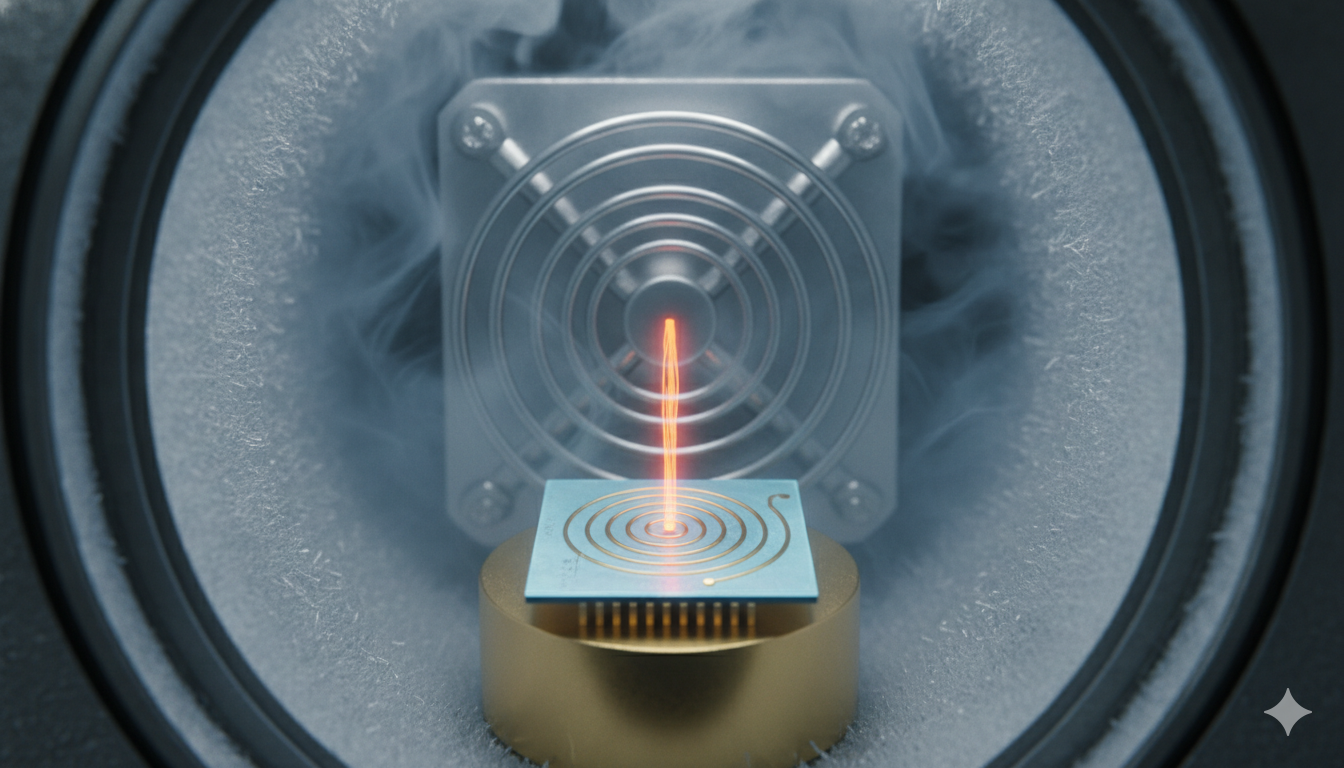
At the heart of the system is the cryostat, a compact closed-cycle cryocooler that keeps the superconducting chip at a temperature just a few degrees above absolute zero. This extreme cooling is necessary to unlock the unique quantum properties of superconductors. While once bulky and power-hungry, advances in cryocooler technology are making them smaller, more energy-efficient, and increasingly suitable for real-world deployments.
Equally essential is the antenna, which acts as the receiver’s gateway to the terahertz spectrum. Miniature on-chip designs, such as spiral or log-periodic antennas, are seamlessly integrated with the superconducting detector. These antennas capture the incoming THz radiation with high efficiency and direct the energy precisely into the detector’s ultra-small active region, ensuring minimal loss and maximum sensitivity.
Once captured, the signal passes through a chain of low-noise amplification and processing circuits. To preserve fidelity, these electronics often operate within the same cryogenic environment, shielding the fragile analog signal from thermal noise. Finally, the conditioned signal is converted into a digital data stream, ready for downstream processing. The result is a system that can detect and translate the faintest THz waves into actionable information, bridging the gap between exotic superconducting physics and practical high-speed communications.
China Achieves Breakthrough in Long-Distance Terahertz Communication
Faster long-distance data transmission has taken a significant step forward with the successful demonstration of high-definition video transmission over more than a kilometer using terahertz wireless communication technology. The achievement marks the first time that superconducting receiver technology has been applied to long-distance terahertz communication, pushing the boundaries of what was once thought possible. Terahertz radiation, which sits between microwave and infrared frequencies, has long been recognized for its potential in medical imaging, security screening, and spectroscopy, but its ability to handle massive data loads makes it especially promising for the future of wireless communications.
Terahertz communication is being widely explored as a key enabler for 6G and beyond because of its extraordinary data-carrying capacity. Compared to microwave systems, which are akin to narrow two-lane roads, terahertz communication offers a vastly wider spectrum—like expanding the road to six or more lanes—allowing faster, denser, and more efficient information transfer. In the recent breakthrough, superconducting detection technology ensured ultra-high sensitivity, enabling signals to travel farther with minimal energy loss. Despite using just a fraction of the power of a typical mobile base station, the system was able to transmit high-definition video clearly across long distances, proving that terahertz links can overcome one of their greatest challenges: severe signal attenuation.
This advancement not only sets a new benchmark in terrestrial wireless communication but also lays the groundwork for future applications in space. Long-distance terahertz transmission could enable real-time, high-capacity communication between satellites and Earth, supporting next-generation space exploration and air-to-ground data networks. With decades of investment in superconducting detectors and terahertz technologies, researchers are now entering a new phase where astronomical science, advanced materials, and communications engineering converge, opening the door to an era of ultra-fast, resilient global connectivity.
Cool Applications and Future Challenges
The integration of terahertz (THz) communications with superconducting receivers has the potential to transform how we move and secure information. This powerful combination brings unmatched sensitivity and efficiency to high-frequency links, enabling revolutionary applications across data centers, space systems, and terrestrial networks.
One promising application lies within data centers, where replacing fiber-optic cables with wireless THz connections could deliver enormous flexibility. Instead of rigid cabling, server racks could be dynamically reconfigured while maintaining ultra-high-speed connectivity. This shift would not only simplify infrastructure but also enhance airflow and cooling, two critical bottlenecks in today’s hyperscale computing environments.
In space, superconducting THz terminals could redefine satellite communications. Because there is no atmospheric absorption in the vacuum of space, these links could enable ultra-secure, high-capacity intersatellite connections. A constellation of satellites linked in this way could form the backbone of a future “internet from space,” supporting global connectivity, real-time Earth observation, and resilient communication networks for both civilian and defense use.
On Earth, superconducting THz systems could power secure, short-range point-to-point links between buildings, command centers, or military platforms. These highly directional links would provide immense bandwidth while being extremely difficult to intercept, making them ideal for applications where security and performance are paramount.
Despite these prospects, challenges remain. The need for cryogenic cooling still limits widespread deployment, adding cost and complexity. Researchers are now focusing on high-temperature superconductors that can operate at more manageable temperatures, as well as next-generation cryocoolers that are compact and energy efficient. These advancements will be key to moving superconducting THz systems out of specialized labs and into real-world use cases.
Conclusion
Superconducting receivers are not merely incremental improvements on existing technology — they are enablers of a new communications paradigm. By dramatically reducing noise and amplifying sensitivity, they make it possible to finally exploit the vast, unused terahertz spectrum. While the idea of cooling electronics to near absolute zero might once have seemed like science fiction, it is increasingly becoming a practical engineering solution.
By giving us the ability to hear the faintest whispers of data, superconducting receivers are laying the foundation for the hyper-connected, high-bandwidth world of the future.