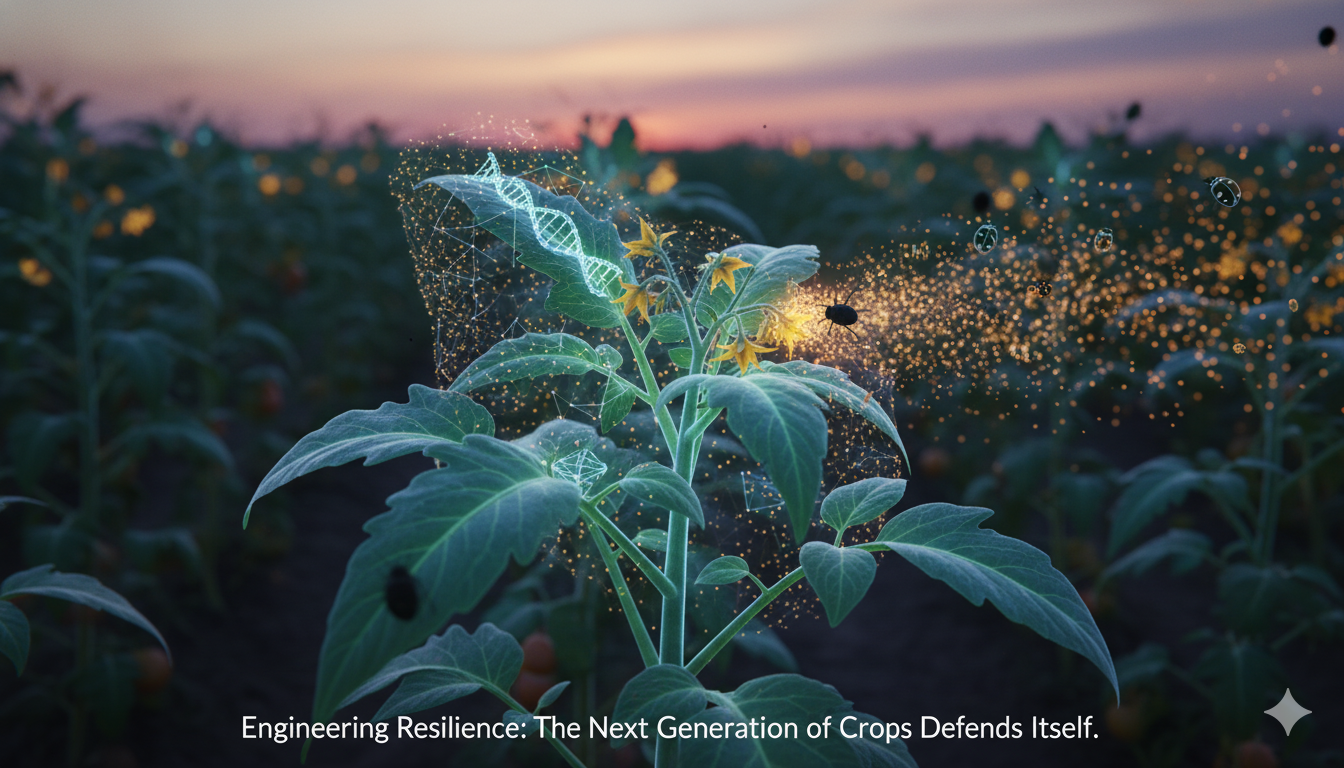
Engineering Nature’s Defenses: How CRISPR, RNAi, and Synthetic Biology Are Revolutionizing Sustainable Agriculture

The Global Food Security Challenge

As the global population races toward 10 billion by 2050, agriculture is under unprecedented strain. Farmers are tasked with boosting yields while simultaneously cutting back on practices that degrade the environment. Among the most formidable threats are pests and pathogens, which destroy up to 40% of global crop production each year. For decades, chemical pesticides have been the dominant line of defense. Yet their widespread use has created new problems: the rise of pesticide-resistant insects, contamination of soil and waterways, loss of biodiversity, and even risks to human health.

To meet these challenges, science is now looking inward—into the very blueprints of plant life itself. Emerging technologies in CRISPR genome editing, RNA interference, and synthetic biology are empowering plants with enhanced versions of their natural defense systems. Instead of relying solely on external chemical sprays, the next generation of crops is being engineered to protect itself from within, marking a pivotal shift toward precision agriculture.

The Science of Plant Self-Defense

Plants may appear passive, but they are anything but defenseless. Over millions of years, they have evolved sophisticated chemical and signaling systems to deter attackers, fight off infections, and even recruit allies such as pollinators or predatory insects. These survival strategies hinge on secondary metabolites—specialized compounds that, while not essential for growth, serve as powerful tools for protection.

Among these defenses, the shikimate pathway produces aromatic amino acids and compounds like salicylic acid, a key regulator of immune responses. The mevalonic acid (MVA) pathway generates terpenoids, a vast and versatile class of molecules that can repel herbivores or attract the natural enemies of pests. Equally important, the lipoxygenase (LOX) pathway leads to jasmonic acid and green leaf volatiles—molecules that act as chemical distress calls, triggering defense responses not only within the attacked plant but sometimes in neighboring ones as well.

These pathways together form a biochemical arsenal that allows plants to adapt quickly to threats in their environment. However, the demands of modern agriculture—characterized by monocultures, crowded fields, and intense pest pressures—often overwhelm natural defenses. Pathogens and insects evolve faster than plants can respond, leaving crops vulnerable and forcing farmers to rely heavily on pesticides and chemical treatments.

This imbalance has spurred a new wave of biotechnological solutions designed to strengthen plant resilience. By enhancing or reprogramming existing defense pathways, researchers can create crops that mount faster, stronger, and more targeted responses to stress. From engineering plants that emit pest-repelling volatiles to designing crops with amplified immune signals, science is now unlocking the potential of plant self-defense in ways that could transform sustainable agriculture.

Cutting-Edge Tools for Enhanced Defense

As agriculture confronts mounting threats from pests, diseases, and climate stress, traditional plant defenses alone are no longer sufficient. Advances in biotechnology are equipping researchers with powerful tools to strengthen and reengineer these natural systems. From gene editing to synthetic biology, these innovations are unlocking new possibilities for crops to resist attacks, adapt to stress, and thrive in challenging environments.

1. Genome Editing with CRISPR-Cas9

CRISPR-Cas9 has revolutionized plant science by enabling precise, targeted modifications in DNA, often without introducing foreign genes. This makes it both a subtle and widely acceptable approach in regulatory and public contexts compared to conventional genetic modification. By fine-tuning a plant’s own genetic circuitry, researchers can enhance natural defenses—for instance, boosting the expression of genes that produce volatile organic compounds (VOCs) to repel pests, or silencing susceptibility genes that pathogens exploit to invade tissues. Emerging tools like CRISPR base and prime editors are taking this further, allowing the engineering of entirely new metabolic traits that give plants defensive abilities beyond what evolution provided.

A powerful demonstration of this potential is seen in rice engineered to resist bacterial blight, one of the world’s most destructive crop diseases. Scientists achieved this by disabling a key susceptibility gene required by the pathogen to establish infection. The result is a variety that stays healthy without heavy dependence on pesticides, ensuring stable yields even in disease-prone environments. Such advances not only reduce chemical inputs but also open the door to crops that can adapt faster to emerging threats, setting the stage for a new era of sustainable agriculture.

2. RNA Interference (RNAi)

RNA interference (RNAi) leverages a natural cellular process in which double-stranded RNA molecules silence specific genes, effectively turning off traits critical to pests or pathogens. By designing RNA molecules to target functions such as digestion, reproduction, or viral replication, scientists can selectively disrupt threats without harming beneficial organisms. This approach can be implemented in multiple ways—engineered directly into crop genomes or applied externally as topical sprays—providing flexibility for farmers and reducing reliance on chemical pesticides.

A compelling case study comes from the fight against the Colorado potato beetle, one of agriculture’s most notorious pests. By silencing genes responsible for gut enzymes essential to digestion, RNAi-treated potatoes left the beetles unable to feed and survive. The result was a dramatic reduction in crop losses without the collateral damage caused by broad-spectrum insecticides. This precision strategy not only protects yields but also supports more environmentally friendly farming practices, pointing toward a future where genetic silencing replaces chemical overuse.

3. Synthetic Biology

Synthetic biology pushes beyond enhancing natural traits by enabling scientists to design entirely new biological circuits inside plants. Instead of working only with existing pathways, researchers can engineer novel metabolic routes that allow plants to produce defense compounds they never evolved naturally. This includes the creation of built-in biosensors that detect pest attacks at an early stage, triggering rapid responses, or programming plants with induced systemic resistance (ISR)—a kind of immune “memory” that primes them for faster, stronger defense when under threat.

A striking example is the engineering of tobacco plants with synthetic pathways that produce unique terpenes, compounds not found in the plant’s natural arsenal. These terpenes act as potent repellents against whiteflies, insects that are notorious vectors of plant viruses. By effectively transforming crops into living chemical factories, this strategy delivers sustainable protection without the ecological risks of chemical sprays. Such innovations highlight how synthetic biology can reimagine agriculture, offering crops not just as food producers but as self-defending, eco-friendly systems.

Integrated Strategies for Resilient Crops

No single technology offers a silver bullet against pests and pathogens. The future of crop protection lies in layering innovations to build multi-tiered defenses. CRISPR and RNAi, for example, can complement one another—CRISPR edits can amplify the release of volatile organic compounds (VOCs) that attract pest predators, while RNAi simultaneously silences the digestive enzymes of the very insects drawn in. Synthetic biology extends this arsenal by equipping plants with entirely new metabolic routes for defense compounds, which can then be stabilized in elite cultivars through conventional breeding programs.

This integrated vision is already becoming reality. In cotton, researchers are combining RNAi constructs with CRISPR-modified lines, enabling plants to withstand bollworm infestations and viral infections at the same time. Similarly, tomato plants engineered with synthetic pathways for terpenoid production are paired with RNAi sprays during peak pest seasons. Together, these strategies transform crops into adaptable, self-reinforcing defense systems—resilient enough to thrive under escalating pest pressures while reducing dependence on chemical pesticides.

Environmental and Ecological Benefits

Shifting from broad-spectrum chemicals to targeted biological defenses could transform agroecosystems. Unlike conventional pesticides, genome editing and RNAi operate with remarkable precision, reducing unintended harm to pollinators, soil microbes, and beneficial insects essential for ecological balance. This precision also means fewer chemical residues in waterways, leading to healthier aquatic ecosystems.

Engineered crops that release selective volatile organic compounds (VOCs) add another dimension, attracting natural allies such as ladybugs and parasitic wasps. Rather than disrupting ecosystems, these plants reinforce them—strengthening natural pest-control networks. Modeling studies predict that adopting such strategies could slash pesticide use by nearly 50% in crops like maize and wheat, while sustaining or even boosting yields.

Navigating Regulation and Public Perception

Despite the promise, adoption is shaped as much by regulation and perception as by science. Countries vary widely in their stance: the United States and Japan exempt certain CRISPR-edited plants from GMO rules when no foreign DNA is introduced, while the European Union maintains stricter GMO-style oversight that slows commercialization. These differences create uneven pathways for innovation and deployment.

A case in point is CRISPR-edited soybeans developed in the U.S. with enhanced oil profiles. They were fast-tracked to market under relaxed USDA guidelines and entered commercial supply chains within just a few years. By contrast, gene-edited crops in Europe—such as mildew-resistant wheat—remain confined to small-scale field trials due to regulatory hurdles, despite their potential to reduce pesticide use.

Equally important is public trust. Acceptance will hinge on transparent communication about benefits, risks, and long-term impacts. Beyond consumer perception, there is a moral imperative to ensure equitable access. Smallholder farmers—especially in the Global South—must not be excluded. Affordable licensing and fair distribution models will be crucial for ensuring these technologies enhance global food security rather than exacerbate inequality.

The Future of Farming Is Precision-Built

The convergence of genomics, synthetic biology, and ecological science is reshaping agriculture into a precision-driven enterprise. Rather than depending on heavy chemical inputs, the new paradigm envisions crops designed to defend themselves—cutting costs for farmers while easing the burden on surrounding ecosystems.

This shift is already underway. CRISPR-edited tomatoes resistant to fungal infections, RNAi-sprayed potatoes that deter beetles, and synthetic-biology-enhanced maize that emits protective VOCs are early signals of what’s possible. These innovations demonstrate that the future of farming is not a distant prospect but a present reality. The seeds of tomorrow are already in the ground, pointing toward a food system that is more productive, more resilient, and more in harmony with nature’s own logic.