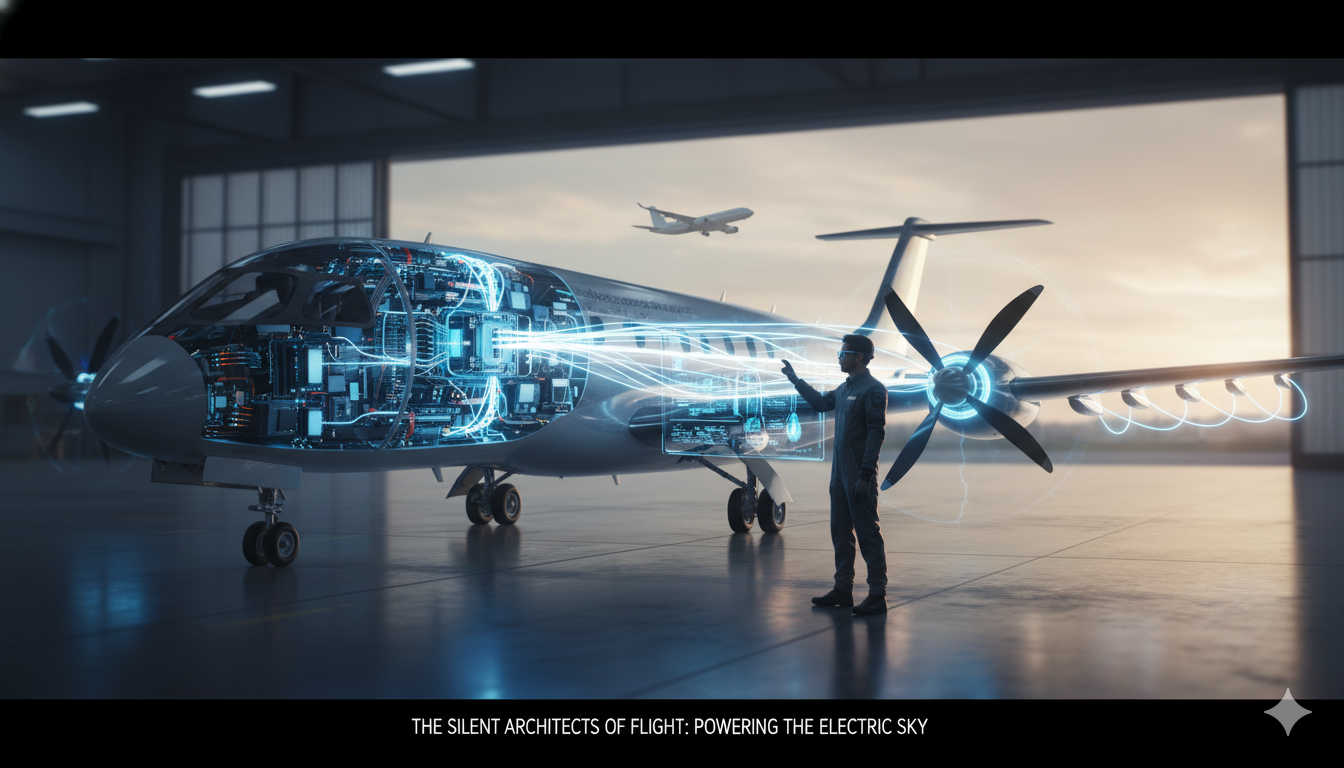
Taking Flight with Power Electronics: The Future of Hybrid-Electric Aircraft

Introduction

The aviation industry is at a crossroads. Long criticized for its environmental footprint, it now finds itself in the middle of a technological revolution aimed at achieving cleaner skies and more efficient travel. Hybrid-electric propulsion has emerged as one of the most promising solutions, blending traditional engines with electric systems to cut emissions, reduce fuel costs, and improve performance. Electric propulsion can be powered by rechargeable batteries, fuel cells, or solar energy.  Electric plane power is much simpler — batteries power an electric motor that spins a propeller. At the center of this transformation is a field often overlooked by passengers but vital to the aircraft of tomorrow: power electronics.

Power Electronics: The Hidden Enabler

Power electronics is emerging as the cornerstone of hybrid-electric aviation, acting as the vital bridge between conventional propulsion systems and advanced electric technologies. These systems encompass a suite of devices, including inverters, converters, and motor drives, all designed to ensure seamless energy transfer and distribution across the aircraft’s combustion engines and electric propulsion components. By enabling precise control over power flow, power electronics not only optimize performance but also enhance safety, reliability, and efficiency—factors that are indispensable in aviation.

At the heart of electric aviation lies a suite of power electronics technologies that are redefining what is possible in aircraft propulsion. Wide-Bandgap (WBG) semiconductors—particularly Silicon Carbide (SiC) and Gallium Nitride (GaN)—represent the cornerstone of this transformation. Unlike conventional silicon, these materials can operate at higher voltages, frequencies, and temperatures while minimizing energy loss. This means that inverters and converters can be made lighter, smaller, and more efficient, offering a decisive edge in aviation where weight and efficiency are everything.

Innovative motor drives further advance the potential of hybrid-electric aircraft by converting electrical energy into mechanical power for propulsion. Beyond efficiency gains, these drives enable advanced functionalities such as regenerative braking, where energy generated during descent or deceleration is captured and stored for later use. This closed-loop approach to energy utilization underscores the transformative role of motor drive technologies, making hybrid propulsion not only efficient but also more resilient and adaptable to varying flight conditions.

High-power inverters form the workhorses of the system, converting direct current (DC) from batteries or hydrogen fuel cells into finely tuned alternating current (AC) for high-performance motors. Recent advances in multi-level inverter architectures provide greater precision in voltage and current control, ensuring optimal efficiency across different flight conditions—from takeoff surges to cruising altitudes. Complementing these are advanced motor drives, which not only deliver seamless propulsion control but also enable regenerative energy capture during descent, feeding valuable power back into the system and extending flight efficiency.

Finally, ensuring safety and reliability in these high-voltage, high-power systems requires next-generation protection technologies. Traditional mechanical circuit breakers are too slow for the demands of electric aircraft. Instead, solid-state circuit breakers—capable of halting thousands of amps in mere microseconds—are emerging as the safeguard of choice.

Equally critical are advanced Battery Management Systems (BMS), which govern the charging and discharging cycles of onboard batteries. A well-designed BMS ensures the judicious use of stored energy, extending battery lifespan while simultaneously maximizing the contribution of electric propulsion. By balancing performance and endurance, these systems enable hybrid-electric aircraft to operate more efficiently across various phases of flight, from takeoff and climb to cruise and landing. In doing so, BMS technologies reinforce the promise of cleaner and more cost-effective aviation.

Finally, no discussion of power electronics in aviation is complete without addressing thermal management. Hybrid-electric systems generate significant heat, and managing this thermal load is essential to maintaining operational reliability and safety. Power electronic technologies are central to this process, enabling effective dissipation and regulation of heat across batteries, converters, and motor drives. In the demanding environment of aviation, where continuous operation and system safety are paramount, efficient thermal management ensures that the promise of hybrid-electric flight can be realized without compromising performance.

These innovations dramatically reduce the risk of system failure, protecting sensitive and expensive components while meeting aviation’s uncompromising safety standards. Together, these technologies form the backbone of the electric flight revolution, turning visionary concepts into airworthy reality.

Emerging Power Electronic Technologies

At the heart of electric aviation lies a suite of power electronics technologies that are redefining what is possible in aircraft propulsion. Wide-Bandgap (WBG) semiconductors—particularly Silicon Carbide (SiC) and Gallium Nitride (GaN)—represent the cornerstone of this transformation. Unlike conventional silicon, these materials can operate at higher voltages, frequencies, and temperatures while minimizing energy loss. This means that inverters and converters can be made lighter, smaller, and more efficient, offering a decisive edge in aviation where weight and efficiency are everything. Companies such as Wolfspeed and STMicroelectronics are already producing aerospace-grade SiC devices, which are being adopted by aircraft developers to push the boundaries of electric propulsion. Airbus’s EcoPulse demonstrator, developed in partnership with Daher and Safran, is a prime example—its distributed hybrid-electric propulsion relies heavily on lightweight, high-efficiency SiC-based inverters to make the system feasible.

Complementing this, multi-level inverters are providing more precise control of voltage and current supplied to electric motors, ensuring smoother operation and improved overall performance. To further optimize these systems, model-predictive control techniques are being applied, leveraging advanced algorithms to anticipate system behavior and adjust operations in real time. By combining these innovations, hybrid-electric aircraft are moving closer to achieving the efficiency, reliability, and performance necessary for widespread adoption in the aviation industry.

High-power inverters form the workhorses of the system, converting direct current (DC) from batteries or hydrogen fuel cells into finely tuned alternating current (AC) for high-performance motors. Recent advances in multi-level inverter architectures provide greater precision in voltage and current control, ensuring optimal efficiency across different flight conditions—from takeoff surges to cruising altitudes. Innovators like magniX, a leader in electric aircraft propulsion systems, are leveraging advanced inverter technologies to deliver reliable and scalable solutions for regional aviation. Complementing these are advanced motor drives, which not only deliver seamless propulsion control but also enable regenerative energy capture during descent. ZeroAvia, a pioneer in hydrogen-electric propulsion, is integrating such systems into its test platforms to improve range and energy efficiency. Boeing, through its ecoDemonstrator program and its partnership with NASA on hybrid-electric propulsion studies, has been actively exploring how these inverter and motor technologies can scale from small testbeds to larger commercial aircraft.

Finally, ensuring safety and reliability in these high-voltage, high-power systems requires next-generation protection technologies. Traditional mechanical circuit breakers are too slow for the demands of electric aircraft. Instead, solid-state circuit breakers—capable of halting thousands of amps in mere microseconds—are emerging as the safeguard of choice. RTX (formerly Raytheon Technologies) has been at the forefront of developing these ultrafast protection systems, which safeguard sensitive and expensive powertrains from catastrophic faults. Airbus is already evaluating such protection systems in EcoPulse, while Boeing and NASA are testing solid-state protection in hybrid-electric propulsion research projects. Together, these innovations form the backbone of the electric flight revolution, turning visionary concepts into airworthy reality.

Breakthroughs in Action: From Lab to Runway

What was once confined to research labs is now taking shape in tangible technologies that are beginning to redefine what is possible in aviation. Companies at the forefront of electric flight are proving that the theoretical hurdles of power density, safety, and thermal management can be overcome with carefully engineered breakthroughs.

One striking example comes from ZeroAvia, a pioneer in hydrogen-electric propulsion. The company recently tested its in-house 230 kW silicon carbide inverter, achieving a remarkable power density of over 20 kW/kg. This achievement is significant because it demonstrates how electric systems can deliver extraordinary power without the penalty of excessive weight—a critical requirement for any aircraft. These advancements form the backbone of ZeroAvia’s powertrains, which are being developed to propel aircraft carrying anywhere from nine to eighty passengers.

Meanwhile, RTX is addressing a different but equally critical challenge under NASA’s Advanced Air Vehicles Program. The company has developed a solid-state circuit breaker capable of handling five times the power of today’s systems. This innovation represents a vital leap in electrical safety and reliability, ensuring that as aircraft systems scale up to handle unprecedented electrical loads, they can do so without compromising performance or security.

The progress does not stop there. Engineers are also taking on the issue of thermal management, a challenge magnified at high altitudes where temperature extremes and heat dissipation become even more complex. To keep power electronics operating efficiently, advanced cooling solutions—often employing liquid-based methods—are now being integrated directly into power modules. By embedding thermal management into the very heart of these systems, developers are striking a balance between maintaining reliability and minimizing weight and complexity.

Together, these examples illustrate that the industry is no longer just theorizing about the future of electric flight—it is actively engineering it. Each milestone brings the vision of sustainable aviation closer to reality, moving step by step from lab benches to runways.

Challenges and Future Prospects

The path to widespread electric flight, though filled with promise, is also lined with significant challenges that must be addressed before it can truly take off. One of the most pressing concerns is energy density. While advances in battery technology are ongoing, the amount of energy stored per kilogram still falls far short of what conventional jet fuel can provide. This limitation means that fully electric aircraft are currently restricted to shorter routes, making hybrid-electric designs a more practical solution for longer flights in the near term. Companies like Wright Electric are working on retrofitting regional aircraft with battery-electric propulsion, while Airbus’ ZEROe program is exploring hydrogen as a high-density alternative fuel to overcome this energy storage gap.

Beyond energy storage, another major hurdle lies in thermal management. High-power electronics and electric motors generate immense heat, and dissipating that heat becomes increasingly difficult at altitude, where the air is thinner and less effective for cooling. Engineers are exploring lightweight, highly efficient cooling systems such as liquid-based thermal loops and phase-change materials. NASA’s X-57 Maxwell project has been instrumental in testing novel approaches to thermal management in distributed propulsion systems, offering insights into how electric aircraft can remain reliable and efficient at cruising altitudes.

Equally critical is the challenge of system integration and certification. Electric propulsion introduces complex, interdependent electrical systems that must meet aviation’s uncompromising safety standards. Ensuring that every subsystem works flawlessly, while also convincing regulatory authorities of its safety and reliability, demands not only advanced engineering but also a rethinking of certification processes. Initiatives like EASA’s Special Condition for Electric and Hybrid Propulsion Systems represent an important step toward providing clear regulatory pathways, while industry leaders such as Rolls-Royce are working closely with regulators to ensure smooth certification of hybrid-electric demonstrators. These hurdles highlight that the journey to electric aviation is not just about technological breakthroughs—it also requires navigating regulatory landscapes and building trust in an entirely new paradigm of flight.

Turning Headwinds into Tailwinds: Emerging Solutions

Although the challenges to electric flight are substantial, the aviation industry is making rapid strides toward solutions that could transform these headwinds into tailwinds. In the realm of energy density, researchers are racing to develop next-generation batteries, such as lithium-sulfur and solid-state chemistries, that promise significantly higher storage capacity while reducing weight. Companies like OXIS Energy and QuantumScape are exploring these breakthroughs, while parallel efforts in hydrogen fuel cells by innovators like ZeroAvia offer an alternative pathway for longer-range zero-emission flight. Each of these technologies has the potential to extend the operational envelope of electric aircraft far beyond today’s limitations.

On the thermal management front, new materials and design innovations are opening exciting possibilities. Advanced composites with superior thermal conductivity are being tested to enhance heat dissipation without adding significant weight. Meanwhile, active cooling strategies—such as microchannel heat exchangers and immersion cooling—are moving from laboratories into prototypes. Startups and research organizations alike are demonstrating that efficient, lightweight cooling systems can be integrated into compact aircraft architectures without compromising performance.

System integration and certification, while daunting, are also seeing promising progress. Aerospace leaders are leveraging digital twins—high-fidelity virtual models of aircraft systems—to simulate and validate performance under thousands of operating conditions before physical testing begins. This not only reduces development time but also provides regulators with more robust safety data. Moreover, collaborative initiatives like the Clean Sky 2 program in Europe are fostering partnerships across industry, government, and academia to establish clearer certification frameworks. By aligning engineering innovation with regulatory evolution, the aviation community is steadily paving the way for the safe adoption of hybrid and all-electric aircraft.

Together, these efforts illustrate that while the road to electric aviation is complex, it is far from insurmountable. Each challenge sparks new opportunities for innovation, and as technology matures, the prospect of quieter, cleaner, and more efficient flight edges closer to reality.

Conclusion

Power electronics may not be as visible as wings or jet engines, but they are the silent architects of aviation’s sustainable future. By enabling the integration of hybrid-electric propulsion systems, they are redefining what is possible in flight. From advanced circuit breakers to high-density inverters, these technologies are unlocking new levels of safety, efficiency, and environmental performance.

The journey is not without obstacles, but the trajectory is clear: aviation is moving toward an era where aircraft fly cleaner, quieter, and more sustainably. Hybrid-electric propulsion, powered by cutting-edge power electronics, is the bridge to that future—an era of greener skies and transformative innovation in the aerospace industry.