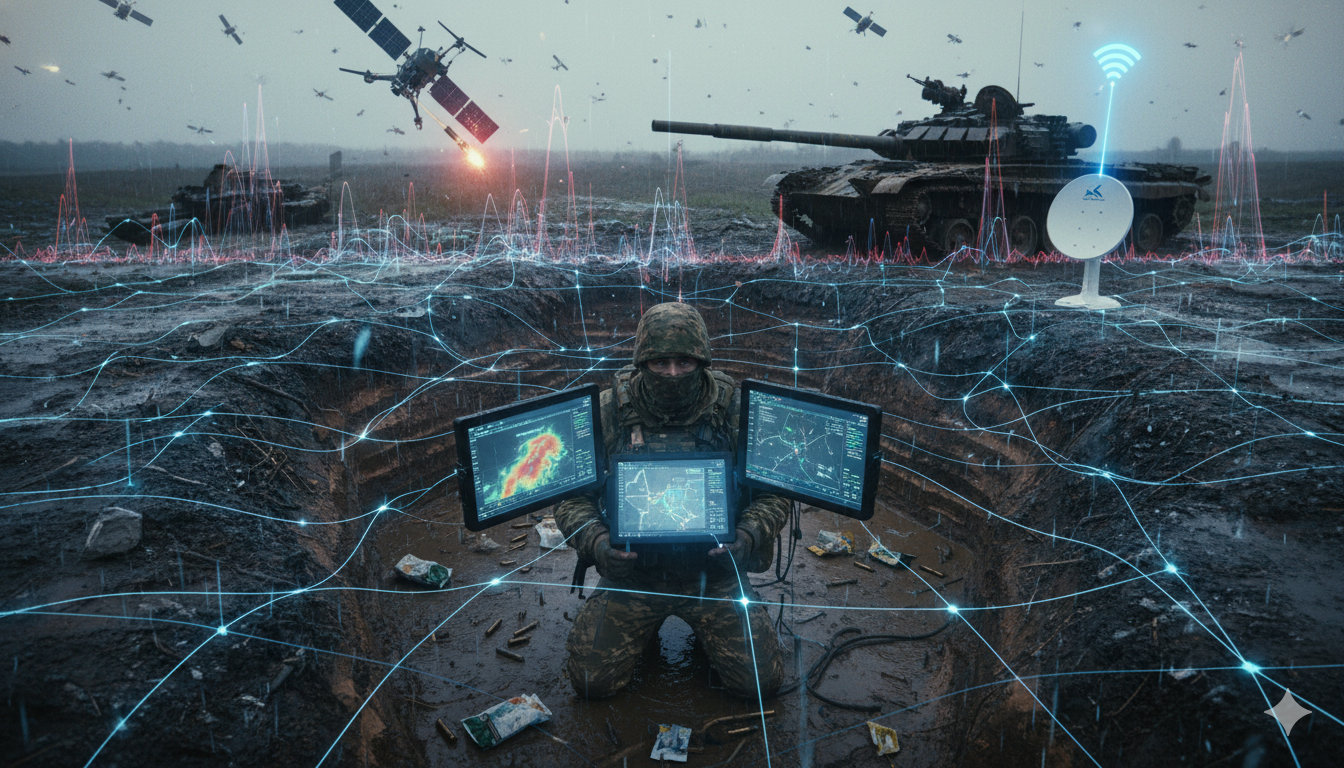
The ongoing Russia-Ukraine conflict, which initially erupted in 2014 with the annexation of Crimea, has escalated dramatically since February 2022 when Russia launched a full-scale invasion of Ukraine. Despite Russia’s significant qualitative and quantitative advantages, Ukraine’s armed forces have mounted a formidable resistance, thwarting Russia’s initial expectations of a swift victory and transforming the conflict into a protracted and grueling war of attrition.
The Russia-Ukraine conflict has become the world’s first full-scale laboratory for 21st-century warfare. It has been described as the first “commercial space war,” the first “drone war,” and the first “AI war,” each label underscoring the unprecedented role of technology in shaping its course. What began as a conventional invasion by a superior military force has evolved into a grueling war of attrition where technological innovation, adaptability, and software are as critical as tanks and troops.
Military strategies and battlefield tactics are increasingly dependent on cutting-edge technology, a trend that has been on full display throughout the conflict. The deployment of drones, electronic warfare systems, cyber capabilities, and satellite technologies has revolutionized the dynamics of combat, offering critical lessons for military powers worldwide.
This conflict demonstrates a fundamental shift: victory is no longer determined solely by the size of one’s arsenal, but by the ability to integrate commercial technologies, harness real-time data, and dominate the electromagnetic spectrum. From the trenches of Donbas to the boardrooms of Silicon Valley, the Ukraine war provides a stark preview of future battlefields and offers critical lessons for global military strategy.
Missiles and Precision Strike: The Data-Driven Arsenal
Missiles have long been a staple of modern warfare, but in Ukraine, they are no longer standalone weapons—they are fully integrated nodes within a networked, software-driven battlefield. Both guided and high-speed missiles are used in tandem with drones, satellites, and AI-enabled analytics, turning real-time data into precise, rapid strikes. The conflict has demonstrated that effective missile warfare now relies as much on intelligence and targeting systems as on explosive power, fundamentally redefining the calculus of offense and defense.
Guided missiles have played a central role in targeting strategic infrastructure and military positions deep behind enemy lines. Russian systems such as the Iskander ballistic missiles and Kalibr cruise missiles have been matched by Western-supplied Storm Shadow/SCALP-EG and Neptune missiles on Ukraine’s side. Targets have included command centers, airfields, ammunition depots, and logistical hubs, often located and verified through real-time drone and satellite reconnaissance. This convergence of kinetic power and digital intelligence illustrates the growing interdependence of different forms of military technology.
Russia initially expected rapid success through conventional airpower combined with missile strikes. Su-24, Su-35, and Su-30SM fighters, supported by cruise missile barrages, were intended to neutralize Ukraine’s defenses swiftly. Instead, poor coordination and rigid command structures left Russian aircraft vulnerable. Ukraine’s mobile, layered air defenses—including legacy systems like the S-300 and modern Western NASAMS and IRIS-T—used “shoot-and-scoot” tactics to inflict significant losses on Russian jets and helicopters, forcing Moscow to rely more heavily on standoff missile strikes.
Anti-tank guided missiles (ATGMs) have further shifted the battlefield dynamic. U.S.-supplied Javelins, British NLAWs, and Ukraine’s Stugna-P have proven devastating against Russian armor. Paired with drone reconnaissance and live intelligence feeds, these portable, precision-guided weapons allow small units to neutralize high-value targets while avoiding direct exposure. Russian tanks, already compromised by poor maintenance, outdated armor, and command missteps, have suffered catastrophic losses, illustrating that modern missile systems are not just destructive—they reshape the operational environment itself.
Supersonic and hypersonic missiles have added a new dimension of speed and unpredictability. Supersonic weapons, traveling between Mach 1 and Mach 5, and hypersonic missiles exceeding Mach 5, such as Russia’s Kinzhal (Kh-47M2), strike targets with minimal warning and evade traditional defenses. While Ukraine has fielded supersonic missiles like the Kh-22, they are less advanced than Russia’s hypersonic arsenal but reflect Kyiv’s efforts to modernize and respond to rapidly evolving threats. The extreme speed of these missiles compresses decision cycles on the battlefield, making real-time data fusion from drones, satellites, and AI systems critical to maximizing their effectiveness.
Taken together, the guided, supersonic, and hypersonic missile capabilities in Ukraine highlight a broader shift in warfare: success depends on the integration of sensors, intelligence, and strike systems into a unified, data-driven network. Missiles are no longer isolated tools of destruction—they are part of a larger ecosystem where drones provide targeting, satellites ensure situational awareness, and AI analytics accelerate decisions. In the software-defined battlefield, precision, speed, and information dominance have become as decisive as firepower itself, signaling a new era in which missiles are only as effective as the networks that guide them.
The Drone Revolution: Asymmetric Warfare on a Budget
Unmanned Aerial Vehicles (UAVs) have emerged as one of the defining symbols of the Russia-Ukraine war, reshaping both battlefield tactics and strategic calculations. Once considered supplementary tools, drones have now become indispensable assets, providing reconnaissance, precision strikes, and psychological impact in equal measure. Ukraine’s pioneering use of inexpensive, commercially available drones has demonstrated how innovation and adaptability can challenge even a conventionally superior adversary.
Ukrainian units, particularly the well-known Aerorozvidka, have excelled in modifying off-the-shelf consumer drones from companies like DJI. These drones, originally intended for civilian use, have been transformed into deadly weapons by equipping them with grenade-drop systems, thermal cameras, and improvised targeting devices. Remarkably, a $2,000 quadcopter can neutralize a tank worth millions, or guide artillery strikes with pinpoint accuracy. This repurposing of consumer technology reflects a masterclass in asymmetric warfare, where creativity offsets disparities in resources.
To scale this innovation, Ukraine launched its ambitious “Army of Drones” initiative. Through this program, the country has procured thousands of UAVs, established training pipelines for new operators, and built a system that prioritizes resilience and rapid adaptation. Rather than depending on slow, expensive, proprietary military hardware, Ukraine has created an agile aerial fleet capable of being replenished and modified quickly. This mass-scale adoption of drones ensures that their tactical advantage persists, even in the face of heavy losses.
Russia’s approach to drones has been markedly different. Relying on military-grade platforms such as the Orlan-10, as well as Iranian-supplied Shahed-136 “suicide drones,” Moscow has emphasized longer-range strikes against Ukrainian infrastructure. These systems have inflicted damage but lack the flexibility and adaptability seen in Ukraine’s grassroots drone operations. Russia’s more centralized, less experimental strategy has struggled to match Ukraine’s decentralized swarm of small UAVs that can overwhelm defenses and adjust tactics on the fly.
The intensity of drone warfare has led to staggering attrition rates on both sides. Analysts estimate that more than 10,000 drones are lost every month, whether to electronic warfare, air defenses, or simple wear and tear. Yet, this high turnover underscores the very nature of modern drone warfare: a contest not of preserving platforms, but of sustaining production, innovation, and operator training at scale. The battlefield has become a proving ground for the future of aerial combat, where adaptability and resilience matter more than technological perfection.
In this sense, the drone revolution in Ukraine has redefined asymmetric warfare for the modern era. It highlights how low-cost, widely accessible technology can disrupt traditional military hierarchies, giving smaller or less-resourced forces a powerful edge. The lessons emerging from this conflict will likely influence how militaries around the world rethink aerial warfare—prioritizing not just advanced platforms, but also swarms of inexpensive, adaptable systems capable of overwhelming even the most sophisticated defenses.
As the conflict continues, drone warfare is evolving at an unprecedented pace. Both sides are working to overcome tactical limitations, improve counter-drone measures, and scale up production to maintain their aerial advantage. Reports suggest that drone losses exceed 10,000 units per month, making rapid innovation and mass production critical. The race to develop more autonomous, resilient, and cost-effective UAVs will likely shape the future of warfare far beyond Ukraine, setting new precedents for military strategy and technological warfare.
The Constellation Overhead: Space as a Contested Domain
The war in Ukraine has irrevocably demonstrated that space is no longer a distant, secondary frontier, but a vital operational domain with immediate implications on the ground. Commercial satellites, once viewed mainly as tools for scientific research or commercial applications, have emerged as decisive assets in warfare. They provide intelligence, surveillance, communications, and resilience at a scale and speed that traditional military infrastructure alone could not achieve. For Ukraine, access to space-based capabilities has provided a strategic edge that offsets Russia’s superiority in conventional firepower.
One of the most significant contributions has come from satellite imagery. Companies such as Maxar Technologies and Planet Labs have made near real-time, high-resolution imagery available, enabling Ukraine to track Russian troop buildups, supply movements, and defensive positions. This constant “eye in the sky” has transformed the battlefield into a transparent arena where surprise offensives are harder to conceal. Beyond military value, this imagery has also been used to verify the effects of strikes, assess damage to infrastructure, and even provide evidence for war crimes investigations before international courts. The result is a level of situational awareness and accountability that would have been unthinkable in previous wars.
Equally transformative has been the deployment of SpaceX’s Starlink satellite internet service. With over 30,000 terminals delivered to Ukraine, Starlink has provided secure, high-speed connectivity at a time when Russia launched relentless cyberattacks against terrestrial internet infrastructure. The network has allowed Ukrainian forces to maintain uninterrupted command-and-control functions, coordinate battlefield operations, and transmit real-time intelligence.
Starlink’s resilience against cyberattacks has allowed Ukrainian forces to maintain communication with global allies, access intelligence, and coordinate military operations. Starlink has also been used by civilians in Ukraine. Many people have used Starlink to stay connected with friends and family, to access news and information, and to work remotely. Starlink’s role in the Russia-Ukraine conflict is a reminder of the importance of reliable and affordable internet access. In times of crisis, internet access can be essential for communication, coordination, and other critical tasks.
Starlink’s role also highlights the profound involvement of the private sector in modern warfare. In previous conflicts, space capabilities were the exclusive domain of states. Today, private companies can directly shape the battlefield by providing critical infrastructure that rivals or even surpasses government-run systems. This blurring of military and civilian roles has raised new questions about sovereignty, security, and the responsibilities of private actors in conflicts. For Ukraine, however, the reliance on commercial providers has proven invaluable, showcasing the agility and resilience of decentralized, market-driven innovation.
For Russia, this dominance of commercial space services has posed a serious challenge. Despite having its own space assets, Moscow has struggled to counter the widespread and redundant coverage offered by global satellite networks. Efforts to jam or disrupt Starlink have had limited success, while attempts to conceal troop movements from commercial imagery have been continually undermined. The conflict has thus underscored that controlling the space domain is not merely about launching satellites but about integrating them effectively into military operations and securing resilience against interference.
In this way, the Russia-Ukraine war has redefined space as a contested and indispensable domain of warfare. It has proven that access to space-based communications and intelligence can mean the difference between isolation and resilience, between surprise and preparedness. As nations study this conflict, they are likely to accelerate investments in commercial partnerships, satellite constellations, and counter-space capabilities, recognizing that the future battlefield is as much above the Earth as it is upon it.
The Algorithmic Battlefield: Data Fusion and AI
Among the many technological revolutions visible in the Russia-Ukraine war, perhaps the most transformative has been the integration of artificial intelligence and advanced data analytics. The modern battlefield produces an overwhelming torrent of information—from drones and satellites to intercepted communications and ground sensors. Turning this raw data into actionable intelligence in real time has become a defining feature of the conflict. The side that can process information faster, fuse it into a coherent picture, and translate it into precise action gains what military strategists call “decision dominance.”
Ukraine has leveraged AI-driven systems to dramatically shorten the traditional “sensor-to-shooter” loop. Companies such as Palantir, Scale AI, and Helsing have provided platforms capable of processing massive streams of drone imagery, satellite data, and signals intelligence. These tools can identify potential targets, recommend optimal artillery firing solutions, and assess the aftermath of strikes with remarkable speed and accuracy. Tasks that once took human analysts hours—or even days—can now be accomplished in minutes. This acceleration allows Ukrainian forces to strike quickly and adapt dynamically, outpacing the slower, more rigid decision-making cycles of the Russian military.
The ability to shorten this loop has proven especially valuable in artillery warfare, which remains central to the conflict. Ukraine has used AI-assisted targeting systems to direct scarce artillery shells with maximum efficiency, prioritizing high-value targets and minimizing wasted fire. This is crucial in a war where supply chains are strained, and every shell counts. The combination of AI analytics with satellite imagery and UAV reconnaissance has allowed Ukraine to transform even limited resources into disproportionately effective firepower.
Beyond targeting, AI and data fusion also enhance situational awareness. By integrating streams of battlefield data, Ukrainian commanders can anticipate enemy maneuvers, allocate resources more effectively, and maintain a clear operational picture even under conditions of intense electronic warfare. In many cases, AI systems provide predictive insights, helping commanders not only respond to events but also anticipate them. This reflects a shift toward algorithmic warfare, where predictive modeling and machine learning begin to shape strategy itself.
Russia, by contrast, has struggled to integrate AI effectively into its operations. Despite ambitious rhetoric about AI-driven warfare, several structural factors have limited Moscow’s progress. Western sanctions have cut off access to advanced semiconductors and high-performance computing hardware, essential components for training and running sophisticated AI models. At the same time, a significant exodus of technical talent has hollowed out Russia’s innovation ecosystem, while rigid bureaucratic structures within its military hinder rapid adoption of new technologies. The result is a noticeable AI gap that reflects not only material shortages but also institutional shortcomings.
The lessons are clear: technological superiority in modern warfare cannot be achieved through hardware alone. What matters most is the ecosystem of innovation—the partnerships between governments, startups, and private industry that allow ideas to be transformed into deployable solutions quickly. Ukraine’s success in harnessing AI shows that a small, agile force backed by global digital support can offset the advantages of a much larger opponent. In the wars of the future, the most powerful weapon may not be the missile or the tank, but the algorithm that directs them.
Cyber Warfare: The New Invisible Battleground
Since the onset of the Russia-Ukraine conflict in February 2022, cyberspace has emerged as a critical theater of war, highlighting its growing role in modern military strategy. Both Russia and Ukraine have launched cyber operations aimed at disrupting critical infrastructure, sowing confusion, and undermining morale. Russia’s cyber offensives, including distributed denial-of-service (DDoS) attacks that crippled Ukrainian government websites on the first day of the invasion, targeted power grids, banks, and telecommunications networks, inflicting widespread economic and operational disruption.
Ukraine, however, has actively countered these cyber threats. Ukrainian hackers have penetrated Russian state-owned media networks, broadcast pro-Ukrainian messages, and temporarily disrupted government websites and banking systems. These retaliatory operations have served not only to impede Russian operations but also to challenge Moscow’s control of the information space. In addition, both nations have waged a battle of narratives, using disinformation and propaganda to influence global perceptions. Russia has relied on fake news campaigns across social media platforms, while Ukraine has leveraged channels like Telegram and Twitter to mobilize international support and counter Russian narratives.
The conflict demonstrates that cyberattacks—relatively low-cost, hard to attribute, and capable of striking both civilian and military systems—are now a decisive component of modern warfare. As capabilities continue to advance, cyber operations are likely to become increasingly central to strategic planning, compelling nations to prioritize robust defenses, resilient infrastructure, and rapid response mechanisms in future conflicts.
Electronic Warfare: Controlling the Electromagnetic Spectrum
Electronic warfare (EW) has similarly emerged as a defining element of the Ukraine conflict, shaping battlefield dynamics by controlling access to the electromagnetic spectrum. EW employs jamming, spoofing, and signal manipulation to disrupt enemy communications, radar, and sensor systems, simultaneously serving offensive and defensive purposes. Mastery of the spectrum can deny adversaries critical operational capabilities and introduce confusion and uncertainty on the battlefield.
Russia entered the conflict with sophisticated EW systems capable of jamming Ukrainian communications, radar networks, and drone operations, creating significant challenges for Ukraine’s command and control. Despite possessing fewer and less advanced EW assets, Ukraine has responded with ingenuity and speed, developing home-grown systems to disrupt Russian operations. From short-range jammers to advanced radio signal tracking stations, these solutions have enhanced Ukraine’s operational flexibility and resilience.
Local startups have been at the forefront of this innovation. Falcons, for instance, has engineered compact, tripod-mounted stations capable of parsing multiple radio signals, including those from drones, repeaters, and even 5G networks, in real time. By identifying the unique “fingerprints” of each UAV, operators can distinguish between friendly and hostile systems with remarkable precision. Similarly, Himera has developed low-cost, encrypted walkie-talkies using signal-hopping and mesh networking, ensuring secure communications even amid extensive jamming and spoofing.
Operational initiatives such as Brave1, a joint platform by Ukraine’s Ministries of Defense and Digital Transformation, have further accelerated EW innovation. Supporting over 100 front-line projects, Brave1 emphasizes rapid prototyping, tactical deployment, and iterative adaptation, allowing Ukrainian forces to leverage local ingenuity effectively against a technologically superior adversary. These efforts demonstrate how agile, locally-driven EW solutions can offset conventional advantages, reshaping the operational balance in contested environments.
The pervasive use of EW has had profound effects on the conflict. It has constrained both sides’ ability to operate advanced electronics, including drones, radar, and GPS-guided munitions, increasing battlefield uncertainty and forcing commanders to innovate continuously. The Ukraine conflict thus illustrates the decisive role of electromagnetic dominance in modern warfare, highlighting the potential of rapid, home-grown technological adaptation to counter established military power.
Key Lessons for the Future of Warfare
The war in Ukraine has become more than just a regional conflict—it has evolved into a proving ground for how wars will be fought in the 21st century. For militaries around the world, it offers stark and urgent lessons that go beyond conventional strategy and force composition. These lessons highlight not just the importance of technology, but the speed, adaptability, and resilience with which it is employed.
One of the clearest insights is that innovation must scale. It is not enough to develop new technologies; success comes from the ability to rapidly mass-produce, deploy, and adapt them in real-world conditions. Ukraine’s widespread use of consumer drones, modified for battlefield tasks, shows how inexpensive and widely available tools can be transformed into decisive weapons when deployed en masse. The side that can innovate quickly, iterate faster, and push solutions to the field at scale will have the edge, even against a conventionally superior adversary.
Another defining lesson is that data has become a weapon in its own right. Real-time collection, fusion, and analysis of information now shapes the outcome of battles as much as physical firepower. From satellites providing reconnaissance to AI systems generating instant targeting solutions, the Ukraine conflict has shown that decision dominance rests on the ability to process and act upon vast streams of data faster than the enemy. In the wars of the future, software will be as critical as hardware, and algorithms may prove as decisive as artillery shells.
The conflict has also underscored that resilience is often more valuable than sophistication. Complex, centralized systems—no matter how advanced—can be jammed, hacked, or destroyed. By contrast, resilient and decentralized architectures, such as Starlink’s satellite internet constellation or mesh-based communications networks, have proven far more survivable under sustained attack. Building systems that can absorb disruption, reconfigure rapidly, and continue operating under pressure will be essential for any modern military force.
Perhaps most striking is the role of the private sector, which has emerged as a direct participant in the conflict. Tech companies are no longer passive suppliers of hardware and software; they are active enablers of battlefield operations. From SpaceX’s Starlink providing critical connectivity to commercial satellite firms offering real-time imagery, private actors have tipped the strategic balance. This blurring of lines between civilian enterprise and military operations raises new challenges for governments, but it also demonstrates the growing power of commercial innovation in shaping global security.
Taken together, these lessons signal a paradigm shift in warfare. Future conflicts will not be won solely by armies with the biggest arsenals, but by nations that can integrate civilian technologies, harness global innovation ecosystems, and build resilient digital and physical networks. The Ukraine war has shown that adaptability, speed, and information superiority may matter more than traditional metrics of military power—a warning and an opportunity for militaries everywhere.
Conclusion: A Paradigm Shift
The Russia-Ukraine war marks a historic inflection point in the evolution of modern warfare. It has shattered the myth of the all-powerful “peer adversary” and demonstrated that a determined nation, empowered by agile technology and supported by global digital infrastructure, can resist and even repel a much larger invading force. The industrial-age paradigm of sheer firepower is giving way to a software-defined battlefield—one where the decisive advantage comes from seamlessly integrated networks of drones, satellites, sensors, and data streams.
This conflict has proven that silicon and code now rival steel and gunpowder as the most critical determinants of military power. Algorithms that can shorten the sensor-to-shooter loop, satellite networks that can restore communications in hours, and commercial platforms that can mobilize information globally are reshaping what it means to fight and win a war. Hardware may still deliver the punch, but software determines how fast, how accurately, and how effectively that punch is thrown.
The lessons emerging from Ukraine will reverberate through defense strategies for decades to come. Militaries will need to rethink procurement, shifting from long cycles of exquisite but fragile systems to agile, scalable, and resilient technologies that can evolve as quickly as the threat itself. Governments will also need to confront the growing reality that private-sector actors are now central to national defense—sometimes outpacing state institutions in speed, adaptability, and reach.
Ultimately, the most powerful weapon revealed by this war is not any single technology, but the resilience and ingenuity of those who wield them. The Ukraine conflict has shown that in the battles to come, victory will belong to those who can innovate the fastest, harness global networks, and out-adapt their adversaries in real time. The paradigm has shifted: the future of warfare belongs not only to armies, but to ecosystems.
References and Resources also include:
https://ecfr.eu/publication/star-tech-enterprise-emerging-technologies-in-russias-war-on-ukraine/