
Critical and emerging technologies are reshaping the foundations of military power, economic competitiveness, and strategic stability. Unlike traditional platforms, these technologies mature unevenly, diffuse rapidly across civilian and military domains, and generate advantage long before they are fully weaponized.
This magazine examines technologies that change how power is created, scaled, and sustained—focusing not on speculative futures, but on capabilities that are actively shaping decision-making, deterrence, and conflict dynamics today.
IDST Intelligence Briefings
Our briefings examine how human performance, training systems, and force design interact with technology under operational stress
Why This Magazine Exists
Emerging technologies are often discussed in isolation or through hype-driven narratives. In reality, their strategic impact depends on engineering maturity, institutional adoption, industrial scaling, and governance frameworks.
This magazine exists to explain which technologies actually matter, how quickly they can be deployed, and under what constraints they meaningfully alter security, military capability, and geopolitical competition.
What We Track
- Artificial intelligence and machine learning for defense and security
- Advanced sensors, computing, and data architectures
- Quantum technologies and cryptographic disruption
- Advanced materials, energy systems, and propulsion
- Biotechnology and human–technology interfaces
- Dual-use technologies crossing civilian and military domains
Latest Analysis & Intelligence
-
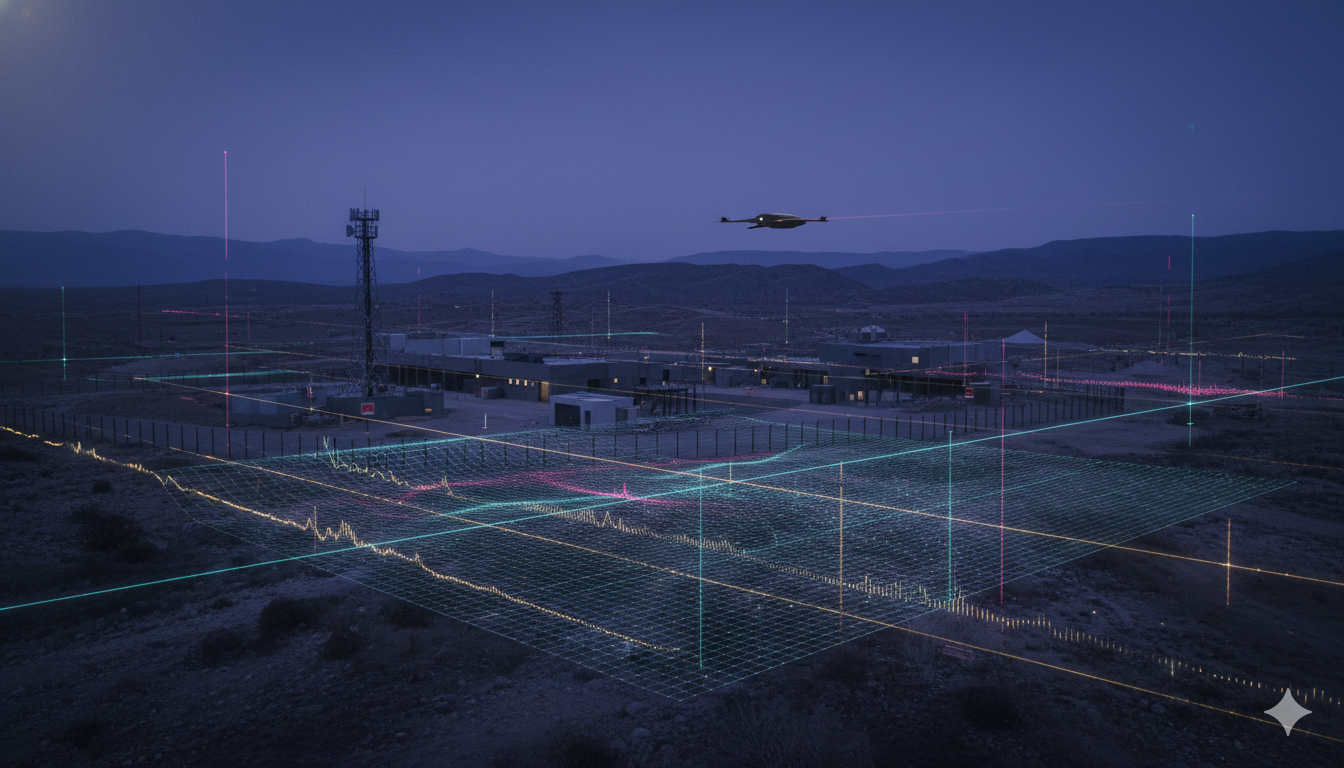
Photonic Sensors 2026: The Invisible Shield Revolutionizing Threat Detection and Military Technology
The next global technology race will not be won solely by whoever computes information fastest, but by whoever can sense, transmit, process, and interpret reality at the speed of light. Photonic sensors—capable of detecting, transmitting, and interpreting optical signals across infrared, visible, and ultraviolet spectra—are not merely supplementing traditional electronic sensing systems but actively replacing…
-

Photonic Sensors 2026: The Light-Speed Revolution Reshaping Global Power, Intelligence, and Industry
Introduction: The Rise of the Optical Intelligence Era The global photonic sensor industry is no longer evolving incrementally—it is undergoing a strategic and technological discontinuity comparable to the transition from analog electronics to the digital age. Between 2025 and 2026, breakthroughs across quantum optics, integrated photonics, neuromorphic imaging, AI-enabled edge sensing, metasurfaces, optical interconnects, and…
-
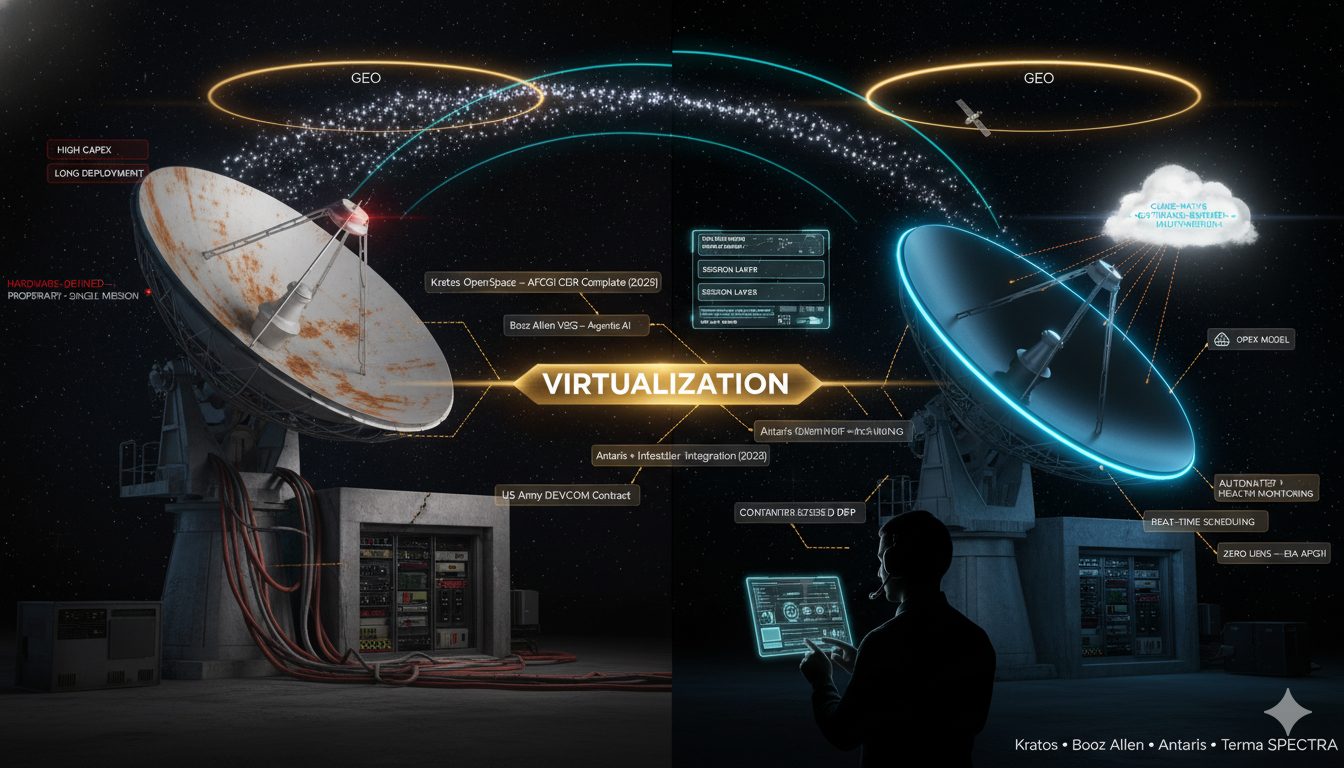
Ground Station Virtualization: Revolutionizing Satellite Communication in the Cloud-Native Era
From Hardware-Centric Infrastructure to Software-Defined, AI-Native Ground Systems Executive Summary Ground station virtualization (GSV) is transforming the satellite ground segment into a distributed, software-defined, and cloud-orchestrated system-of-systems capable of supporting the scale, complexity, and responsiveness required by next-generation space architectures. As LEO mega-constellations, multi-orbit networks, and latency-sensitive applications proliferate, legacy ground systems—built around fixed-function RF…
-

The Quantum Supremacy Race 2026: Who Leads the Next Computing Era?
Introduction: Quantum Computing Becomes Strategic Infrastructure Quantum computing is no longer merely a scientific ambition pursued inside elite physics laboratories. By 2025–2026, it has evolved into a central arena of geopolitical competition, industrial policy, cybersecurity planning, and technological sovereignty. Governments increasingly view quantum technologies in the same strategic category as semiconductors, artificial intelligence, and nuclear…
-
Biohybrid Systems: Where Biology Meets Machine
The Emergence of Biohybrid Technologies Neuro- or biohybrid systems are entities formed by integrating at least one biological component with at least one engineered artificial component. Unlike conventional biomedical devices, these components do not function independently. Instead, they exchange information in one or both directions, forming a unified hybrid entity capable of behaviors neither biological…
-

The AI-Powered Investigation 2026: How Artificial Intelligence Is Transforming Criminal Justice, Digital Forensics, and Law Enforcement
Introduction: Criminal Justice Enters the Algorithmic Era The global criminal justice system is undergoing its most profound technological transformation since the introduction of DNA forensics and digital policing. By 2025–2026, artificial intelligence has moved beyond experimental pilots and entered operational deployment across policing, intelligence analysis, digital forensics, prosecution, corrections, and judicial administration. Law enforcement agencies…
-

Nanomaterials as Ideal Single-Photon Sources Driving the Quantum Technology Revolution
Nanomaterials as Ideal Single-Photon Sources Driving the Quantum Future The Quantum Photonics Revolution Quantum technology is rapidly emerging as one of the defining technological transformations of the twenty-first century. By exploiting uniquely quantum phenomena—such as the Quantum Superposition, Quantum Entanglement, and the No‑cloning Theorem—scientists are developing systems capable of computing, communicating, and sensing in ways…
STRATEGIC SUB-MAGAZINES
Modern military power emerges from the interaction of platforms, people, doctrine, and integration across domains. The Defense & Military Systems magazine is structured into focused sub-magazines that examine how combat capability is built, sustained, and employed across air, land, sea, weapons, and human systems.
Artificial Intelligence, Data & Intelligent Systems
Focuses on the platforms, technologies, and doctrines that define control of the air and near-space domains. This sub-magazine examines combat aviation, unmanned air systems, aerospace surveillance, and emerging flight technologies shaping future air superiority.
Explore the Artificial Intelligence, Data & Intelligent Systems Sub-Magazine →
Biotechnology, Bioengineering & Synthetic Life Systems
Examines how modern armies fight, maneuver, and survive in increasingly contested land environments. This sub-magazine focuses on armored platforms, artillery, battlefield networking, and the transformation of ground combat through automation and data.
Explore the Biotechnology, Bioengineering & Synthetic Life Systems Sub-Magazine →
Communications, Networks & Information Infrastructure
Analyzes the technologies and doctrines shaping sea control, power projection, and undersea dominance. This sub-magazine covers surface fleets, submarines, maritime surveillance, and naval systems operating across blue-water and littoral theaters.
Explore the Communications, Networks & Information Infrastructure Sub-Magazine →
Electronics, Sensors & Electronic Warfare Systems
Focuses on the strike capabilities that deliver military effects across domains. This sub-magazine examines missiles, precision weapons, directed energy, and emerging strike technologies that shape deterrence and combat outcomes.
Explore the Electronics, Sensors & Electronic Warfare Systems Sub-Magazine →
Advanced Materials & Structural Technologies
Explores the evolving role of the individual warfighter within increasingly networked and automated battlespaces. This sub-magazine focuses on human performance, survivability, and the integration of soldiers into complex combat systems.
Explore the Advanced Materials & Structural Technologies Sub-Magazine →
Mechanical Systems, Robotics & Physical Engineering
Focuses on the strike capabilities that deliver military effects across domains. This sub-magazine examines missiles, precision weapons, directed energy, and emerging strike technologies that shape deterrence and combat outcomes.
Explore the Mechanical Systems, Robotics & Physical Engineerings Sub-Magazine →
Nanotechnology & Engineered Matter
Explores the evolving role of the individual warfighter within increasingly networked and automated battlespaces. This sub-magazine focuses on human performance, survivability, and the integration of soldiers into complex combat systems.
Explore the Nanotechnology & Engineered Matters Sub-Magazine →
Photonics, Optics & Directed Energy Systems
Focuses on the strike capabilities that deliver military effects across domains. This sub-magazine examines missiles, precision weapons, directed energy, and emerging strike technologies that shape deterrence and combat outcomes.
Explore the Photonics, Optics & Directed Energy Systemss Sub-Magazine →
Quantum Science & Strategic Quantum Technologies
Explores the evolving role of the individual warfighter within increasingly networked and automated battlespaces. This sub-magazine focuses on human performance, survivability, and the integration of soldiers into complex combat systems.
Explore the Quantum Science & Strategic Quantum Technologies Sub-Magazine →
Related Domains & Cross-Cutting Themes
Emerging technologies rarely operate in isolation. Their real impact is shaped by integration, governance, and human-system interaction.
Ethics, governance, and technology control
Industrial scaling and supply-chain constraints
Human–machine teaming and trust
Interoperability across platforms and institutions
Export controls and technological rivalry
Explore the Critical & Emerging Technologies Magazine →
Explore the Industry, Markets & Supply Chains Magazine →
Explore the Space Technology, Defense & Exploration Magazine →