
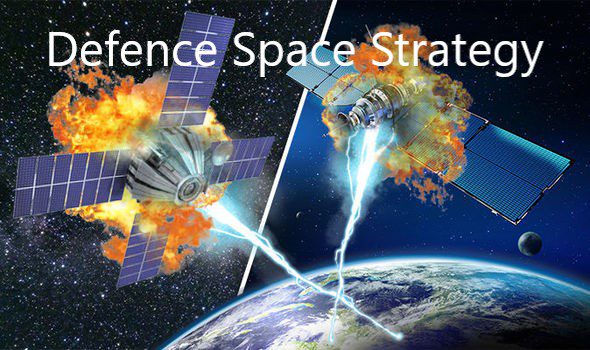

As the space domain has become more congested, the potential for intentional and unintentional threats to space system assets has increased. Space is also becoming another domain of conflict due to enhanced militarization and weaponization of space. There has been enhanced testing of Anti-satellite weapons (ASAT) and space weapons designed to incapacitate or destroy satellites for strategic military purposes.
Although no ASAT system has yet been utilised in warfare, a few nations have shot down their own satellites to demonstrate their ASAT capabilities in a show of force. Only the United States, Russia, China, and India have demonstrated this capability successfully. The roles include: a defensive measure against adversary’s space-based nuclear weapons, a force multiplier for a nuclear first strike, a countermeasure against adversary’s anti-ballistic missile defense (ABM), an asymmetric counter to a technologically superior adversary, and a counter-value weapon.
China continues to develop a variety of capabilities designed to limit or prevent the use of space based assets by adversaries during a crisis or conflict, including the development of ground-based direct ascent missiles that can physically destroy a satellite, directed-energy weapons and satellite jammers. Since 2005, China has conducted eight anti-satellite tests. Tests conducted in 2010, 2013, and 2014 were labelled “land-based missile interception tests.” China has conducted a series of tests of on-orbit proximity and rendezvous operations, Brian Weeden director of program planning at the Secure World Foundation, said, although the publicly available evidence “does not indicate they are explicitly aimed at offensive capabilities.”
Chinese military strategists see military space capabilities and operations as a key component of strategic deterrence, critical to enabling the PLA to fight informatized local wars and counter U.S. military intervention in the region and essential for supporting operations aimed at protecting China’s emerging interests in more-distant parts of the world, says RAND report.
Russia flight tested its Nudol system in April 2020, a ground-launched, mobile ballistic missile that has been in development since 2010. No intercept appears to have been attempted, according to the available facts. The Nudol is a mobile ASAT missile launcher that can reach satellites in Low Earth Orbit (LEO). Russia’s satellite constellation, of which military apparatuses account for two-thirds, is the world’s third-largest. On another front, Moscow is working on a new Anti Ballistic Missile system: the A-135 anti-ballistic missile system will be replaced by A-235. Experts suspect this will serve an anti-satellite purpose. There are multiple reports of Russia using GPS jammers in Eastern Ukraine, and , and also resurrected an airborne laser dazzler system known as the A-60.Russia has also done a series of its own on-orbit proximity and rendezvous operations demonstrations, both in low-Earth and geosynchronous orbits. “Russia has been designing an airborne laser to disrupt our space-based system. And it claims to be developing missiles that can be launched from an aircraft mid-flight to destroy American satellites, ” said Vice President Mike Pence.
Russia and China are engaged in robust efforts to fight wars in space, developing technology and weapons designed to take out U.S. satellites that provide missile defense and enable soldiers to communicate and monitor adversaries, according to US reports.
On 27 March 2019, India successfully conducted an ASAT test called Mission Shakti. The interceptor was able to strike a test satellite at a 300-kilometre (186 mi) altitude in low earth orbit (LEO), thus successfully testing its ASAT missile. The interceptor was launched at around 05:40 UTC at the Integrated Test Range (ITR) in Chandipur, Odisha and hit its target Microsat-R after 168 seconds. The operation was named Mission Shakti. The missile system was developed by the Defence Research and Development Organisation (DRDO)—a research wing of the Indian defence services. With this test, India became the fourth nation with anti-satellite missile capabilities. India stated that this capability is a deterrent and is not directed against any nation.
The testing of ASAT weapons is driving nations whose military is highly dependent on space to launch their military space strategy and operationalize space command to protect their space based assets. US President Donald Trump has launched a new Pentagon command focused on warfare in space. It comes as US military chiefs see China and Russia making advancements in the military final frontier. Trump, in a recent speech said that “space is a war-fighting domain, just like the land, air and sea. We may even have a space force. We have the Air Force; we’ll have the space force.” The primary aim of establishing a sixth armed service—the others being the Air Force, Army, Coast Guard, Marine Corps, and Navy—is to accelerate the development and deployment of new technologies for space warfighting, Deputy Secretary of Defense Patrick Shanahan told reporters.
Under Space Policy Directive 4, the role of the US space force will be to organise, train, and equip military space forces of the nation to operate in space and to perform offensive and defensive space operations, and joint operations in all domains. During his speech at the White House signing ceremony Trump said: “We are investing in new space capabilities to project military power and safeguard our nation’s interests, especially when it comes to safety and defence.
But the intent is not to militarize space; rather it is to avert a potentially disastrous conflict, said Todd Harrison, an analyst at the Center for Strategic and International Studies. If the United States leaves its satellites vulnerable to new Russian and Chinese weapons, the likelihood that these weapons will be used increases, he argued. The United States is probably the world leader in on-orbit proximity and rendezvous operations, he said, and there have been a lot of rumors about the U.S. considering developing more offensive capabilities to “defend” its satellites or take out Russian and Chinese satellites.
Speaking at the UK Space Conference in Newport, Andrew Ash from the space team at DSTL, said the government is planning for the ‘increasing militirisation’ of space and the possibility of a conflict within the next 15 years. But countries including China, Russia, Iran and North Korea are developing anti-satellite missiles, jammers, high-power microwaves, robots, lasers and chemical sprayers which could bring the country to a standstill. Britain currently has more than 50 satellites in orbit, and also relies heavily on international systems such as GPS, telecommunications networks and weather monitoring services.
To counter growing threats arising from China’s growing space capabilities, India organised its first ever simulated space warfare exercise. The development is significant as it comes after India constituted an all-new tri-service Defence Space Agency in March following a successful launch of an anti-satellite missile under “Mission Shakti.”
The purpose of the exercise is to understand the possible challenges in space warfare and to counter China’s growing influence in this domain, which poses a major threat to India’s national security interest. “The main aim is to assess the requisite space and counter-space capabilities that are needed by India to ensure we can protect our national security interests in this final frontier of warfare,” the daily quoted a senior official as saying.