
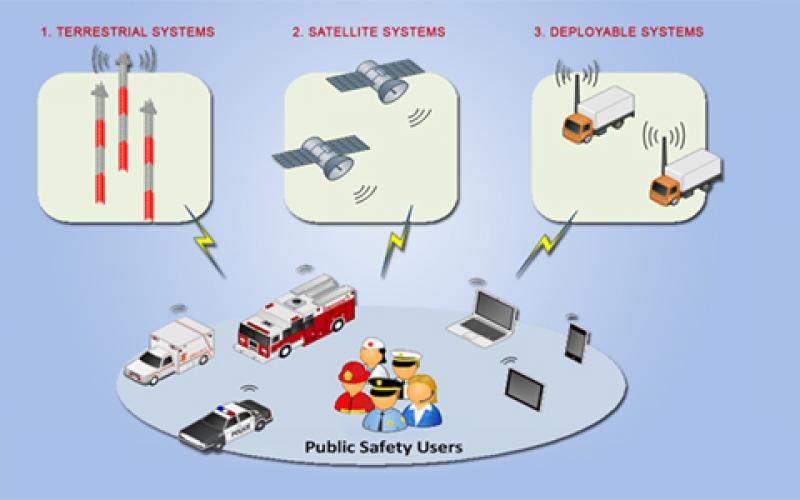

The occurrence of a large natural or man-made disaster is often combined with the destruction of the local infrastructures on the ground. For example, the earthquake in Wenchuan in May, 2008 did not only has a huge destructive power, but also made the disaster area into many information isolated islands where the communication with outside was cut off.
During Disaster there is an immediate need for life saving aid; the distribution of food, water, and shelter becomes paramount to relief efforts. In addition to providing life-sustaining resources, aid workers are now being called upon to provide things like Wi-Fi access and cellular support. All these operations require robust communication network that can work without need of telecommunications towers which can be destroyed during such operations.
The statistics show that the 50% death took place within two hours after the disaster. So it is very important to set up a set of reliable emergency communication system rapidly and effectively, which can ensure the communication for the government to make disaster rescue plans and take rescue actions.
Although the short wave or satellite communication system is generally applied to the existing emergent communication system and they both have the advantages of long communication distance and mature techniques, the short wave communication has the problem of channel congestion and the satellite communication has the big problem of long delay. What’s more, special terminal equipments and using skills are needed and the price is high in the two kinds of systems, so that only the government, the army and some other the important departments can afford using them
Although the paralysis of the terrestrial mobile communication system may be caused by the destruction of the fixed BSs or optical cables, most mobile phones of victims of a disaster can be used, and their batteries can be maintained for two to three days. So fully utilization of these resources will play a very important role in disaster rescue.
New technology has enabled sirens to work more effectively by incorporating modern software into new and existing siren infrastructures. For example, the prominence of social media updates throughout Hurricane Sandy points to the growing reliance on these platforms for real-time emergency updates and news. Today’s cellular and satellite networks equip sirens to communicate through tones, text-to-voice, pre-recorded audio and more, allowing public administrators to customize communications and effectively reach more people.
Researchers from Nanjing Telecommunication Technology Institute Nanjing, China have proposed aerial wireless emergency communication system which can satisfy a rapid and reliable communication with the outside world in disaster area.
The aerial BSs can move randomly or keep static location, which can help to deploy them flexibly according to the population density and topographic features of the disaster areas, and there can be one or more Ad Hoc networks. If the population in the disaster area is dense, then this area can be compared to the terrestrial cellular system, and air cellular system can be established; if the topography and population is sparse, then one aerial BS can cover an information island, and several aerial BSs form an Ad Hoc network in the air; the aerial BS can even move back and forth in the air which will provide intermittent service and so on.