
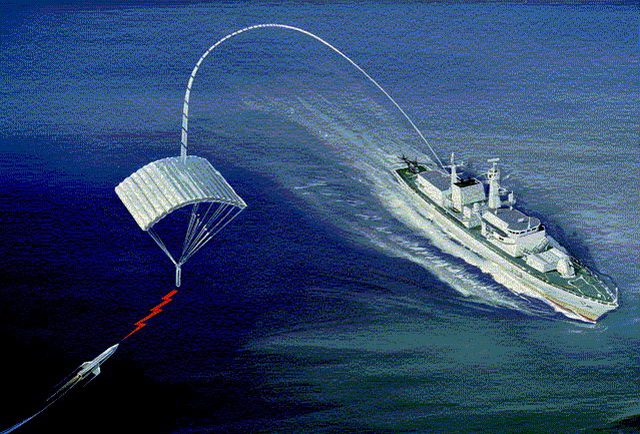

Naval Warships now faces wide spectrum of threats from hypersonic missiles, ballistic and cruise missiles, cavitating torpedoes, rail guns, lasers and UAVs. Anti-Ship Missiles are guided missiles most of them of the sea skimming variety, and many use a combination of inertial guidance and active radar homing. A good number of other anti-ship missiles use infrared homing to follow the heat that is emitted by a ship; it is also possible for anti-ship missiles to be guided by radio command all the way.
Hard kill counter measures include long-range surface-to-air missiles, like the American SM-6 or the British Sea Viper. Next up are medium-range SAMs like the Evolved Sea Sparrow, Aster 15 or SA-N-12 Grizzly. These will be joined by the main guns from the battle group’s cruisers and destroyers firing proximity-fused AA shells (or, with some very new guns, beam-riding guided shells). If the missiles made it through those defenses, or were fired closer, the shipboard Close-In Weapons System, the rapid-firing autocannon-based weapons would engage it.The US uses one called Phalanx, the Dutch use one called Goalkeeper, the Russians have one called Kashtan.
Hard kill options dominate the doctrinal thinking of shipboard missile defense. Papers have been written modeling the value of various engagement doctrines, the optimal load out of long, medium, and short range missiles, and much more, all of it focused on how to kill missiles before they can reach the ship. Much less has been written, doctrinally, about not expending limited missiles in the first place.
Soft countermeasures include decoys that are designed to emit fake radar signatures, to sucker the missiles away from the warships . Modern Warships have launchers for a variety of decoys including basic chaff (metal strips to confuse radar) and flares to decoy infra-red sensors. Royal Navy’s Type 45 and 23/26 also have launchers for floating decoys designed to simulate a ship’s radar signature. With seconds to react it takes considerable skill to select which type of decoy to use and where to position it.
The concept of using chaff to defend against AShMs was first proven at the Battle of Latakia in 1973, where Israeli missile corvettes rendered the SS-N-2 ‘Styx’ missiles of the Syrian Komar and Osa class missile boats all but useless through competent use of chaff and jamming. By modern standards this is not that impressive as the Styx had a fantastically simple and rudimentary radar seeker, but the destruction of three enemy missile boats without taking a single hit speaks well to the importance of ship launched chaff. It is also important to note that the Israeli corvettes had no hard kill capabilities. If they had not been able to decoy and jam the incoming missiles, they would have likely suffered heavy losses.
Soft Kill methods have their own advantages . Hard kill methods have a firm upper limit as to how many incoming missiles they can defend against. Once you run out of missile and bullets, you have no more hard kill capability. Overwhelming majority of ships can only carry, at the outside, a few interceptor missiles at maximum load, whereas chaff and flare launcher reloads can be carried by the hundreds. Jammers such as SLQ-32 don’t run out of ammunition, only electricity or processing power. Floating decoys such as SLQ-49 can theoretically distract as many missiles as lock onto it, as the decoy has the Radar cross-section (RCS) of a 500ft+ long ship, but the size of a mid-range sedan. It is unlikely the decoy will take a direct hit, and is an incredibly difficult thing to sink even after multiple near misses. Chaff clouds, depending on the weather, can remain in place for tens of minutes if not more than an hour.
Low observable anti-ship weapons like LRASM and the forthcoming Block V Tomahawk will reduce the probability of kill for individual interceptor missiles such that uneven quantities will need to be used per inbound missile killed. Even with the large VLS cell numbers on the new Type 055 destroyers, it is unlikely that the task force will have enough interceptors to shoot down every incoming missile, especially with the low detection times that low observable missiles like LRASM and Naval Strike Missile allow for.
All of this means that against the theoretical worst-case, thousand-missile salvos an adversary may launch at US fleets in the future, decoying and forcing misses will be critical to keeping the fleet intact, as it will run out of interceptor missiles before the adversary runs out of AShMs. Even with revised engagement doctrines, such as shoot-look versus shoot-shoot-look, hard kill measures do not have the depth to keep fleets safe for repeated engagements. Naval ships employ integrated combination of soft-kill countermeasures, that make incoming missiles miss, and hard-kill countermeasures, that destroy incoming missiles.