

The current satellites mostly operate at lower frequencies like C- and X-bands each have 500 MHz of bandwidth and they are already crowded with users. Today, naval C- and X-band shipboard SATCOM terminals require supplemental EMI rejection filters to allow them to operate in a battle group environment, especially in close proximity with Aegis surface combatants.
Now the military is moving to higher millimeter-wave region of the electromagnetic spectrum that corresponds to radio band frequencies of 30 GHz to 300 GHz and is sometimes called the Extremely High Frequency (EHF) range. The AEHF (Advanced Extreme High Frequency Satellite), a.k.a. AWS (Advanced Wideband Satellite), program is the next generation of highly secure, high capacity, survivable communications to the U.S. warfighters during all levels of conflict, and will become the protected backbone of the Department of Defense’s military satellite communications architecture. The system will provide military communications and jointly serve armed forces of the US and international partners, including Netherlands, the UK and Canada.
One of the greatest and most important uses of millimeter waves is in transmitting large amounts of data. The high frequency of millimeters waves as well as their propagation characteristics (that is, the ways they change or interact with the atmosphere as they travel) make them useful for a variety of applications including transmitting large amounts of computer data, cellular communications, and radar.
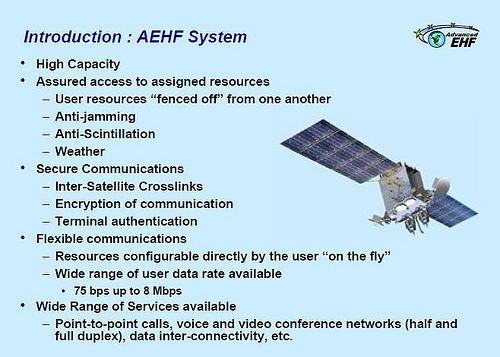
Use of extremely high frequency (EHF) also enable satellite communications systems to achieve a high degree of survivability under both electronic warfare and physical attack. Unlike systems dependent on lower frequencies, EHF satellite communications recover quickly from the scintillation caused by a high-altitude nuclear detonation. The use of higher frequencies offers a number of advantages — assurance of reliable communications in a nuclear environment, minimal susceptibility to enemy jamming and eavesdropping, and the ability to achieve smaller secure beams with modest-sized antennas.
Another military benefit is that K/Ka-band SATCOM terminals are smaller in size hence can provide benefit in reduced radar cross section (RCS) of the platform carrying them. Smaller antennas with reduced RCS also reduce the highly reflective hot spots in a warship’s topside that is of paramount importance in the face of threats from increasingly sophisticated sea-skimming anti-ship cruise missiles.
Certain characteristics of the earth’s atmosphere pose both problems and solutions for millimeter wave applications. For example, at 60 GHz (5 mm or 0.2 inches wavelength) oxygen molecules will interact with electromagnetic radiation and absorb the energy. Since there is almost no oxygen in space at the geosynchronous altitudes of 43,000 km or 26,000 miles), 60 GHz works just fine for communication between satellites and between satellites and earth.
AEHF System
The AEHF operational system is composed of three segments: space, terminals, and mission control. The space segment consists of a cross-linked constellation of satellites to provide worldwide coverage. The terminal segment includes fixed and mobile ground terminals, ship and submarine terminals, and airborne terminals. The mission control segment controls satellites on orbit, monitors satellite health, and provides communication system planning and monitoring. This segment is also survivable, with both fixed and mobile control stations.