
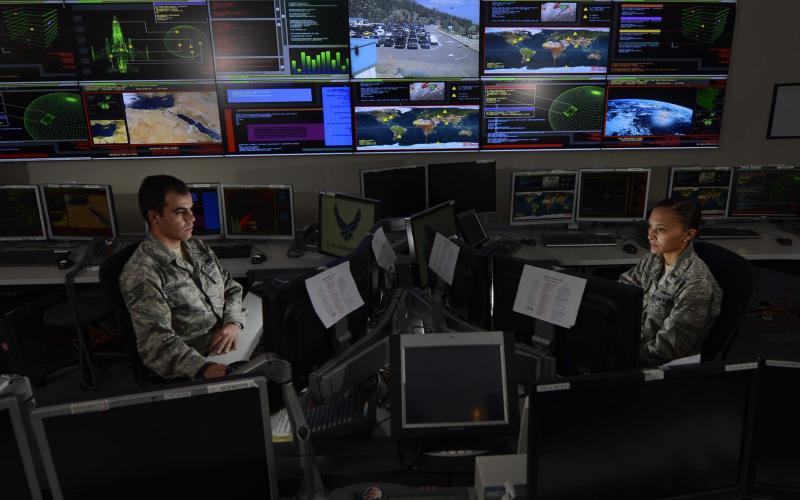

The Air Force must help develop new battle management networks and operating concepts as the Pentagon seeks to stay ahead of advanced adversaries, Deputy Secretary of Defense Bob Work had said. The ability to coordinate the operations of autonomous systems and other cutting-edge platforms and capabilities will be critical for warfighting and executing the new “third offset” strategy in the coming years, he said.
The Defense Department is developing and acquiring next-generation technologies and platforms, but tying them together will be essential if the U.S. is to maintain its combat advantage, the deputy defense chief noted. “It’s the most important thing we have to understand,” he told Air Force officials and members of industry. ”What is the brain that will make this work and what are the connections, the central nervous system that will allow us to wield this battle network effectively?”
The Air Force must now expand battle systems management and operating concepts beyond the service’s traditional domains, Work said. “Airmen think in terms of space, cyberspace and air,” he told service officials. “I hope you can lead the joint force into a new way of thinking where air superiority effects might originate under the sea, or land superiority is made possible through … multi-domain and multi-functional effects, and maritime superiority is achieved by cooperative operations at sea, on land and in the air.”
“We need ideas on how to connect sensing and effect grids through a command-and-control grid that is multi-domain, multi-functional,” he said at an Air Force Association air, space and cyber conference in National Harbor, Maryland. “We need Air Force thinkers to expand the idea of the [combined air operations center] and think in terms of building a joint learning C3I [command, control, communications and intelligence] network that can mesh operations across domains, across functions, with allies and sometimes across regions,” Work added.
Artificial intelligence will be the key ingredient in any solution, he noted. In the coming years, the adoption of various AI technologies will likely be gradual, Work said. “But if … [Air Force officials and others in the defense community] figure out a vision for a learning C3I network in which all of the narrow AI is contributing to better, faster knowledge and connecting the sensor grid to the effects grid, then that is when you will see the major revolutionary step” in warfighting capability, he said.
The Pentagon’s No. 2 official identified the recent creation of the Joint Interagency Combined Space Operations Center as an example of the push to develop better command-and-control networks to deal with emerging threats and thwart advanced adversaries who could seek to take down U.S. systems. The center, known as the JICSPOC, is charged with developing new tactics, techniques and procedures for operating and protecting military, intelligence and civilian space assets. It became operational last year as other countries continued to grow their counter-space capabilities.