
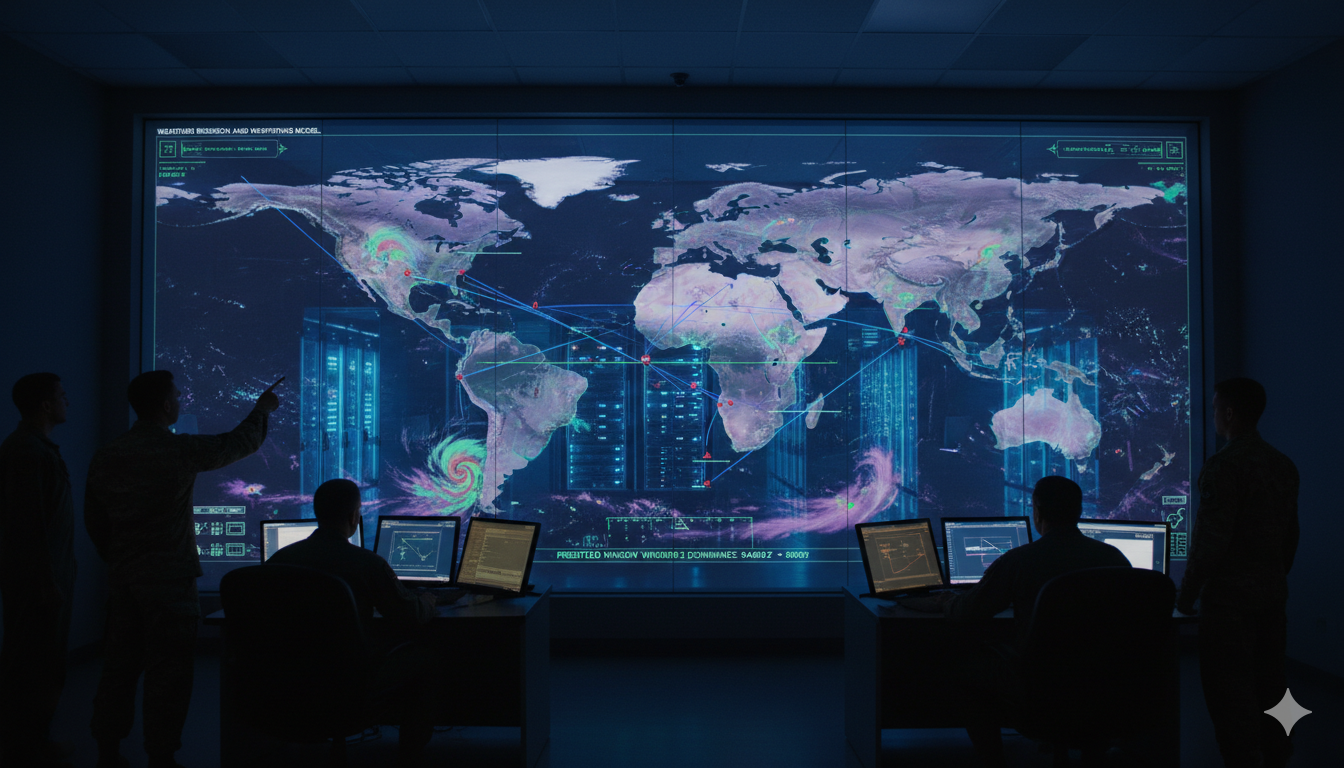

“A supercomputer takes very complex problems and breaks them down into parts that are worked on simultaneously by thousands of processors, instead of being worked on individually in a single system, like a regular computer. Thanks to parallel processing, researchers and scientists can generate insight much faster considering a laptop might take days or weeks to solve what a supercomputer can solve in minutes or hours,” explained Scott Tease, Lenovo’s executive director of High Performance Computing and Artificial Intelligence.
Before supercomputers, we couldn’t receive early warnings for tsunamis and researchers couldn’t see the trajectory or impact of hurricanes or study patterns in climate change. We were really limited to making a guess based on a few basic inputs—because complex models, with thousands of rapidly-changing variables, were virtually impossible.
Today, accurate weather modeling is dependent on a few major factors. Initial data gathering via satellite, buoys and ground weather stations provides current weather conditions at the point of collection. The ability to compile that data is a second step. The final step relies on some of the largest computing centers on earth to crunch composite conditions and forecast the likely future state of the weather.
“Today, weather forecasting is achieved via the use of mathematical weather models of the atmosphere. These models consist of equations describing the state, the motion and the time evolution of various atmospheric parameters such as wind and temperature,” said Dr. Zaphiris Christidis, Lenovo’s weather segment leader. “Consequently, these equations are solved numerically on supercomputers which simulates the actual behavior of the atmosphere.”
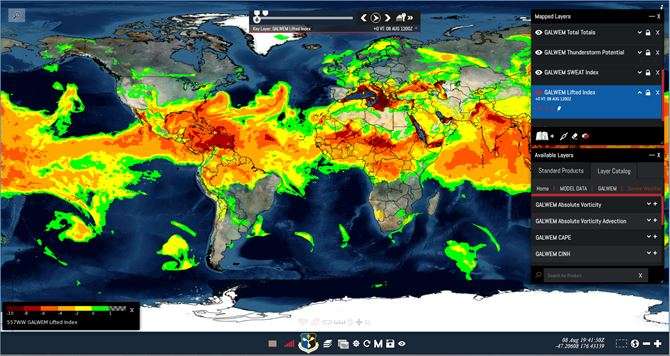
But these weather simulations take millions of initial data points from sensors on weather satellites, weather balloons, ocean buoys, and weather stations—huge amounts of data. Weather models today are generally limited by compute performance. As the performance of these supercomputers improves, more complex weather models can be employed, more data points can be ingested, and more scenarios can be accommodated to develop more accurate predictions.
“Even once we began using computer calculations in the 1950’s, weather predictions were highly inaccurate because of the limited computational power. For example, a weather model that we can run today in under 15 minutes on a standard Lenovo ThinkSystem server would have taken nearly 600 years to process on computer systems in the 1960’s,” added Dr. Christidis.
“If we know a severe weather event is about to occur ahead of time, we can take preventive measures to minimize any potential impact,” added Robert Daigle, Artificial Intelligence business leader at Lenovo.
“When we talk about improving the accuracy of weather predictions and early warning systems, the resolution of the model is important to capture the local weather phenomena. To double the resolution of a weather model, we must increase the compute performance by 8x, therefore computational power becomes essential,” he said.
Tease chimed in and shared an example between Lenovo and the Malaysian Meteorological Department (MMD). MMD works non-stop for the safety and well-being of Malaysian citizens by forecasting the weather and issuing the appropriate weather warnings. They wanted to improve their resolution from three kilometers to one kilometer and extend their forecast from three to seven days, which required a 27x increase in computational power.
With the support of Lenovo’s Scalable Infrastructure, MMD is now able to run a model for a seven-day forecast at a resolution of one kilometer in under three hours. “Improving the resolution of weather models allows MMD to detect local weather patterns such as convective thunderstorms that are very common in Malaysia which can bring heavy rain, hail, strong winds and even tornados,” said Tease.
The United Kingdom-based European Centre for Medium-Range Weather Forecasts (ECMWF), a supercomputer-powered weather forecasting organization backed by most of the countries in Europe, has signed a four-year, $89-million contract with Atos in a deal that is expected to quintuple its computing power. Atos will supply the Centre with its BullSequana XH2000 supercomputer, which will be hosted in a new datacenter in Bologna, Italy. The supercomputer – which will use AMD Epyc 7742 (64-core, 2.25 GHz) processors, alongside HDR InfiniBand from Mellanox and a DDN storage solution – is expected to become fully operational in 2021 following its installation in 2020.
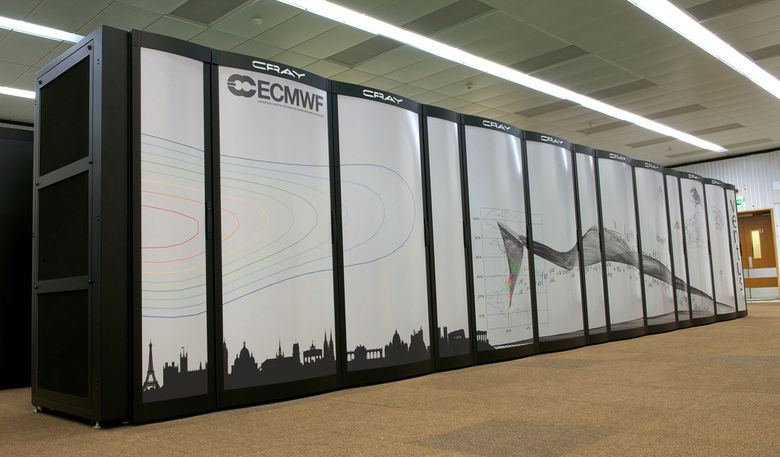
“One cannot overestimate the importance of accurate weather prediction,” said Günther Tschabuschnig, convener of the ECMWF subgroup that selected Atos. “This has never been truer than in our current age, as the effects of climate change are increasingly felt. Individuals and societies need ever greater amounts of information to ensure they are prepared.
In June 2020, the United States’ Global Forecast System received a major upgrade that the National Oceanic and Atmospheric Administration hoped would help to reestablish the U.S. as a leader in international weather modeling. In late 2018, the Korean Institute of Atmospheric Prediction Systems introduced a challenger to the U.K. Met Office’s popular Unified Model, which has served as a standard for most major weather organizations for over 25 years. Cray has picked up some significant business from this one-upsmanship: the Indian Institute of Tropical Meteorology, for instance, secured a pair of Cray XC40s in early 2018, and the UK Met Office continues to utilize three XC40 systems, an XC50 system and Cray’s Urika-XC AI and analytics tools.