

China, Russia and North Korea are looking to develop their submarine fleets . Russia is seeking to further bolster its sub-surface capabilities, with new generations of conventional and nuclear propulsion submarines, which promise to be significantly more difficult to detect and track for western naval forces. This includes the Yasen, Lada, Borei and Kalina classes of submarines. According to some estimates, Beijing’s diesel-electric submarine fleet could grow from roughly fifty in 2016 to seventy-five in 2030.
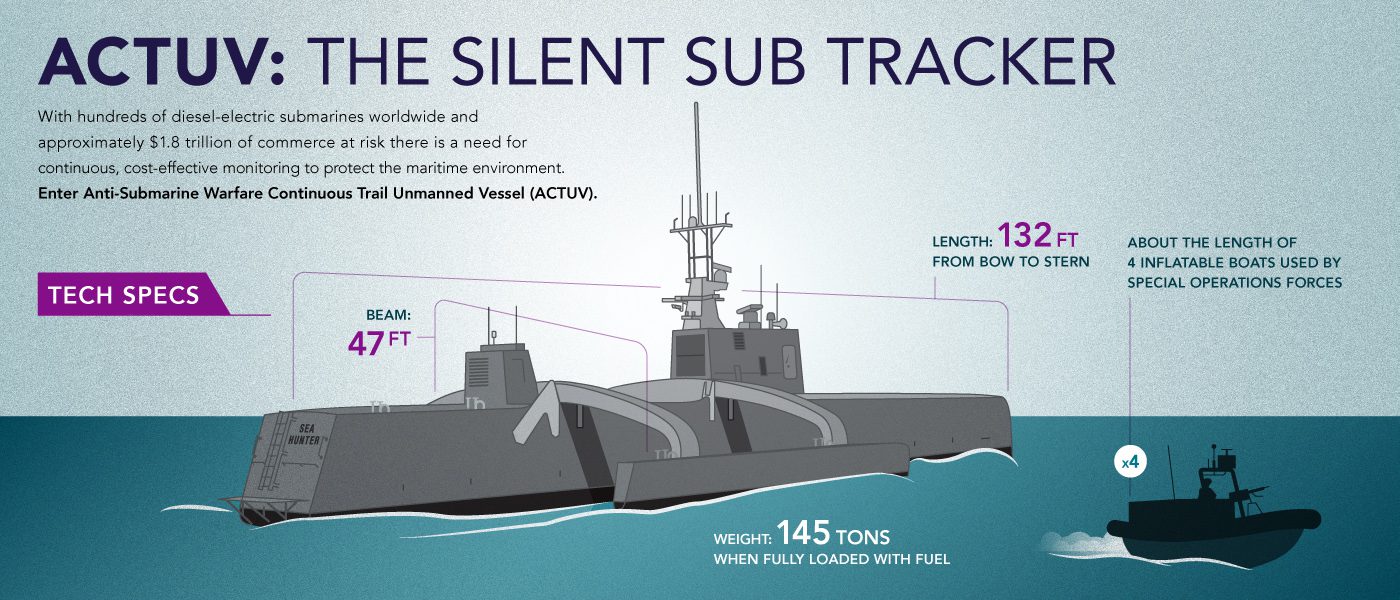
Improving America’s ASW capability is a pressing need, given the proliferation in the number and sophistication of enemy submarines. DARPA launched Anti-Submarine Warfare (ASW) Continuous Trail Unmanned Vessel (ACTUV) program — pronounced “active” — originally conceived as a project to create an unmanned underwater drone that could track enemy submarines. The aim of DARPA’s ACTUV project was to develop an unmanned surface vessel that will be able to locate and track submarines deep under the water, at levels of precision, persistence and flexibility beyond those capabilities available by manned surface ships operating anti-submarine warfare.
DARPA believes using large numbers of inexpensive unmanned ACTUVs are a way to counter submarines as an undersea component of anti-access warfare. “ACTUV represents a new vision of naval surface warfare that trades small numbers of very capable, high-value assets for large numbers of commoditized, simpler platforms that are more capable in the aggregate,” said Fred Kennedy, director of DARPA’s Tactical Technology Office (TTO).
While other unmanned water vessels have been limited by their need to be deployed from a larger ship and remotely-controlled, the 120-foot Sea Hunter is autonomous and designed to be able to launch from a pier and function on its own for up to months at a time and travel for thousands of miles. The ship, which was built by defense contractor Leidos, is currently undergoing trials as part of a joint project with the U.S. Office of Naval Research.
The Class III unmanned surface vessel (USV) has the potential to traverse thousands of kilometres of open ocean for months without a single crew member aboard and at a fraction of current costs – estimates range from $15,000-$20,000 a day compared with $700,000 a day to operate a destroyer. And should an enemy submarine be detected , it would guide U.S. Navy warships or aircraft to the sub’s location to destroy it (the Sea Hunter does not carry any weapons systems). According to DARPA, Sea Hunter could ultimately lead to a whole new class of ocean-going vessel and eradicate the need for larger manned warships, transforming conventional submarine warfare.
In addition to hunting enemy subs, ACTUV will be capable of a wide range of missions, such as reconnaissance and counter-mine deployments. It could also be useful to resupply troops. A suite of sensors “capable of tracking quiet, modern diesel electric submarines” will be implemented, including very high frequency sonar that will produce an “acoustic image” of the target to identify and classify the specific submarine. ACTUV will be smart, it will not just identify other vessels, but also predict how they will behave.
DARPA program manager Ellison Urban, quoted by Defense One, explains the rationale behind the U.S. Navy’s push for robot ships: Instead of chasing down these submarines and trying to keep track of them with expensive nuclear powered-submarines, which is the way we do it now, we want to try and build this at significantly reduced cost. It will be able to transit by itself across thousands of kilometers of ocean and it can deploy for months at a time. It can go out, find a diesel-electric submarine, and just ping on it.
The prototype submarine tracking vessel was ordered in 2012 by the Defense Advanced Research Projects Agency (DARPA), launched in January 2016 and christened Sea Hunter two months later. In October 2016, DARPA and ONR began at-sea testing of Sea Hunter’s sensing and autonomy suites. Between February and September 2017, the vessel passed three progressively challenging tests to integrate the suites and use them to comply with International Regulations for Preventing Collisions at Sea (COLREGS) in operationally realistic scenarios.
DARPA successfully completed its Anti-Submarine Warfare (ASW) Continuous Trail Unmanned Vessel (ACTUV) program in 2018 and has officially transferred the technology demonstration vessel, christened Sea Hunter, to the Office of Naval Research (ONR). ONR will continue developing the revolutionary prototype vehicle as the Medium Displacement Unmanned Surface Vehicle (MDUSV).
The ONR is planning to assess the vessel’s suitability for roles other than submarine hunting, such as logistics support, hydrographic survey and surveillance. Sea Hunter has already demonstrated the Towed Airborne Lift of Naval Systems (TALONS), employing a parakite to elevate various sensors, increasing their range and enhancing the vessel’s situational awareness.
ONR plans additional at-sea tests to further develop ACTUV/MDUSV technologies, including automating payload and sensor data processing, rapidly developing new mission-specific autonomous behaviors, and exploring autonomous coordination among multiple USVs.
The U.S. Navy plans to establish a Surface Development Squadron (SURFDEVRON) to help with the integration of future autonomous platforms like the sub-hunting robot ship Sea Hunter, in an ongoing effort to make U.S. naval surface forces more distributed and reliant on unmanned ships and aircraft, according to local media report.
The new SURFDEVRON will help integrate the new platform and subsequent USVs into the surface fleet. “We’ve got to figure out command and control,” Brown told Defense News. “We’ve got to figure out the man, train and equip aspects — there’s got to be an administrative commander in charge of them, got to be a guy who equips those things, got to be a guy who oversees the training of the people who interact with and use the USVs.”