
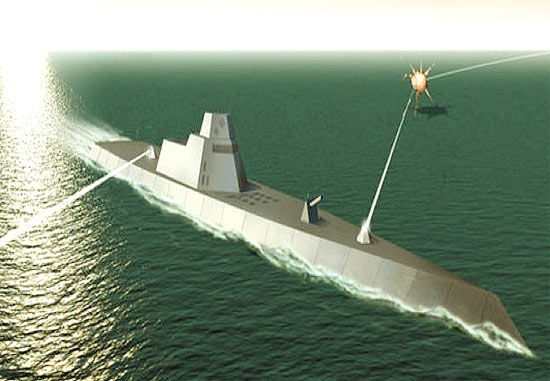

Navy ships face an increasing number of threats in conducting their missions, including UAVs, armed small boats, and adversary intelligence, surveillance and reconnaissance systems. The US Navy is concerned about the survivability of Navy surface ships in potential combat situations against adversaries, such as China, that are armed with large numbers of missiles, including advanced models, and large numbers of UAV. In response, the Navy surface evolved a new organizing for the Navy’s surface fleet called distributed lethality. Under distributed lethality, offensive weapons such as anti-ship cruise missiles (ASCMs) are to be distributed across a wider array of Navy surface ships, and new operational concepts for Navy surface ship formations are to be implemented.
The aim of distributed lethality is to boost the surface fleet’s capability for attacking enemy ships and make it less possible for an enemy to cripple the U.S. fleet by concentrating its attacks on a few very high-value Navy surface ships (particularly the Navy’s aircraft carriers), according to Congressional Research Service Report.
“Although Navy surface ships have a number of means for defending themselves against anti-ship cruise missiles (ASCMs) and anti-ship ballistic missiles (ASBMs), some observers are concerned about the survivability of Navy surface ships in potential combat situations against adversaries, such as China, that are armed with advanced ASCMs and with ASBMs,” observes CRS report: Navy Lasers, Railgun, and Hypervelocity Projectile: Background and Issues for Congress.
Three new ship-based weapons being developed by the Navy—solid state lasers (SSLs), the electromagnetic railgun (EMRG), and the gun-launched guided projectile (GLGP), also known as the hypervelocity projectile (HVP)—could substantially improve the ability of Navy surface ships to defend themselves against surface craft, unmanned aerial vehicles (UAVs), and eventually antiship cruise missiles (ASCMs).
The requirement for the laser stems from the proliferation of high-tech, anti-ship cruise missiles that travel at ever-increasing speeds with greater degrees of sophistication. Although Navy surface ships have a number of means for defending themselves against anti-ship cruise missiles (ASCMs) and anti-ship ballistic missiles (ASBMs), some observers are concerned about the survivability of Navy surface ships in potential combat situations against adversaries, such as China, that are armed with advanced ASCMs and with ASBMs.
Two key limitations that Navy surface ships currently have in defending themselves against ASCMs and ASBMs are limited depth of magazine and unfavorable cost exchange ratios. Limited depth of magazine refers to the fact that Navy surface ships can use surface-to-air missiles (SAMs) and their Close-in Weapon System (CIWS) Gatling guns to shoot down only a certain number of enemy unmanned aerial vehicles (UAVs) and anti-ship missiles. But the U.S. believes China and Russia are developing tactics and systems to force ships to expend all their missiles against an incoming salvo, and they might accomplish this by firing more missiles than the ships can shoot down — a saturation attack designed to leave the ships helpless after a certain number of salvos
Unfavorable cost exchange ratios refer to the fact that a SAM used to shoot down a UAV or anti-ship missile can cost the Navy more to procure than it cost the adversary to build or acquire the UAV or anti-ship missile. In the FY2018 defense budget, procurement costs for Navy SAMs range from about $976,000 per missile to several million dollars per missile, depending on the type.
Laser weapons use high power lasers to damage or destroy adversary equipment, facilities, and personnel. SSLs, offer a potential for dramatically improving depth of magazine and the cost exchange ratio: Depth of magazine. SSLs are electrically powered, drawing their power from the ship’s overall electrical supply, and can be fired over and over, indefinitely, as long as the laser continues to work and the ship has fuel to generate electricity. Cost exchange ratio. An SSL can be fired for a marginal cost of less than one dollar per shot (which is the cost of the fuel needed to generate the electricity used in the shot), while GLGP reportedly had an estimated unit procurement cost in 2018 of about $85,000.
In addition to a low marginal cost per shot and deep magazine, potential advantages of shipboard lasers include fast engagement times, an ability to counter radically maneuvering missiles, an ability to conduct precision engagements, and an ability to use lasers for graduated responses ranging from detecting and monitoring targets to causing disabling damage.
The technology provides major advantages for military applications due to High precision and rapid on-target effect, precise and scalable effects, Avoidance of collateral damage caused by fragmenting ammunition, Low logistics overhead and minimum costs per firing. Lasers can follow and maintain their beam on radically maneuvering missiles that might stress the maneuvering capabilities of Navy SAMs. Light from a laser beam can reach a target almost instantly (eliminating the need to calculate an intercept course, as there is with interceptor missiles) and, by remaining focused on a particular spot on the target, cause disabling damage to the target within seconds.
Navy surface ships would use high-energy SSLs initially for jamming or confusing (i.e., “dazzling”) intelligence, surveillance, and reconnaissance (ISR) sensors, for countering small boats and UAVs, and potentially in the future for countering enemy missiles as well. High-energy SSLs on Navy ships would generally be short-range defensive weapons—they would generally counter targets at ranges of about one mile to perhaps eventually a few miles.
Lasers can perform functions other than destroying targets, including detecting and monitoring targets and producing nonlethal effects, including reversible jamming of electro-optic (EO) sensors. Lasers offer the potential for graduated responses that range from warning targets to reversibly jamming their systems, to causing limited but not disabling damage (as a further warning), and then finally causing disabling damage.
The first generation Navy surface ships used high-energy SSLs initially for countering small boats, UAVs, and intelligence, surveillance, and reconnaissance (ISR) sensors. Between 2009 and 2012, the Navy successfully tested a prototype SSL called the Laser Weapon System (LaWS) against UAVs in a series of engagements that took place initially on land and subsequently on a Navy ship at sea. LaWS had a reported beam power of 30 kilowatts (kW).The system, offers military leaders precision accuracy at cost as low as a dollar per shot.
High-energy SSLs that have enough beam power to counter small boats and UAVs, but not enough to counter missiles, could nevertheless indirectly improve a ship’s ability to counter missiles by permitting the ship to use fewer of its SAMs for countering UAVs, and more of them
for countering missiles.
In August 2014, the Navy installed LaWS on the USS Ponce (pronounced ponSAY)—a converted amphibious ship that operated in the Persian Gulf as an interim Afloat Forward Staging Base (AFSB[I])—to conduct evaluation of shipboard lasers in an operational setting against swarming boats and swarming UAVs. In December 2014, the Navy declared LaWS on the Ponce to be an “operational”
system. Ponce remained in the Persian Gulf until it was relieved in September 2017 by its replacement, the new-construction Expeditionary Sea Base ship Lewis B. Puller (ESB-3).

The LaWS system integrates six solid-state IR beams, tunable to either low output for warning and sensor crippling, or high output for target destruction. The system is powered and cooled by a so-called “skid” that provides power through a diesel generator and is separate from Ponce’s electrical systems. ONR showed off a video in which the LaWS system — mounted on the ship’s super structure above the bridge — disabled a small Scan Eagle-sized UAV, detonated a rocket propelled grenade (RPG) and burned out the engine of a rigid hull inflatable boat (RHIB).
It is now developing next generation laser DEW for countering ASCMs and ASBMs as well.