
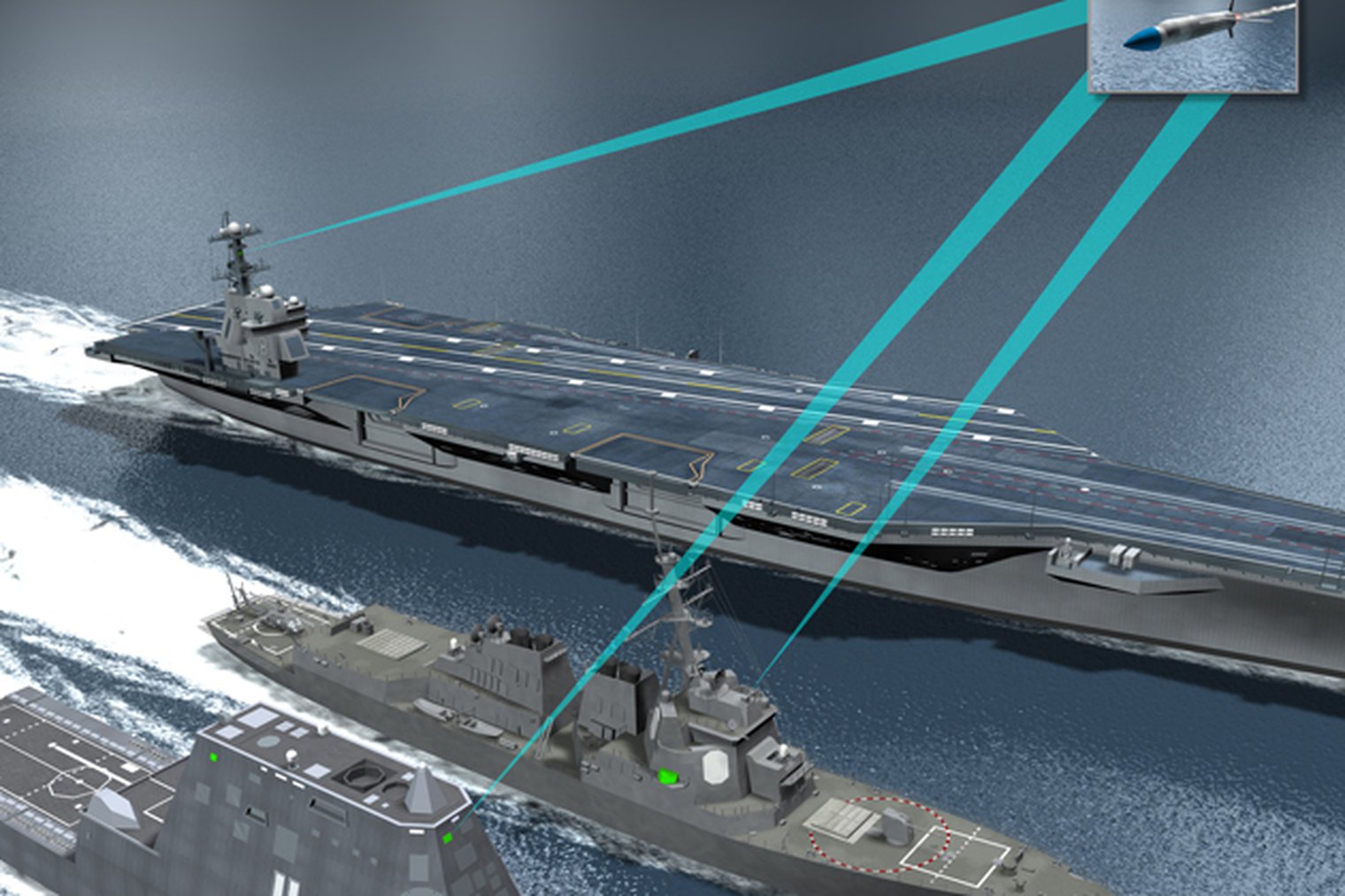

Naval Warships now faces wide spectrum of threats from air threats such as hypersonic missiles, ballistic and cruise missiles, rail guns, lasers , UAVs and underwater threats like cavitating torpedoes. One of the prime over water threat is from Anti-Ship Missiles type of guided missiles mostly of the sea skimming variety, and many use a combination of inertial guidance and active radar homing. A good number of other anti-ship missiles use infrared homing to follow the heat that is emitted by a ship; it is also possible for anti-ship missiles to be guided by radio command all the way.
The littoral environment, is also characterized by dense, commercial air traffic and merchant shipping, which present challenges to the combat systems (and their operators) in distinguishing between hostile, neutral, and friendly tracks.
Reduced radar cross sections and lowlhigh-altitude flight profiles will be employed to reduce the available battlespace by limiting the detection range and thus the time to react to and engage the target. The high-speed and high-acceleration (high g) terminal maneuvers can challenge the weapon system performance by stressing the defensive missile’s kinematics and agility. In addition, multimode seekers (combinations of RF active, antiradiation homing, or IR homing), as well as strict emissions control aimed at minimizing detection opportunities and the effectiveness of deceptive electronic countermeasures and decoys, can create further challenges for defensive electronic warfare systems.
A robust, autonomous ship self-defense capability is essential for these ships to be able to sustain operations and accomplish their missions. Improvements in each of the three major weapon system elements-detect, control, engage-are required to operate effectively in this environment and counter the air threat. Increased target detection ranges, decreased system reaction times, advanced command and control features, and improved hardkill and electronic warfare weapons can be developed, integrated, and coordinated to provide an effective defense.
The near-land, highclutter environment, coupled with sea-skimming missiles, can overburden many of existing sensors. Radar improvements in effective radiated power, aperture, waveform flexibility, and signal processing are required to achieve adequate detection ranges. Improved integration and the increased automation of sensors, weapons, and fire control systems are essential to shorten reaction time and coordinate weapon response. I
In addition, advanced command and control features are needed to enable command personnel to direct and monitor the overall operation of the combat system in this environment with complex rules of engagement and identification requirements. Finally, advanced defensive missiles with increased kinematics, fast flyout, multimode seekers (e.g., semi-active homing and IR terminal), improved au topilots and agility, and improved low-altitude ordnance fuzing are essential to countering the advanced-cruise missile threat.
To satisfy self-defense requirements, US Navy has embarked on series of upgradation of existing system elements and initiation of new critical developments under its Surface Electronic Warfare Improvement Program (SEWIP) program. The Navy has kept SEWIP a multi-prime effort, with General Dynamics providing much of Block 1, Lockheed Martin winning SEWIP Block 2, and Northrop Grumman winning the most recent Block 3 prime in February 2015.
The electronic warfare threats the Navy is facing is now employ wider frequency bands, low power signals, frequency diversity, complex emitters, electromagnetic capability/electromagnetic interference, and flight profiles. The Navy wants to harden its aircraft carriers, cruisers, destroyers and warships against an evermore hostile electronic warfare environment. And to do so, the service recently awarded Lockheed Martin an $184 million contract.