

Military is integrating Smartphones and tablets into their military operations, to enhance situational awareness and as backup communication in denied situations. Marines are considering airborne operations with tablets, Air Force looks at maintenance efficiencies, they have also widely used for training and education. They are also using ruggedized cases to withstand water, impact, and environmental challenges.
Instant messaging has become more convenient for quick and easy communication of text, voice or video than email or SMS text messaging. WhatsApp mobile messaging service owned by Facebook now has grown to more than 1 billion users. The instant-messaging app sees nearly 42 billion messages sent each day via its platform, with over 1.6 billion photos being shared daily. Numbers also reveal that over 250 million videos are shared each day on WhatsApp, and that there are over 1 billion groups.
Users are also concerned with lack of privacy; therefore, the next generation message apps are being designed with security in mind. A secure messaging application will let you safely exchange private information with employees, clients and co-workers, without worrying that your data could be compromised. However, these enhanced security features also allow the terrorist groups to carry out their clandestine communications and propaganda broadcast. FBI has warned about the dangerous dark future where criminals use technology that’s impossible to spy on.
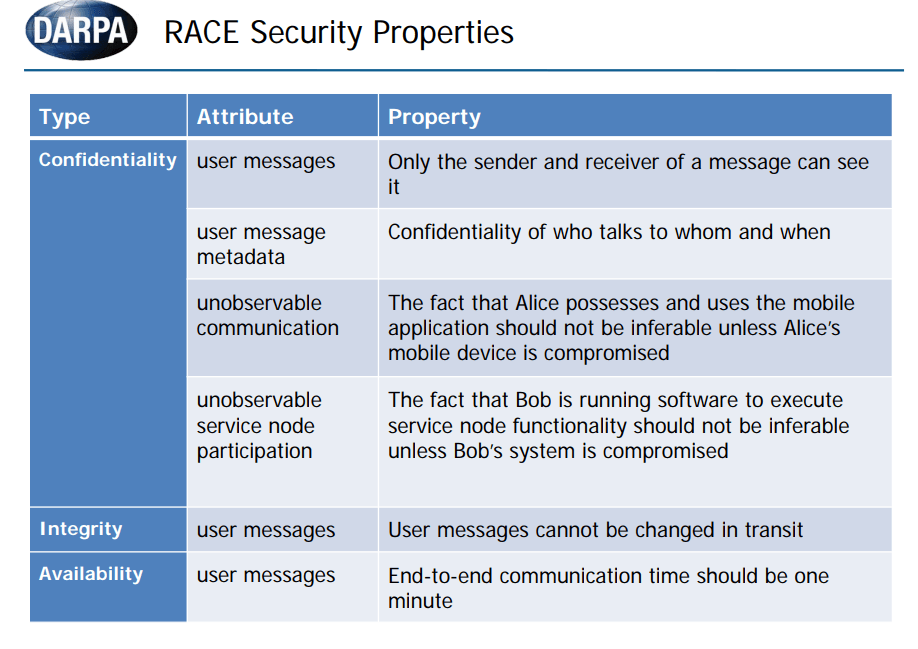
As per a Proposers Day briefing document by Dr. Joshua Baron, DARPA is working on an anonymous, hack-proof and end-to-end mobile communication system. DARPA is soliciting innovative research proposals in the area of cryptographic and communication obfuscation techniques in order to build an anonymous, attack-resilient mobile communication system that can reside completely within a network environment. Proposed research should investigate innovative approaches that enable revolutionary advances in science, devices, or systems. Specifically excluded is research that primarily results in evolutionary improvements to the existing state of practice.
Military is also building secure networks which these mobiles can use. “If you could build a secure network, one that troops could actually use in the most remote stretches of wilderness and the most war torn cities, even the simplest of smartphone functions would be tremendous tools not only for communicating but also for other simple tasks that are quickly complicated in battlefield scenarios”, said DARPA program manager Doran Michels