
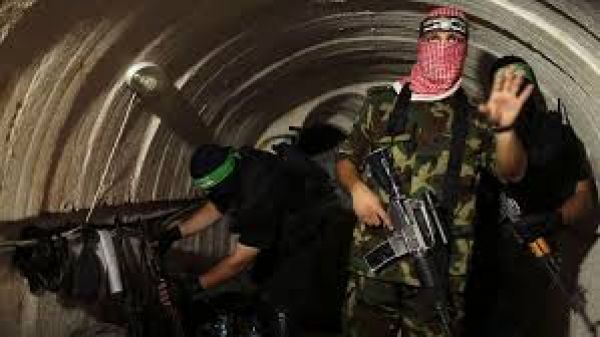

Criminals, terrorists and military have been using tunnels since long time to evade detection as surface based detection methods are ineffective underground .
Indian Border Security Force (BSF) troopers in Nov 2020 discovered an underground tunnel on the international border at Regal area in J&K`s Samba district, officials said. As per the BSF officials, the underground tunnel was discovered by a patrol party and “could have been used for infiltration from across the border”. DGP Dilbag Singh confirmed that a150-metre long underground tunnel was detected by the BSF at the International Border in Jammu and Kashmir’s Samba sector . The BSF officials further said that a massive anti-tunnelling operation was carried out jointly by the Army and police.
The tunnels threat was also faced by the U.S.-led coalition against ISIS who lurked in trenches and in a complex system of caves and tunnels. The tunnels, which are thought to run for at least two kilometers, seemingly helped hide tens of thousands of people, mostly IS fighters and their families, through much of the early part of the U.S.-backed Syrian Democratic Forces (SDF ) offensive.
The tunnel threat is also a serious and growing concern to U.S and Mexico, as they enable human trafficking and smuggling of drugs and weapons across the border. Recently a drug smuggling tunnel was discovered along the California-Mexico border that set the record for the longest cross-border tunnel ever discovered in Southern California. Around 170 tunnels have been discovered since 1990, Sixty percent of them discovered in just the last three years. According to the Department of Justice’s accounting, the tunnel was estimated to span 800 yards, and likely a lot longer due to its “zig-zagging” route, as Assistant U.S. Attorney Timothy Salel put it. “It is equipped with rail and ventilation systems, lights and a sophisticated large elevator leading from the tunnel into a closet inside the Tijuana residence,” he added. “It is one of the narrowest tunnels found to date, with a diameter of just three feet for most of the length of the passageway.”
It seems tunnel warfare is becoming a global concern as it is also common in other parts of the world such as Iraq, Afghanistan and Syria where rebels use them in combating Assad’s military forces. In between 2001 and 2016, India has discovered at least eight tunnels originating from across the border along Pakistan, at an average of one every two years. And, only one of these is suspected to have been dug for drug running, while the others are linked to possible or successful infiltrations.
Many defense companies including Lockheed Martin and Raytheon, are developing technologies for detecting tunnels. U.S. government is earmarking $120 million over the next three years and partnering with Israel to help develop a new tunnel detector. The goal, U.S. Defense Department spokesman Christopher Sherwood told Foreign Policy, “is to establish anti-tunnel capabilities to detect, map, and neutralize underground tunnels that threaten the U.S. or Israel…”
In recent Israel-Palestine Conflict, Israel had carried out massive ground offensive to wipe out a vast network of tunnels built by Hamas. Israel sees these being built for infiltrating its territory, smuggle large amounts of firearms and other sabotage materials into the Gaza Strip. The Israel Defense Forces has installed a series of underground sensors ( acoustic and seismic ) along the northern border in order to detect any new subterranean tunnels entering Israeli territory from Lebanon.
In December 2018, the IDF launched Operation Northern Shield, an effort to locate and destroy tunnels dug by Hezbollah into northern Israel from southern Lebanon. In total, the military said it found six such passages and rendered them inoperable — either using explosives or filling them with concrete — last year. The IDF believes that the six tunnels dug by Hezbollah into northern Israel were built with the specific purpose of allowing thousands of Hezbollah terrorists to stage an infiltration attack on military and civilian targets in northern Israel as a surprise opening maneuver in a future war.
Prime Minister Benjamin Netanyahu and Defense Minister Avigdor Liberman in oct 2017, hailed the IDF for destroying an attack tunnel from the Gaza Strip discovered near a kibbutz inside Israeli territory, with the two leaders attributing its discovery to Israel’s new “breakthrough technology.” I told you many times before that we are developing breakthrough technology to deal with the tunnel threat,” said Netanyahu at the start of the meeting. “We are implementing it. Today, we located a tunnel and we destroyed it.”
Earlier, the military said the tunnel had been under surveillance for an extended period of time and was under active construction at the time of the demolition. “The tunnel was detonated from within Israel, adjacent to the security fence,” the military said in a statement. IDF spokesperson Lt. Col. Jonathan Conricus said the tunnel was at least two kilometers away from the Israeli town and did not pose a threat to its residents. Liberman also said no Israelis were endangered by the tunnel.
In March 2016, the Indian BSF floated a Request for Proposal for a pilot project of the CIBMS in two five-km patches along the border in Jammu. Tata Power SED and Dat Con have won a pilot project of the Ministry of Home Affairs to install an integrated border-guarding system to test technology for preventing infiltration, especially by detecting cross-border tunnels as well as possible entries through aerial and underwater routes. Called the Comprehensive Integrated Border Management System (CIBMS), it is a major counter-infiltration measure to prevent cross-border terror attacks and detect tunnels.