
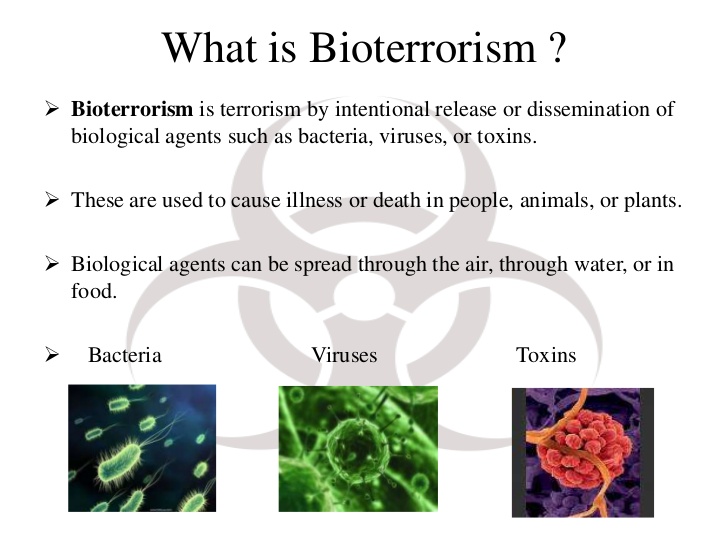

The COVID-19 pandemic has demonstrated that significant biological threats can and will emerge from nature without warning, demonstrating that a single viral strain can have a profound impact on modern society. It has also demonstrated that infectious diseases can rapidly spread throughout a population without human engineering making them the ideal substrates from which to develop engineered weapons. Viruses and bacteria have been used as weapons for millennia. Biological weapons achieve their intended effects by infecting people with disease-causing microorganisms and other replicative entities, including viruses, infectious nucleic acids and prions. The chief characteristic of biological agents is their ability to multiply in a host over time.
The use of a pathogen for hostile purposes became a consuming concern to the American people soon after 9/11. About a half-dozen letters containing anthrax spores were mailed to journalists and politicians beginning one week after the jetliner attacks. In the end, at least 22 people had become infected, five of whom died. Meanwhile, scores of buildings were belatedly found to be contaminated with spores that had leaked from the letters. At least 30,000 people who were deemed at risk required prophylactic antibiotics. Millions more were fearful, many of them anxious about opening their own mail.
The threat posed by biological weapons—is especially challenging because of the unique character of these weapons. A prime distinction is the fact that exposure to minute quantities of a biological agent may go unnoticed, yet ultimately be the cause of disease and death. The incubation period of a microbial agent can be days or weeks; unlike a bombing, knifing, or chemical dispersion, a bioattack might not be recognized until long after the agent’s release. Accordingly, bioterrorism poses distinctive challenges for preparedness, protection, and response.
The threat is further compounded by growth of Synthetic biology. In April 2019, small group of scientists at ETH (German: Eidgenössische Technische Hochschule) Zurich developed a technology which modified a genome using computers within the time frame of one year at 120,000 Swiss francs which is a fraction of the cost of the previous experiments. They could achieve this in the Caulobacter genome, by synthesising 236 genome segments and inserting them into the bacterial genome after joining them together, a process which replaced about one-sixth of the genome. By doing so, the researchers demonstrated the ability to produce strains of bacteria that contained both the naturally occurring Caulobacter genome and also segments of the new artificial genome.
Researchers at the Medical Research Council Laboratory of Molecular Biology in Britain were similarly able to rewrite the DNA of the bacteria Escherichia coli and configure a synthetic genome four times larger and way more complicated than any previously created. Such developments have great potential for the growth of synthetic organisms that have the capability of producing a wide variety of products such as DNA vaccines and other life-saving molecules. On the negative side, we could also use this technology for making bio-weapons. , say US New report .
In response, US has launched its New Biodefence Strategy. Biological threats emanate from many sources, and they know no borders, They have great potential to disrupt the economy, exact a toll on human life, and tear at the very fabric of society, according to the report. Robert P. Kadlec, the Department of Health and Human Services (HHS) Assistant Secretary for Preparedness and Response echoed this sentiment, saying, Whether a natural outbreak, an accidental release, or a deliberate attack, biological threats are among the most serious we face, with the potential for significant health, economic and national security impacts. Therefore, promoting our health security is a national security imperative.