

China is developing a new type of spy satellite using ghost imaging technology which could spot stealth aircraft and see through smokescreens and camouflage.
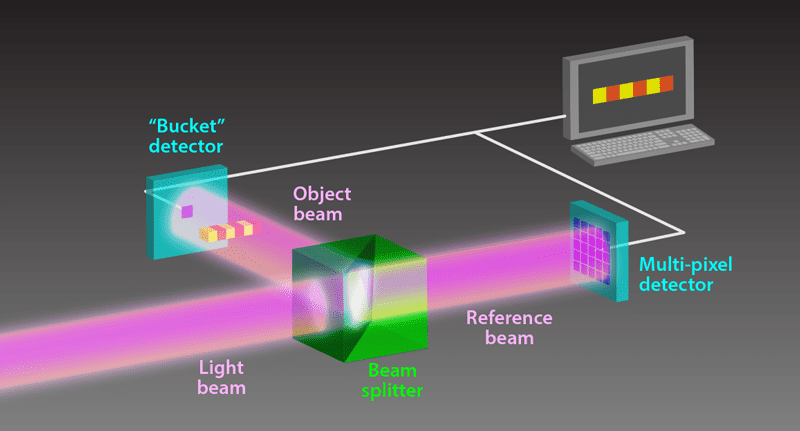
Ron Meyers, quantum physicist at the Army Research Laboratory. Meyers explained ghost imaging, a technique that allows a high resolution camera to produce an image of an object which the camera itself cannot see. It uses two sensors, one that looks at a light source and another that looks at the object. A computer program then compares and combines the patterns received from the object and the light. This creates a “ghost image,” a black and white or color picture of the object being photographed. The earliest “ghost images” were silhouettes but current ones depict the objects more realistically. “I think, or I would hope, in a few years that we have a soldier using a quantum ghost imaging imager to look through battlefield smoke and identifying friend or foe,” Meyers said.
Quantum ghost imaging can achieve unprecedented sensitivity by detecting not just the extremely small amount of light straying off a dim target, but also its interactions with other light in the surrounding environment to obtain more information than traditional methods.
Gong Wenlin, research director at the Key Laboratory for Quantum Optics, Chinese Academy of Sciences in Shanghai – whose team is building the prototype ghost imaging device for satellite missions – said their technology was designed to catch “invisibles” like the B-2s.
Tang Lingli, a researcher with the Academy of Opto-Electronics, Chinese Academy of Sciences in Beijing, said numerous new devices had been built, tested in the field and were ready for deployment on ground-based radar stations, planes and airships.
While ghost imaging has already been tested on ground-based systems, Gong’s lab is in a race with overseas competitors, including the US Army Research Laboratory, to launch the world’s first ghost imaging satellite.
The chinese team showed the engineering feasibility of the technology with a ground experiment in 2011. Three years later the US army lab announced similar results.