
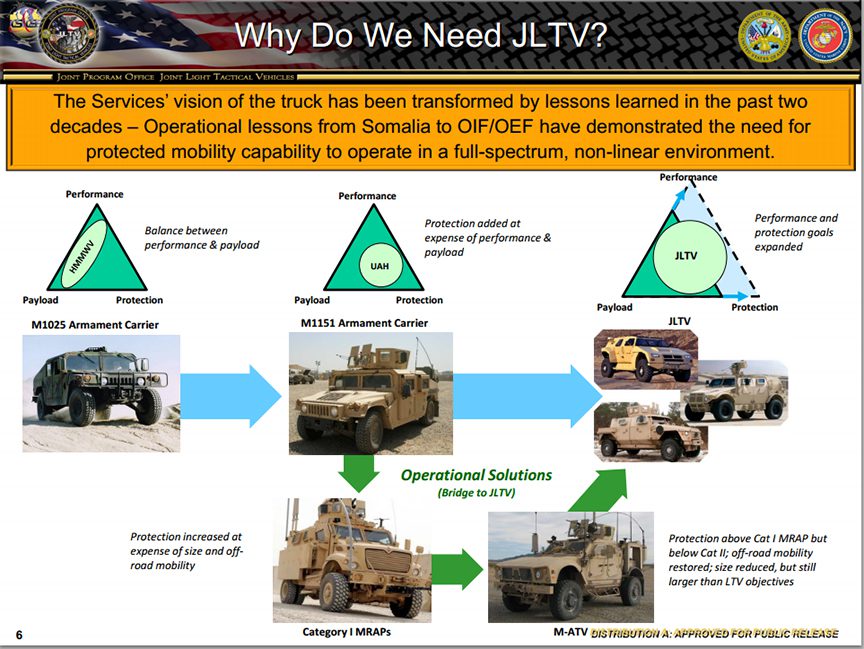

The Joint Light Tactical Vehicle (JLTV) is an Army-led, multiservice initiative to develop a family of future light tactical vehicles to replace many of the High Mobility, Multi-Wheeled Vehicle (HMMWV), which has been in service since 1985. The unarmored Humvee were found vulnerable to IEDs in Iraq and Afghanistan where hastily added armor provided a flawed and temporary solution. The difficulties and costs experienced in “up-armoring” HMMWVs already in the inventory have led to renewed emphasis on vehicle survivability. The JLTV, however, is built for driving among the IEDs, rocket-propelled grenades, and small-arms fire of the modern battlefield.
The JLTV program is a joint Army/Marine Corps effort to develop and produce both vehicles and associated trailers, capable of performing multiple mission roles while providing protected, sustained, and networked mobility for personnel and payloads across the full spectrum of military operations. Originally, there were three variants, but now there are two JLTV variants: a four-passenger Combat Tactical Vehicle (CTV) and a two-passenger Combat Support Vehicle (CSV). Category B variant was eliminated because it proved to be too heavy to meet the required weight limit of approximately 15,639 pounds to make it transportable by Army CH-47F and Marine Corps CH-53K helicopters.
As planned, JLTVs would be mechanically reliable, maintainable (with on-board diagnostics), all-terrain mobile, and equipped to link into current and future tactical data nets. Survivability and strategic and operational transportability by ship and aircraft are also key JLTV design requirements.
JLTV provides the warfighter significantly more protection against multiple threats while increasing mobility and payload compared to the current armored High Mobility Multipurpose Wheeled Vehicle platforms. JLTV provides improved off-road mobility, fuel efficiency and reliability over Mine Resistant Ambush Protected All-Terrain Vehicles. Its maneuverability enables activities across the spectrum of terrain, including urban areas, while providing inherent and supplemental armor against direct fire and improvised explosive device threats. The JLTV is transportable by a range of lift assets, including rotary-wing aircraft, to support operations across the range of military operations.
The 14,000-pound costing $399,000, JLTV is being manufactured by Oshkosh Defense and is in the low-rate initial production (LRIP) testing phase for the current contract to deliver about 5,000 vehicles, according to Fullmer. The $6.7 billion contract calls for just under 17,000 trucks, along with test support and fielding and maintenance services, with three years of LRIP production and five years of full-rate production, he said. The Army plans to acquire about 55,000 trucks by the mid-2030s that would replace both services’ active-duty and reserve Humvee fleets.
The JLTV, which is scheduled to be fielded with Marines in 2019, will provide the force with capabilities it’s never seen before in a light tactical vehicle. It’s light, mobile, protected, and flexible enough to accept any combination of weapons systems necessary for each mission», said George Mansfield, Vice President and General Manager of Joint Programs, Oshkosh Defense.
In addition to the recently completed operational testing, the JLTV also completed Reliability Qualification Testing earlier in 2018, accumulating over 100,000 miles and exceeding reliability requirements. Till June 2018, Oshkosh has produced more than 2,000 JLTVs and has delivered more than 1,600 JLTVs to the U.S. Army and Marine Corps. A Full Rate Production (FRP) decision is expected in FY19.
Full-rate production should begin in November or December of 2019 ahead of fielding, and initial operating capability is expected for early to mid-2020. According to the Marine Corps, fielding for the JLTV will begin in spring 2019.
The U.S. Department of Defense (DOD) wants to buy 54,599 JLTVs — 49,099 for the U.S. Army and 5,500 for the U.S. Marine Corps. The U.S. Government Accountability Office (GAO) estimates that the DOD will spend more than $53.3 billion on the JLTV program — $1.1 billion for research and at least $52.3 billion for procurement. In all, the Army plans to purchase 49,000 JLTVs and the Marine Corps will purchase 9,091. Air Force will acquire 140 JLTVs in FY2018 for its Security Forces that protect missile launch facilities. The British Army is reportedly trying to acquire 750 JLTVs through Foreign Military Sales (FMS).