
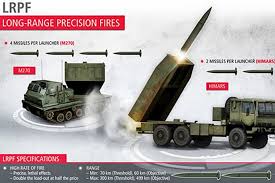

As the focus of the US Army shifts from low intensity conflicts against guerrillas, non-state actors, and terrorists to near peers like Russia, China and North Korea which have mechanized ground forces, the Army is trying to boost its conventional firepower, both in lethality and range.
The United States Army is looking to replace older, Cold War era missiles with new ones capable of hitting targets up to three times farther than before. The new missile will also be more compact, allowing twice as many to fit into existing launchers, and feature precision guidance.
“We need cannons that fire as far as rockets today, we need rockets that fire as far as missiles, and we need missiles that push out to 499 kilometers and beyond,” Gen. Robert Brown, commander of U.S. Army Pacific, told an Association of the U.S. Army audience in Huntsville, Alabama.
The US Army has completed the preliminary design review (PDR) of the new surface-to-surface missile known as DeepStrike. Developed by Raytheon, the DeepStrike missile fulfils the US Army’s Precision Strike Missile (PrSM) requirement. During the PDR, the new missile was evaluated on all of its characteristics, including advanced propulsion system, lethality package and guidance system.
In 2017, the U.S. Army has awarded Raytheon a contract to continue developing a new long range tactical missile system. Known as DeepStrike, the missile will replace the Army Tactical Missile System, or ATACMS. The missile will be able to strike targets up to 309 miles away with precision, including moving targets both on land at sea. Raytheon’s contract is worth $116.4 million and will result in a series of live fire demonstrations in 2019. According to the Phoenix Business Journal, Raytheon believes it can deliver the missile ahead of schedule.
That would make the Army capable of fulfilling PACOM head Admiral Harry Harris’ dream of getting the Army back into the business of sinking ships. The idea is that in any future air-land-sea conflict, particularly in the Pacific, Army forces could land on an island or coastline, bring DeepStrike with them, and immediately project a 309 mile “no-go” zone against enemy targets on both land and sea.