
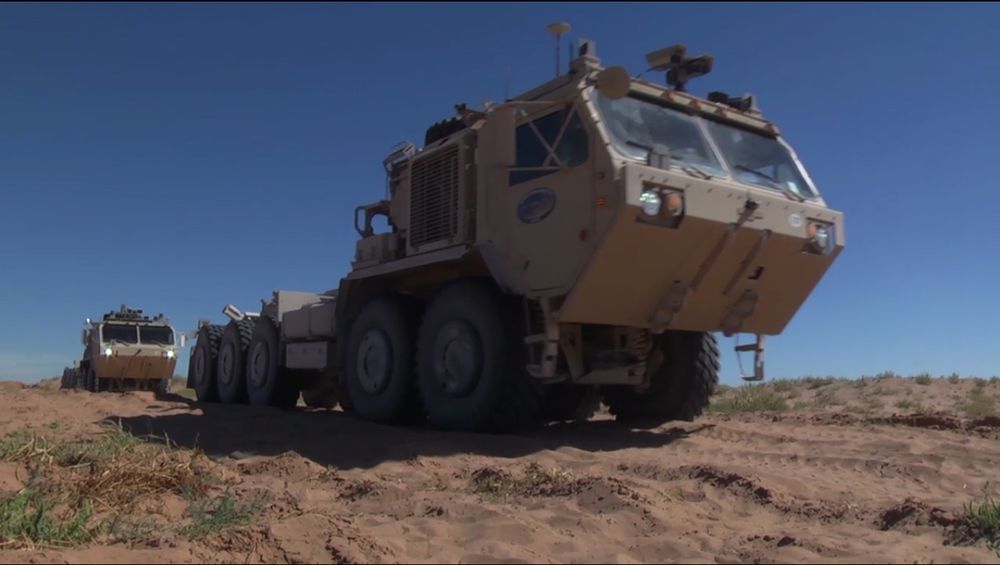

Recent combat operations have continually demonstrated the vulnerability of convoys due to their fundamental requirement for delivering sustainment supplies over long distances of unsecured routes. This operational reality of convoy missions makes them particularly vulnerable to attack and ambush. According to US DOD 52 percent of all battlefield casualties are caused when soldiers are delivering fuel, food or other supplies.
Autonomy is a key technology, critical to the future fleet of fighting vehicles. Keeping soldiers safe continues to be the main reason the military enlists unmanned vehicles into its ranks, when driving into a combat zone especially for resupply missions. Driverless technology could reduce the risk of injury or death for convoys traveling through territory with hidden roadside bombs, reducing the number of casualties associated with ground resupply missions. The Army believes the self-driving vehicles could be ideal during humanitarian relief missions in a natural disaster or for resupplying troops in the field, recognizing opportunities for cost savings and fewer crashes.
Carmakers and tech companies are very heavily focused on the driverless vehicles. Some of the world’s largest car manufacturers and technology companies are competing to tap into what could be a $7-trillion revenue stream. Of course, industry talking points emphasize something besides money: safety. Many fatal road-traffic accidents are caused by errors people make when distracted by, for instance, texting, drinking or napping while driving. Self-driving technology promises to fix this. However, migrating the commercial driverless cars technology to autonomous military vehicles have additional challenges due to battlefield environment of dust, interference, obstacles and threats.
Rise in Military Robotic and Autonomous Systems (RAS)
The Army RAS Strategy describes it as ‘the application of software, artificial intelligence and advanced robotics to perform tasks as directed by humans’. Likewise, it has also been described by Paul Scharre as ‘a machine, whether hardware or software, that, once activated, performs some task or function on its own’.
The key is that a RAS can be physical or non-physical and that it fulfils a function without requiring human input. Levels of autonomy and functionality are variable, with graduated levels of human input or supervision. This ranges from remote control, which is how the military traditionally uses Uncrewed Air Systems (UAS), to semiautonomous systems where relatively simple inputs enable control, to full autonomy. Full autonomy is currently employed in some manufacturing processes and in the mining sector, where humans merely supervise autonomous dump trucks from thousands of kilometres away.
The potential for RAS to benefit logistics has been highlighted in the UK, where it has been identified that ‘[s]ustainment will be improved … by improved stock and platform monitoring and anticipation; but also by automated logistic delivery’. It is helpful to note that logistic systems are configured to overcome two key problems—time and volume. The requirement to have the correct commodity, in the right quantity, at the right place and in a timely manner drives the logistic structure to support an operation.
There is an opportunity to address time and volumetric limitations through significantly enhanced logistic situation awareness, monitoring and artificial intelligence (AI) assisted decision-making. This would require more than simply an enhanced recognised logistic picture; rather, it would require a system that fuses logistic information, real-time usage monitoring and an understanding of future intentions. Such a system would be able to not only identify what is needed and where but also recommend, plan, and deliver the commodity in a timely manner. This would reduce stock waste and avoid unnecessary logistic movement.
Robotic and Autonomous Systems (RAS) highlights the physical (robotic) and cognitive (autonomous) aspects of these systems. RAS offers the possibility of a wide range of platforms—not just weapon systems—that can perform “dull, dangerous, and dirty” tasks—potentially reducing the risks to soldiers and possibly resulting in a generation of less expensive ground systems.
China is attempting to become the world leader in artificial intelligence by 2030. Artificial intelligence is a national priority in China, whose government has established an Artificial Intelligence Innovative Platform. China’s military is already using some artificial intelligence technology, including the use of drones and military robotics that feature extensive autonomous capabilities.
In recent years, the Russian military has achieved major breakthroughs in the development of unmanned systems. Russian investments in artificial intelligence and other emerging technologies will help their soldiers counter the physical, cognitive, and operational challenges of urban warfare and perform better in future conflicts. In fact, Russia’s Military Industrial Committee has approved plans to derive 30% of Russia’s combat power from remote-controlled systems and platforms enabled by artificial intelligence by 2030.
Russia is currently working on two tank-like combat systems referred to as Shturm (Storm) and Soratnik (Ally). According to the Russian defense manufacturer Kalashnikov, “Robot tanks do not need crews. Robots without human intervention will detect enemy weapons, destroy them, and issue target designations.” This certainly indicates Russia’s intent to develop unmanned combat systems without need for a human in the decision loop. The US Army Robotic and Autonomous Systems (RAS) Strategy describes how the Army will integrate new technologies into future organizations to help ensure overmatch against increasingly capable enemies.