

Among all the electromagnetic waves in the universe, the most relevant to us are those in the visible spectrum. It is the radiation at these wavelengths that enables us to see our surroundings and live, by breathing in oxygen generated by photosynthesis. Ultraviolet (UV) is electromagnetic radiation with a wavelength from 10 nm to 400 nm, shorter than that of visible light but longer than X-rays. Ultraviolet rays are invisible to all humans, although insects, birds, and some mammals can see near-UV.
In the deep UV, which corresponds to wavelengths of 280 nm or less, photons have higher energies and can interact with living cells, exciting electrons and disrupting critical chemical processes. This has led to mutation and cancer. Fortunately, however, UV light also has a good side. Highly energetic photons can be used to excite, engineer or break materials and chemical bonds in numerous applications.
One example of the positive use of UV light is as a source for enabling the identification of unknown biochemical substances. Radiation in this spectral range is ideal for this task, because all the functional groups are absorptive in the deep UV, compared to just a few in the visible.
Current UV-based detection equipment include light emitting diodes (LEDs), fluorescent lamps, or large form-factor lasers such as solid-state or Excimer lasers. While LEDs are small, inexpensive, and have demonstrated continuous wave (CW) power levels around 70 mW at 270 nm, they lack the coherency of true laser sources that exhibit narrow linewidth, high beam quality and high power density. Similarly, fluorescent lamps are good for broad UV illumination but do not have the linewidth necessary for high-resolution spectroscopy.
This makes for stronger signals that speed detection. Using UV light to identify substances is not easy, however. Many applications cannot be taken out of the lab, because today’s gas and solid-state deep UV lasers are bulky, complex, and costly.
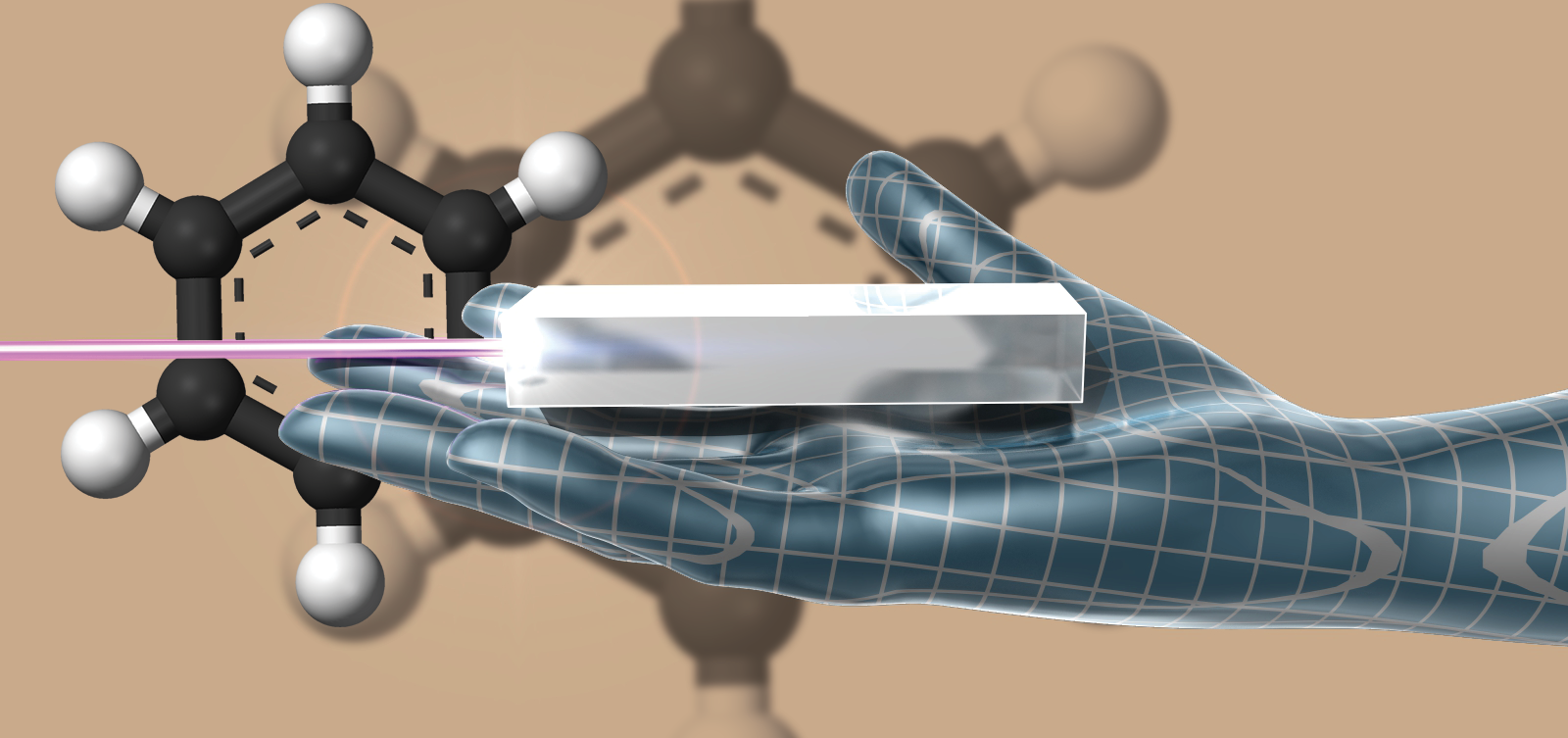
To tackle this issue, DARPA has funded and led two consecutive programmes: Compact Mid-Ultraviolet Technology (CMUVT) and Laser UV Sources for Tactical, Efficient Raman (LUSTER). These programmes had a primary purpose of developing deep UV semiconductor diode lasers for efficient, low-cost, tactical Raman spectroscopy.
Benefits of a compact, deep UV laser are by no means limited to providing a source for Raman spectroscopy. This device could also aid non-line-of-sight (NLOS) communication, which is enabled by special characteristics of our atmosphere. In its upper region, ozone absorbs nearly all the sun’s deep UV light. Consequently, light in this solar band is nearly non-existent on the earth’s surface. The result is a low noise environment for the deep UV radiation, where photodetectors can reach a quantum-limited level of photon-counting detection.
Another appealing feature of the NLOS communication technology is that close to ground level, molecules and aerosols produce strong angle-independent scattering of deep UV light. This creates numerous communication paths from the source to the receiver, enabling the transfer of information even when line-of-sight obstacles are in the way’ such as buildings in an urban city. What’s more, deep UV light from the source is absorbed moderately by the atmosphere. This limits the distance that information may be transmitted, making this communication technology ideal for tactical applications.
DARPA has awarded separate contracts to Palo Alto Research Center and Sensor Electronic Technology, Inc. in support of the Laser UV Sources for Tactical Efficient Raman (LUSTER) program. Zhenqiang (Jack) Ma, of UW-Madison, and collaborators from Michigan State University, the University of Texas at Arlington and North Carolina-based company HexaTech Inc., have also received a $4 million DARPA grant to develop compact and highly efficient light sources for ultraviolet lasers under LUSTER program.
“In addition to detecting chemical and biological agents in the field—or at home to protect against mass terror attacks—UV lasers have many other uses,” said Green. “The new class of UV lasers envisioned from the LUSTER program is expected to impact a broad range of applications such as point-of-need medical diagnostics, advanced manufacturing and compact atomic clocks.”