

As the name indicates, ultrasonic sensors measure distance by using ultrasonic waves. The basic working principle of these sensors is based on echolocation, which involves transmission of ultrasonic waves to the target object, which reflects it back to the source after receiving the initial wave. The ultrasonic sensors detect the exact position of the object by calculating the distance from the original source “echo”, generated by the object.
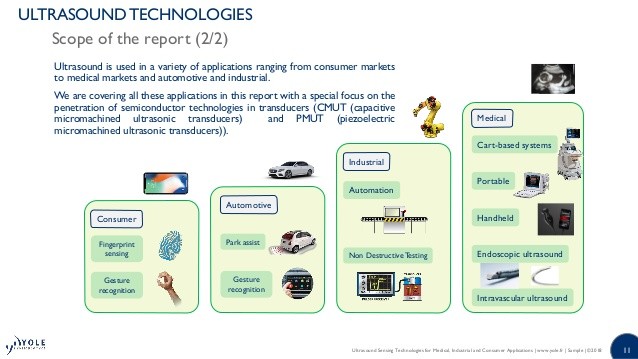
Ultrasonic sensors are being widely used in automotive, healthcare, industrial, food and electronics sector. The conventional ultrasonic devices are being commercialized to be used in multiple industries; these devices possess the capability of being able to search inside objects in a non-destructive manner.
Ultrasonic devices offer several applications in the automotive sensors, like parking assistance, safety alarms, collision avoidance, object detection and automatic braking system. They play an important role in shaping up the future of the next generation driver assistance and self-driving systems. On-board sensing systems are being offered in advanced cars for premium process.
These systems rely on ultrasonic sensors for measuring relative distances of objects from the car. Long-range radar capabilities are being integrated with cruise control systems in order to avoid collisions between vehicles. These sensors are also being used for detection of distances on the rear end of the automobiles for parking assistance and braking control. Additionally, sensor vendors have been offering several variants of ultrasonic sensors with increased capabilities like open-structures, waterproofing and external casing for reducing damage. Thus, with the expected hike in ADAS systems in the future, ultrasonic sensors will witness a proportional rise.
Ultrasonic sensors have been at the forefront of technological advancements in the medical applications industry. These applications have been offering cutting-edge innovative solutions for enhancing the quality of life and ensuring greater diagnostic capabilities in this sector. The use of ultrasonic sensors in medical industry can be studied under two distinct labels, namely detection and measurement. These sensors are available in multiple shapes and sizes, and may be used on the surface of the body or can be inserted into a specific part, depending on the nature of the medical examination.
Ultrasonic sensors can be used to send ultrasonic waves through the human body for generating visual images. The foetuses of pregnant women are pictured using these sensors. This is a risk-free alternative to radiography solutions. Ultrasonic sensors also offer a cost-effective alternative to piezoelectric sensors, and they operate in a wider range of conditions. These sensors can be used for diagnosis of abdominal conditions, thyroid glands, cardiological problems, and vascular and transrectal system. Multiple sensors may be used for detection of physical ailments. Thus, the demand for better health care facilities is set to drive growth in the ultrasonic sensors market.
Researchers at the University of Queensland have developed a new method for building ultrasound sensors that dramatically improves the technology’s sensitivity. This new ultrasound technology is anticipated to transform the landscape of the digital healthcare sector, impacting everything from medical devices to spatial imaging used in unmanned vehicles.
Engineers at the University of British Columbia have developed a new ultrasound transducer, or probe, that could dramatically lower the cost of ultrasound scanners to as little as $100. Their patent-pending innovation–no bigger than a Band-Aid–is portable, wearable and can be powered by a smartphone