

Organic semiconductors enable the fabrication of a range of lightweight and mechanically flexible optoelectronic devices. Organic LEDs, solar cells, and field-effect transistors are now routinely made in bendable or even stretchable formats and with extremely low specific weights.
Most organic semiconductor lasers, however, have remained rigid and relatively bulky until now, predominantly due to the need for macroscopic and solid support substrates (typical substrate thickness, >100 µm).
Optically pumped organic solid-state lasers have gained widespread attention as coherent light sources that are easy to fabricate, have emission tunable across the whole visible range, and are potentially disposable and biocompatible. These lasers hold great promise for a number of applications, e.g. for on-chip spectroscopy, data-communication, biosensing, and chemo sensing for detecting explosives.
Researchers from The University of St Andrews have developed an ultra-thin membrane organic semiconductor based laser, that could be harnessed for new applications in security, biophotonics and photomedicine.
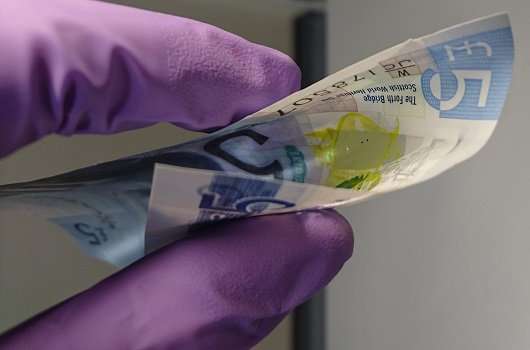
They were then able to stick these ultra-thin lasers onto banknotes and contact lenses, where they suggest the devices could be used as flexible and wearable security tags. Flexible organic optoelectronics – in particular for displays, photovoltaics and wearable sensors – are on the verge of large-scale commercialisation, with prototype devices already achieving staggering form factors and bending curvatures. The findings have been published in Nature Communications.